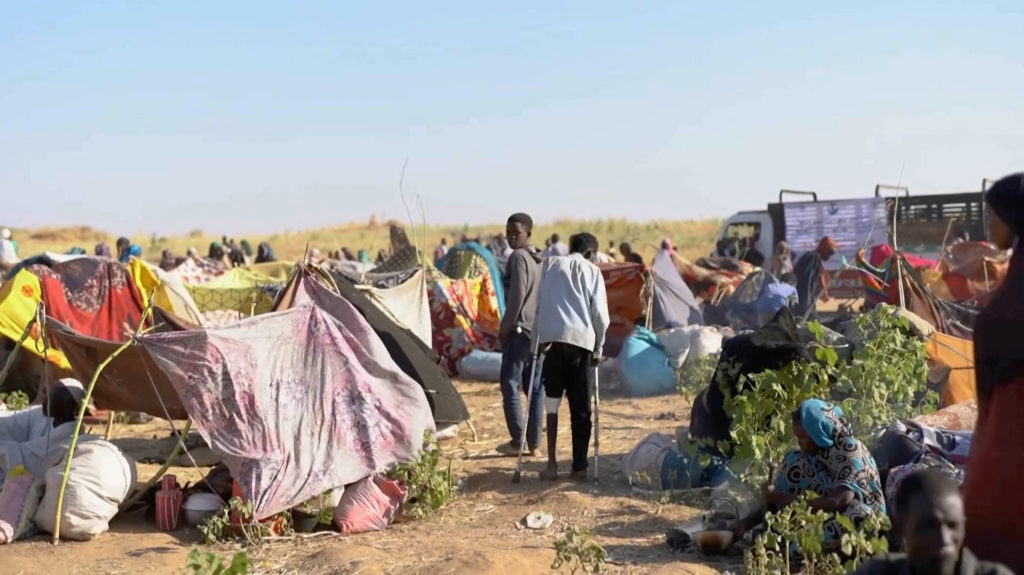
Famine conditions were confirmed by a worldwide hunger monitor on Monday in Kadugli, another besieged city in the south of Sudan, and al-Fashir, the Sudanese city captured by the paramilitary Rapid Support Forces (RSF) following a protracted siege.
Although it had previously confirmed famine in camps for displaced persons in al-Fashir, the capital of North Darfur, in December, the U.N.-backed Integrated Food Security Phase Classification (IPC) has now declared that the cities are experiencing famine for the first time.
In addition to uprooting millions of people and igniting waves of ethnically tinged violence in Darfur, the battle between the RSF and the Sudanese army, which started two and a half years ago, has resulted in widespread starvation and malnutrition throughout Sudan.
The army-supported government in Sudan has criticized the IPC’s results, which are the internationally accepted benchmark for assessing the severity of hunger crises.
DURING SIEGE, FOOD SUPPLIES CUT OFF
In August 2024, the Zamzam displacement camp south of al-Fashir was the first location where the IPC determined that there was starvation during the conflict.
Before it surrendered late last month, al-Fashir had been under siege and attacked by the RSF for almost 18 months, further dividing Sudan geographically. Residents claimed that because food supplies were cut off during the siege, people were forced to eat animal feed and occasionally animal hides. They told Reuters that drone attacks targeted locations where people congregated for meals prepared in communal kitchens.
According to MSF project coordinator Sylvain Pennicaud, who spoke to Reuters on Monday, adults were gaunt, and all children who fled al-Fashir and arrived in the nearby town of Tawila were malnourished.
Prosecutors at the International Criminal Court announced Monday that they were gathering proof of alleged rapes and mass murders following al-Fashir’s downfall. In Darfur, the head of the Red Cross claimed that history was being repeated.
According to Monday’s IPC study, which was based on analysis for September 2025, Tawila, Mellit, and Tawisha—two further locations where people fled al-Fashir—were in danger of starvation.
According to the IPC, as a result of increased access and progressive stabilization in central Sudan, where the Sudanese army assumed control at the beginning of the year, the total number of Sudanese experiencing acute food insecurity decreased by 6% to 21.2 million, or 45% of the entire population.
However, IPC noted that as conflict intensified in the Darfur and Kordofan regions, the situation worsened there, displacing people, raising costs, and denying them a means of subsistence.
The humanitarian crisis in Sudan has gotten worse due to cuts in international funding and administrative roadblocks that make it difficult for the UN and other aid organizations to deliver food and other supplies.
Another focal point of the conflict is Kordofan.
Despite the fact that famine has been spreading there since the beginning of the conflict, the RSF-allied SPLM-N armed group has been besieging Kadugli, the capital of South Kordofan state.
The battle has shifted its focus to the larger Kordofan area, which is situated between the army-controlled part of the country and RSF-dominated Darfur. According to the IPC, there may be famine in the nearby city of al-Dalanj as well, but a lack of information made a decision impossible.
Three volunteers who were beaten in a video clip in a city in North Kordofan state that was overrun by the RSF were later slain, a Red Crescent official said on Monday.
The RSF has denied any involvement in the purported summary executions.