Africa’s agricultural program is seeking $100 billion as AGRA reiterates its support for states
To propel Africa’s agricultural transformation, up to $100 billion would be needed to implement the Comprehensive Africa Agriculture Development Programme (CAADP) Strategy and Action Plan, which runs from 2026 to 2035.
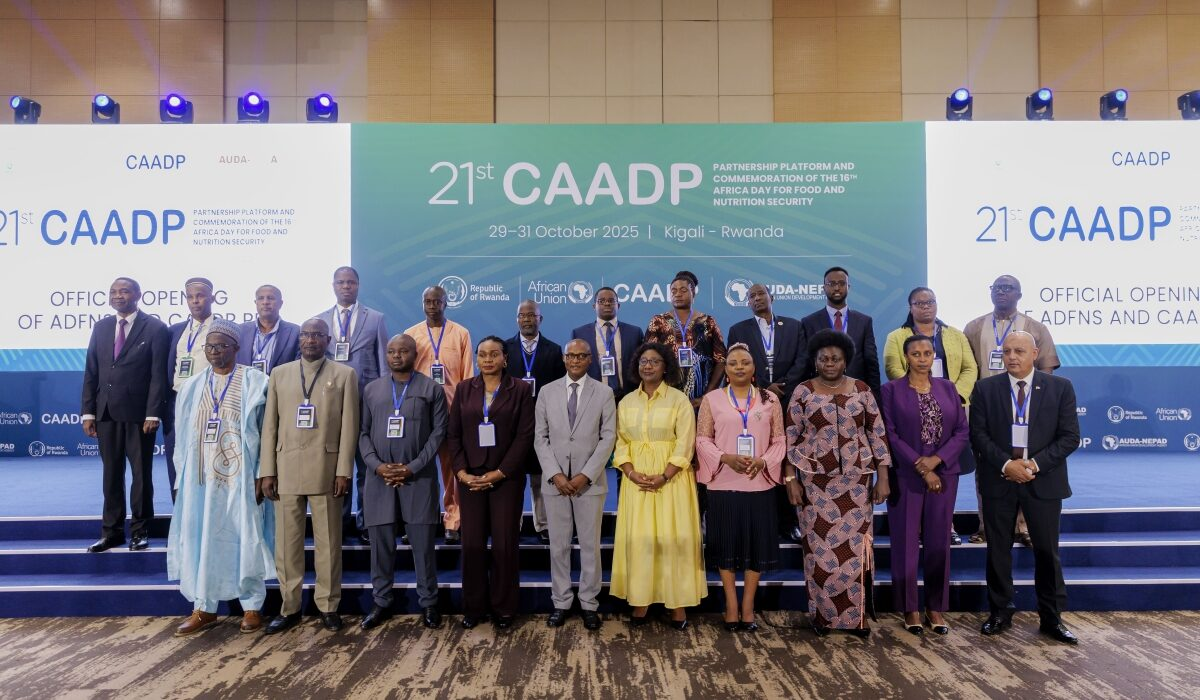
The 22nd Comprehensive Africa Agriculture Development Programme Partnership Platform (CAADP-PP) and the 16th Africa Day for Food and Nutrition Security (ADFNS), which took place in Kigali from October 29 to October 31, both addressed the need.
The CAADP Strategy and Action Plan, which was approved during an Extraordinary African Union (AU) Summit in Kampala in January 2025, builds on two decades of advancements in food security, poverty alleviation, and agricultural expansion.
The Kampala CAADP Declaration on Building Resilient and Sustainable Agrifood Systems in Africa, which goes with it, lays out a 10-year plan with 35 intervention areas and six commitments.
As the continent moves into a pivotal stage of food systems reform, the Alliance for a Green Revolution in Africa (AGRA) renewed its dedication to helping African institutions and governments fulfill their promises of agricultural transformation.
In the Kigali forum, which was co-organized by AUDA-NEPAD and the AU Commission, the AGRA delegation emphasized the necessity of moving away from promises and toward coordinated delivery that is rooted in Africa’s own goals and leadership.
At this year’s CAADP-PP, AGRA and its partners came together to focus on key themes that would lead to measurable improvements in Africa’s agrifood systems.
AGRA’s Africa Food Systems Report (AFSR) 2025, which offers indicators to monitor development in supply chains, diets, food environments, and outcomes, was presented during the event.
Jonathan Said, AGRA’s Vice President for Technical Expertise, stated, “Partners align on what we will deliver together on the CAADP Partnership Platform.”
Assisting the AUC and AUDA-NEPAD in maintaining partner coherence and concentrating on important goals including food corridors, end-to-end value chain development, and seed system commercialization is our responsibility. This will make it possible for nations to expand access to financing for farmers and SMEs, draw in private investment, and carry out their National Agriculture Investment Plans more quickly.
Providing governments with concrete assistance to improve the coordination and implementation of flagship agricultural policies and programs that propel the transformation of food systems was the main goal of the shared commitments.
It was also decided that promoting regional trade integration and encouraging private sector investment in value addition and market access should be a top goal.
According to Said, “AGRA’s initiatives are designed to de-risk agro-processing investment, connect smallholder farmers to regional markets, and mobilize new financing models that catalyze growth along entire value chains—ward Africa’s self-sufficiency and inclusive agricultural growth.”
Partners also agreed to expedite the African Soil Health and Fertilizer Agenda, acknowledging that one of the biggest obstacles to food security is still soil deterioration.
To increase access to information and inputs, initiatives are being made to support farmer-centered extension systems, effective fertilizer use, and integrated soil fertility management.
The AU’s Seed and Biotechnology Action Plan, which prioritizes the commercialization and uptake of climate-smart, high-yielding, nutrient-dense seeds and technologies, will also be expedited, the meeting agreed.
AGRA demonstrated its tri-partite methodology for developing and implementing nutrient-dense, climate-resilient crop varieties through its Center of Excellence for Seed Systems in Africa, which connects AGRA, One CGIAR, and National Agricultural Research Systems.
A renewed focus was also placed on women’s and youth empowerment as important forces behind the development of Africa’s food systems.
Aware of their pivotal position in agriculture, AGRA is advocating for focused initiatives that provide access to capital, land, and agribusiness expertise.
A side session on monitoring youth employment and entrepreneurship in agrifood systems was also organized by the African Union Commission, which pointed out that many nations still lack consistent benchmarks to assess development and efficiently allocate funding to successful youth-led businesses.
Setting an ambitious agenda for the upcoming decade, the three-day high-level meeting in Kigali signaled a significant shift from the Malabo Declaration of 2014 to the Kampala CAADP Strategy and Ten-Year Action Plan.
Rwanda’s Minister of Agriculture and Animal Resources, Mark Cyubahiro Bagabe, emphasized that Africans must lead Africa’s development via collaboration, ingenuity, and shared purpose, and challenged partners to go beyond promises to concrete action.
Bagabe stated that reaching the Kampala goal of raising $100 billion by 2035 would be necessary to carry out the CAADP plan.
“Bold, blended financing that successfully blends public, private, and climate-focused investments is required for this.”
The Kampala Declaration, which is defined as more than a policy document—rather, it is a commitment to create resilient, inclusive, and sustainable agrifood systems that provide zero hunger, equitable livelihoods, and environmental sustainability by 2035—was promoted during the meeting.
Director of Agriculture, Food Security, and Environmental Sustainability at AUDA-NEPAD, Estherine Fotabong, emphasized the transition from empty promises to quantifiable change.
“Given in hectares restored, markets expanded, youth employed, and communities nourished, the Kampala Declaration must be about delivery and transformation,” she stated.
In addition to being a development priority, eradicating hunger and malnutrition is also a question of justice and dignity, stated Moses Vilakati, AU Commissioner for Agriculture, Rural Development, Blue Economy, and Sustainable Environment. In order to achieve true reparative justice, we must also regain control over our food systems, restore farmers’ dignity, and establish more equitable trade and investment opportunities.
He continued by saying that the new plan reflects a strategic need for Africa to develop resilient and independent food systems, which includes preserving agricultural biodiversity and reviving native crops to increase climate shock resistance.