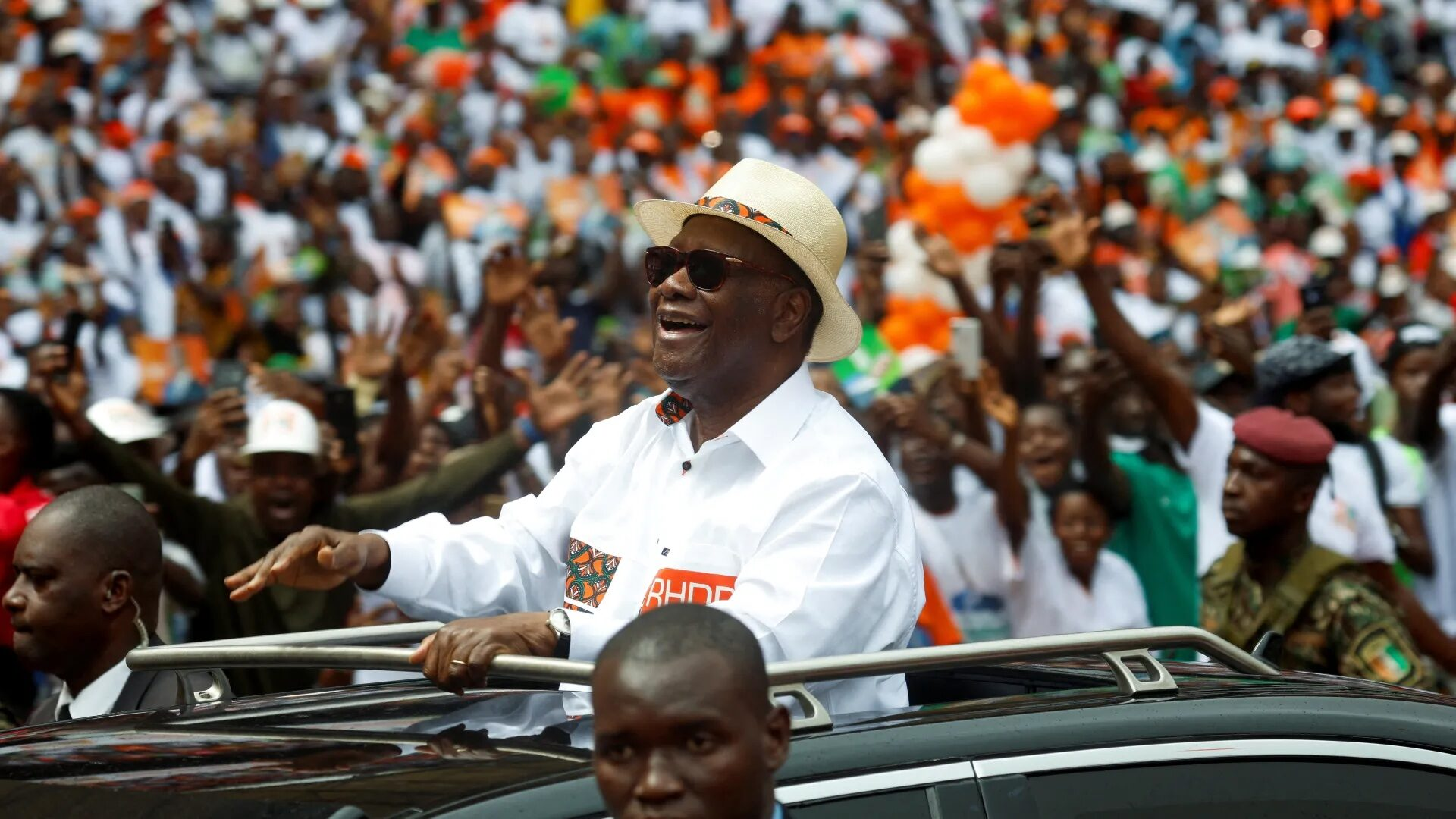
Alassane Ouattara, the president of Ivory Coast, won a resounding reelection on Monday, securing a fourth term. This result was largely anticipated since his most formidable rivals were declared ineligible.
After a much closer election in 2011, the 83-year-old former international banker garnered 89.77% of the vote, marking his third consecutive resounding victory.
Due to his predecessor Laurent Gbagbo’s refusal to accept defeat in that campaign, a four-month conflict that claimed almost 3,000 lives broke out.
Since then, Ouattara has guided the largest cocoa producer in the world through a phase of very stable economic expansion.
According to the results announced on state television by Ibrahime Coulibaly-Kuibiert, the electoral commission’s president, former Commerce Minister Jean-Louis Billon, who admitted defeat to Ouattara on Sunday, received 3.09% of the vote, while former First Lady Simone Gbagbo received 2.42%.
A source told Reuters that Simone Gbagbo congratulated Ouattara on his victory over the phone on Monday.
The turnout of about 50% was much lower than the 80% who cast ballots in the first round of the 2010 presidential election, but it was equivalent to the 2020 and 2015 elections.
Since former Credit Suisse CEO Tidjane Thiam and Laurent Gbagbo were not legally allowed to compete this year and the other opposition candidates did not have the support of a major political party, Ouattara was the overwhelming favorite.
In a statement released on Monday, Thiam said that the election was “not a real election” and that low voter turnout resulted from a fear-based atmosphere.
The voting process was pointless. It was everything set up for Ouattara to win these elections. Thiam and Laurent Gbagbo were disqualified as candidates. “There was nothing at risk,” stated Arsene Kanga, a machinist employed by an Abidjan-based company that produces cooking oil.
According to Rinaldo Dipagne, deputy head of the Africa program for International Crisis Group, many Ivorians have lost interest in politically active participation in general since the fighting that followed the 2010 election.
“People saw that they didn’t have a future with politics, or they couldn’t imagine that politics would bring positive change to the country,” he explained.
The conclusions of the electoral commission are anticipated to be confirmed by the Constitutional Council in the next several days.
ADVANCED VISION OF THE FUTURE LEADERS
In a fourth term, Ouattara, a former deputy managing director of the International Monetary Fund, has stated that he would continue to expand the economy and draw in private capital.
In order to let a new generation of political leaders take over, he also pledged to use his fourth term.
The ruling party is divided and there is now no obvious successor.
Dipagne warned that the nation would experience a crisis similar to the one that followed the passing of founding President Felix Houphouet-Boigny, characterized by political animosity and armed strife, if Ouattara does not name one.
After days of sporadic protests in places like Yamoussoukro, the political capital, where authorities enforced a curfew on Friday night, the election proceeded without significant disturbance on Saturday….
According to Amnesty International, the government imposed a disproportionate ban on protests and sent out 44,000 security force members.
The Interior Ministry reported that scores had been sentenced to up to three years in prison for offenses including breaching public order, and hundreds had been arrested.
Former Prime Minister Patrick Achi, the government’s spokesperson, told Reuters last week that while the government was committed to upholding order, it also supported freedom of speech.