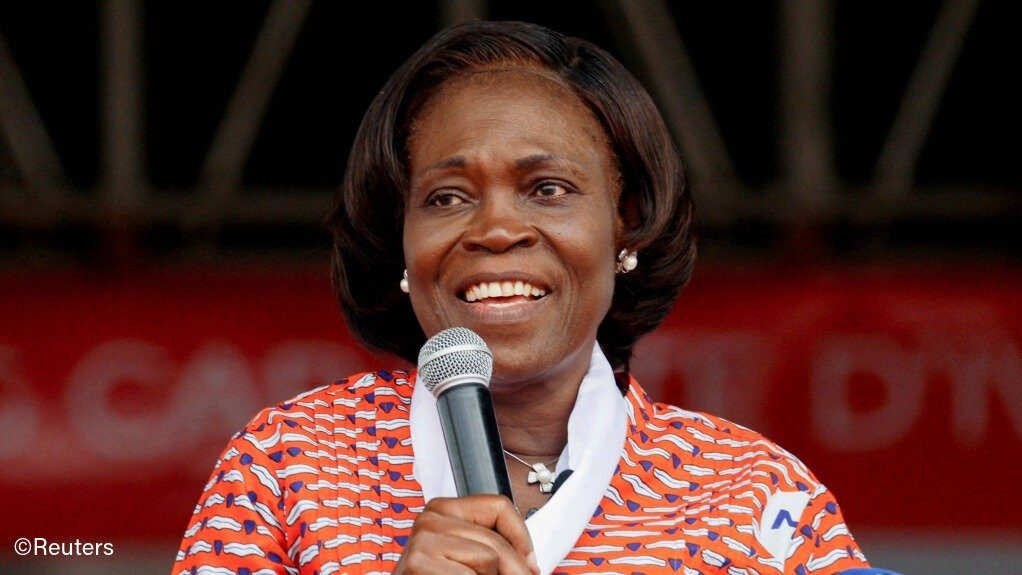
Ivory Coast’s former first lady Simone Gbagbo, who was formerly wanted by the International Criminal Court for crimes against humanity, will begin a new chapter in her political career on Saturday by running for president without her ex-husband.
The 76-year-old politician, referred to as the “Iron Lady” in the West African country, is the most well-known of the candidates permitted to challenge incumbent Alassane Ouattara, who is predicted to win a fourth term.
During the turbulent era of former President Laurent Gbagbo, which was characterized by civil war from 2002 to 2007 and again following the 2010 election, Simone Gbagbo played a pivotal role.
She previously told the French daily L’Express, “I am frequently positioned above the ministers, and they all respect me.”
FROM DETENTION TO CREATION OF A NEW PARTY
When Laurent Gbagbo refused to accept Ouattara’s defeat in 2010, it resulted in warfare that killed almost 3,000 people before the couple was captured together at their home in Abidjan.
A relationship that began while they were young opposition activists came to an end in 2021 when Laurent Gbagbo filed for divorce. Simone Gbagbo founded the Movement of Skilled Generations, her current party, a year later. She has said that the movement is based on social democratic ideals.
Political analyst and historian Arthur Banga stated that he does not believe Simone Gbagbo would win this year due to the small number of voters in her new party.
“But she is positioning herself for the future,” he told Reuters, adding that she might be able to fill the gap left by former Credit Suisse CEO Tidjane Thiam and Laurent Gbagbo. The electoral commission rejected both of their candidacies.
“She will become the leader of the political opposition after these elections,” Banga stated.
OPPOSITION POLITICS BACKGROUND
In the 1970s, Simone Gbagbo began her political career as a trade unionist, opposing Felix Houphouet-Boigny’s one-party system of governance.
Together with other opposition leaders and Laurent Gbagbo, whom she married in 1989, she co-founded the Ivorian Popular Front party in the 1980s. In 1995, when the Democratic Party of then-President Henri Konan Bedie dominated general elections, she made her debut in national politics by securing a seat in the National Assembly.
Five years later, her husband became the president.
Simone Gbagbo was not sent by Ouattara’s government to the International Criminal Court in The Hague, despite Laurent Gbagbo’s 2011 arrest.
Rather, she was tried at home and sentenced to 20 years in prison for offenses against the state in 2015.
In a move generally interpreted as an attempt to defuse political tensions, Ouattara gave her amnesty in 2018.
NATIONAL RECONCILIATION PLEDGE
A national reconciliation plan that includes both justice and reconciliation for historical political atrocities is part of Simone Gbagbo’s program.
According to her party, she would enact a general amnesty law that would free all military and political prisoners and make it easier for exiles to return.
Simone Gbagbo is also well-known for advocating for “true monetary autonomy” in Ivory Coast, the largest cocoa producer in the world, by substituting a different subregional currency for the euro-pegged CFA franc.
She has also declared her intention to back West African nations belonging to the Alliance of Sahel States (AES), whose military leaders have recently taken over through coups. These nations have a hostile relationship with Ouattara: Burkina Faso, Mali, and Niger.
Charles Ble Goude, a close friend of Simone Gbagbo’s ex-husband who, like Laurent Gbagbo, was cleared by the ICC in 2019, backed her campaign earlier this month.
The 83-year-old Ouattara is expected to run in this election for the final time, and Banga stated that “Simone Gbagbo has demonstrated that she is a committed politician and, above all, a pragmatic woman.” She appears to be in a position to increase her popularity credibility.
“Let’s not forget that 2030 will be different,” he stated.