Africa’s First Artificial Intelligence Academy Is Launched by OpenAI and UNILAG
The OpenAI Academy at UNILAG will promote fair technology education and innovation in Africa by providing free AI training across sectors.
By choosing the University of Lagos (UNILAG) to house its first Artificial Intelligence academy in Africa, OpenAI has cemented the university’s developing standing as a continental center for innovation, research, and international cooperation.
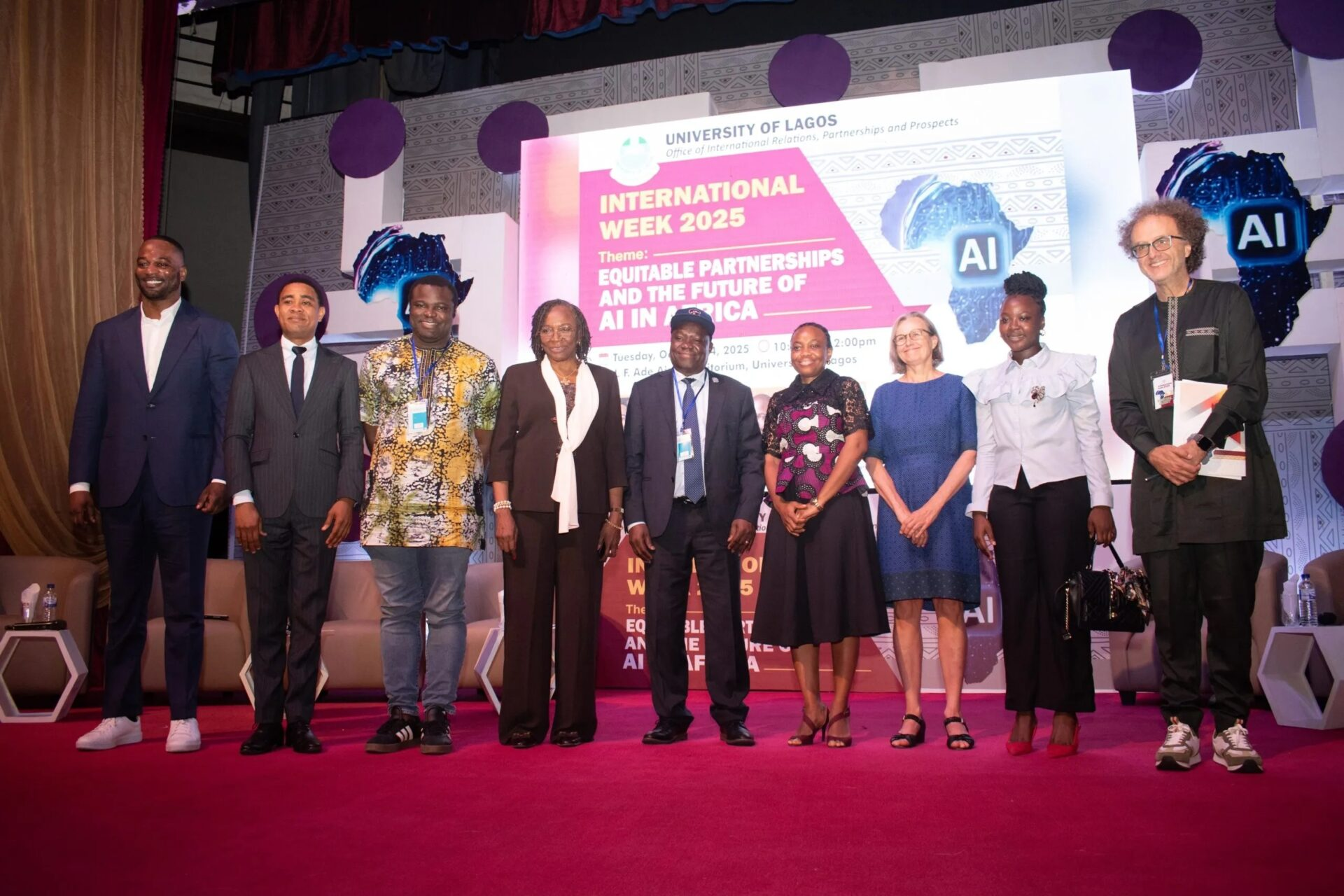
UNILAG’s 2025 International Week, with the topic “Equitable Partnerships and the Future of AI in Africa,” opened in Akoka, Lagos, with the announcement. Academics, inventors, government representatives, and business executives from around the globe convened at the event to discuss how international collaboration may hasten the continent’s equitable technology development.
Deputy Vice-Chancellor (Development Services) Professor Afolabi Lesi defined International Week as an event that aims to establish international collaborations that generate mutual influence.
“We are here to go from intention to outcomes that our students, faculty, communities, and countries can see and feel. Research, industry involvement, internationalization, and artificial intelligence all come together at UNILAG in a way that is egalitarian, moral, and purposeful, according to Lesi.
According to him, the foundation of UNILAG’s cooperation concept is shared standards and co-design. “UNILAG is chosen by partners because it matches capability with contextual knowledge that has been tested in real-world settings.” Thus, technology responds to people and places rather than the other way around, he continued. “Our engineers collaborate with linguists, and our clinicians with social scientists.”
Professor Folasade T. Ogunsola, the vice chancellor, called the meeting a crucial assembly of visionary and purposeful minds. “Artificial intelligence exists now; it is not the future. AI is a chance for Africa to overcome obstacles and reinvent industry, governance, healthcare, and education. However, she added, “fair partnerships that are based on mutual respect, growth, and co-creation rather than charity must be the cornerstone of AI’s true benefit to Africa.”
The university’s health innovation challenge, nuclear engineering partnerships, and medicinal plant research are examples of locally relevant innovation, according to Ogunsola, who cited UNILAG’s ongoing research projects.
“In the minds of young Africans who dare to dream, build, and lead, the future of AI is not in Silicon Valley alone; it is in Lagos, Nairobi, Kigali, Accra, Cairo, and Johannesburg,” she said to cheers.
When OpenAI’s Africa Lead, Emmanuel Lubanzadio, announced the opening of the OpenAI Academy at UNILAG—the first of its type on the continent—it was the event’s high point.
OpenAI is adamant about granting access to everyone since it can truly be a tremendous equalizer. We are thrilled to be working with a company that supports the use of technology to address pressing human issues. According to Lubanzadio, the OpenAI Academy will develop African talent and make sure that innovation is liberated from a select few hands and spreads throughout communities.
With the warm reception that his announcement received from students, scholars, and tech innovators, Nigeria took a significant step toward becoming a major participant in AI research and education.
Dr. Bosun Tijani, Nigeria’s Minister of Communications, Innovation, and Digital Economy, commended UNILAG in his goodwill message for playing a pivotal role in building the nation’s AI future. The National Centre for AI & Robotics’ Director, Dr. Olubunmi Ajala, spoke on his behalf. He called AI “the great equalizer, which affords Africa the opportunity to close the gap of existing inequalities.”
Tijani further disclosed that in order to ensure that every Nigerian has access to innovation and digital opportunities, the Tinubu administration has started a nationwide fiber optic effort to provide high-speed internet to all 774 local government areas. According to him, “all Nigerians must have democratized access to the capacity to innovate and create value.”
Adding a private-sector viewpoint, Ms. Yvonne Ike, Head of Sub-Saharan Africa and Managing Director at Bank of America, praised UNILAG for turning forth graduates who are competitive worldwide. You are doing well with your items, but I’m not sure what the water you drink here is composed of. They excel when they face Harvard or Cambridge pupils, she observed, “without hesitation or complexity.”
“Africa’s greatest asset in the AI era is its people,” she continued. The technology itself won’t determine our future. Ike said, “It depends on who develops, implements, and gains from it.”