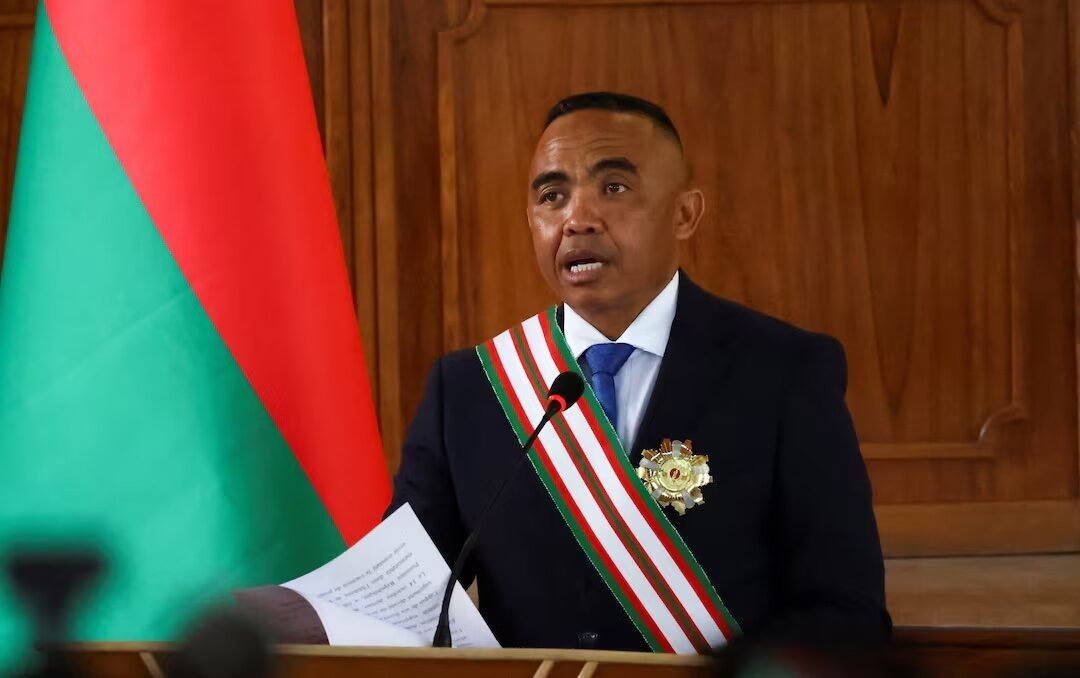
Colonel Michael Randrianirina, who led the coup in Madagascar, was sworn in as president on Friday to cheers, blaring horns, and raised swords. He had taken control of the island nation days before, after youth-led protests forced out the previous president.
Former leader Andry Rajoelina was impeached by lawmakers after he fled abroad over the weekend. He has spoken out against the takeover and refused to resign while he is in exile, even though many people in the security forces have left the government and the High Constitutional Court approved the army takeover within hours of it happening.
The African Union and Antonio Guterres, the Secretary-General of the UN, have both spoken out against the coup. It happened after weeks of “Gen Z” protests that were first caused by severe, long-lasting power and water shortages.
COMMITTEE LED BY THE ARMY WILL RUN FOR UP TO TWO YEARS
“I will fully, completely, and justly fulfill the high responsibilities of my position as President of the Republic of Madagascar,” Randrianirina said at a ceremony at the High Constitutional Court, which is a red-brick building from the colonial era with French windows, segmental arches, and stone balustrades.
“I swear that I will use the power that has been given to me and use all of my strength to protect and strengthen national unity and human rights,” he said. To mark the change, military officers raised their swords and blew trumpets.
Randrianirina said that a military-led committee will rule with a transitional government for up to two years before holding new polls, but experts don’t think this is a sure thing.
Ketakandriana Rafitoson, a Malagasy researcher and Vice Chair of Transparency International, told Reuters from Washington, D.C., “Whether the military returns power depends less on words and more on binding safeguards, incentives, and oversight.”
“Commitments such as ‘We will hand over in two years’ are weak if unaccompanied by mechanisms that limit the junta’s capacity to entrench itself” .
Even though a lot of young people were happy that Rajoelina, who was elected in 2009 in a coup, was gone, some are already worried about how quickly the army stepped in.
Youths from Generation Z, some of whom wore T-shirts with a skull and a straw hat from the Japanese comic series “One Piece” to protest the new military leader’s inauguration, still felt like they had work to do.
“Not yet,” said 18-year-old student Mioty Andrianambinintsoa outside the court as officials carrying the Malagasy flag’s red, green, and white colors walked past her to jeeps that were waiting. “This is a stage.” Our goals have not been met.
Francko Ramananvarivo, 23, another protester, was asked what their goals were. He said, “Our goal is to be led by a government that is close to the people.” We’re still not there.”
ELITE ARMY UNIT
The special CAPSAT army unit led by Randrianirina was involved in the 2009 coup that put Rajoelina in power, even though Randrianirina himself wasn’t involved in that coup. During the protests, he went against the president and told forces not to shoot at the protesters. He also offered to protect them.
People in Madagascar are usually very young (the average age is under 20) and live in some of the poorest conditions in the world; three-quarters of the 30 million people who live there are poor.
Even though the island in the Indian Ocean sends valuable goods like vanilla, nickel, sapphires, and the white pigment ilmenite, its average income is only $600 a year, and the prices of basic goods like rice have gone through the roof.
According to the World Bank, from the time it became independent in 1960 to 2020, its GDP per capita fell by almost half. This made it one of the few countries that actually got worse off during that time.