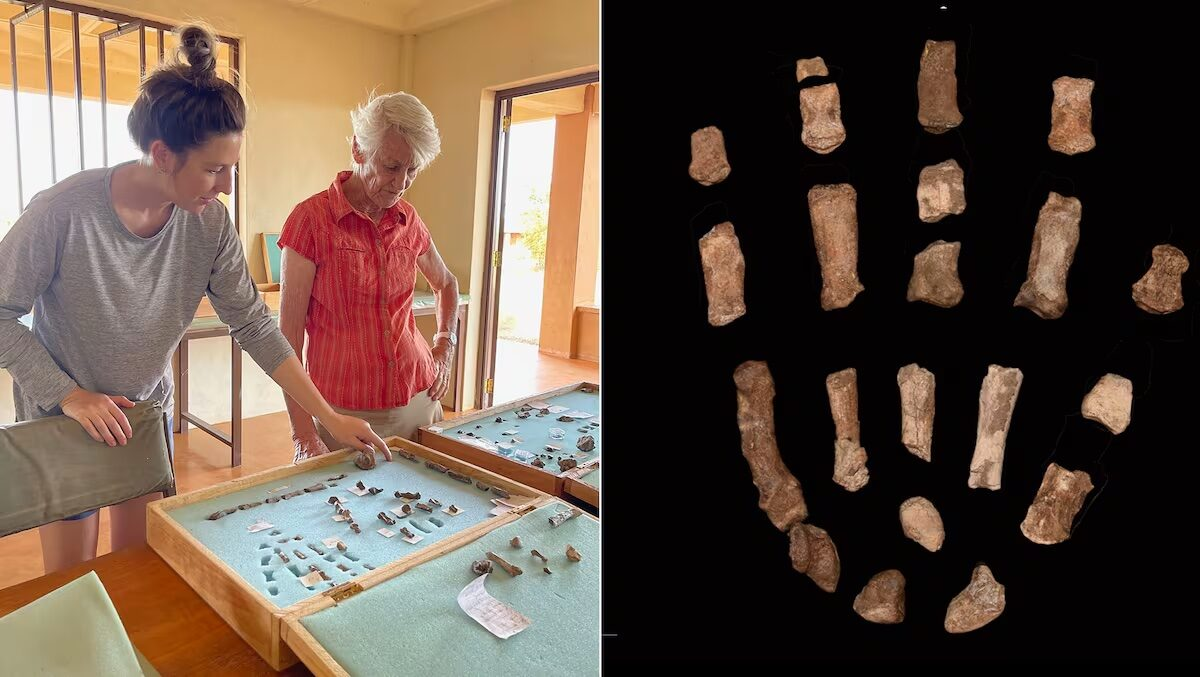
Researchers have discovered fossils of the hand and foot bones of an ancient human cousin from 1.52 million years ago near Lake Turkana in northern Kenya. These bones show that the species was fully bipedal and would have been able to grasp and use things like stone tools.
The bones from the fossils were the first to be clearly identified as belonging to the species Paranthropus boisei. A partial skeleton comprising the majority of the hand, three foot bones, the majority of the teeth, a partial forearm bone, and pieces of the cranium was found by the researchers.
Given how fragmentary the earlier fossils of this species were, the new finding was groundbreaking.
This species belonged to the human evolutionary tree and was basically a relative of the much later-evolving Homo sapiens.
Large teeth and powerful jaws characterized the robust build of Paranthropus boisei. A crest on top of the cranium served as an anchor for the enormous jaw muscles, and its flared cheekbones formed a dish-shaped face. Its skull was designed for hard chewing of difficult plant materials. It was challenging to comprehend the species, especially whether or not it would have been able to create and use basic tools, in the absence of hand and foot fossils.
“This is the first time we can confidently link Paranthropus boisei to specific hand and foot bones, 65 years after the original discovery of this species,” said Carrie Mongle, a paleoanthropologist from Stony Brook University in New York, who is the lead author of the study that was published this week in the journal Nature, opens new tab.
The fossils were found on the eastern shore of Lake Turkana in an area known as Koobi Fora.
According to paleoanthropologist and research co-author Louise Leakey, director of the Koobi Fora Research Project, “scientists were limited to the cranial and dental remains of this species before this find, and very little was known about the rest of the skeleton.”
According to Mongle, this creature would have been able to make and use stone tools since the hand bones demonstrate that it could form precise grips like those of current humans.
When Leakey said, “It would have had a very firm handshake,” “We can tell that the hand of this species was built for forceful and sustained grips, and similar to gorillas in that it would have used its hands to process tough plant foods, stripping, tearing or crushing vegetation, which is consistent with its hard and fibrous diet, as seen from its robust dentition.”
By demonstrating that the species was suited to walking upright on two legs, the fossils also shed light on how it moved.
“We can tell from the few foot bones that it was fully bipedal, not flat-footed like a chimp, and that its foot would have had a lateral arch, similar to ours, which would have propelled it forward while it walked,” Leakey explained.
The term “hominin” refers to species that are members of the human evolutionary line. Approximately one to two million years ago, four hominid species, including Paranthropus boisei, coexisted in East Africa. Although tools made of stone and bone have been found from that era, it is unknown if Paranthropus could have made and used them.
A genus is a collection of closely related species, and our species is a member of the genus Homo. In East Africa, the extinct species Homo habilis, Homo rudolfensis, and Homo erectus coexisted with Paranthropus boisei.
A few of these species really came into contact. In what was once a swampy lakeside at Koobi Fora, a research released last year revealed that tracks produced by Paranthropus boisei and Homo erectus intersected. The finding sparked fascinating debate over the two species’ relationship and potential resource rivalry.
“Conventional wisdom has been that while Homo specialized in larger brains and stone tool-making that made them highly adaptable to a changing climate, Paranthropus boisei became a dietary specialist focused on grasses,” Mongle explained.
The death of Paranthropus was “an evolutionary dead end,” according to Leakey.