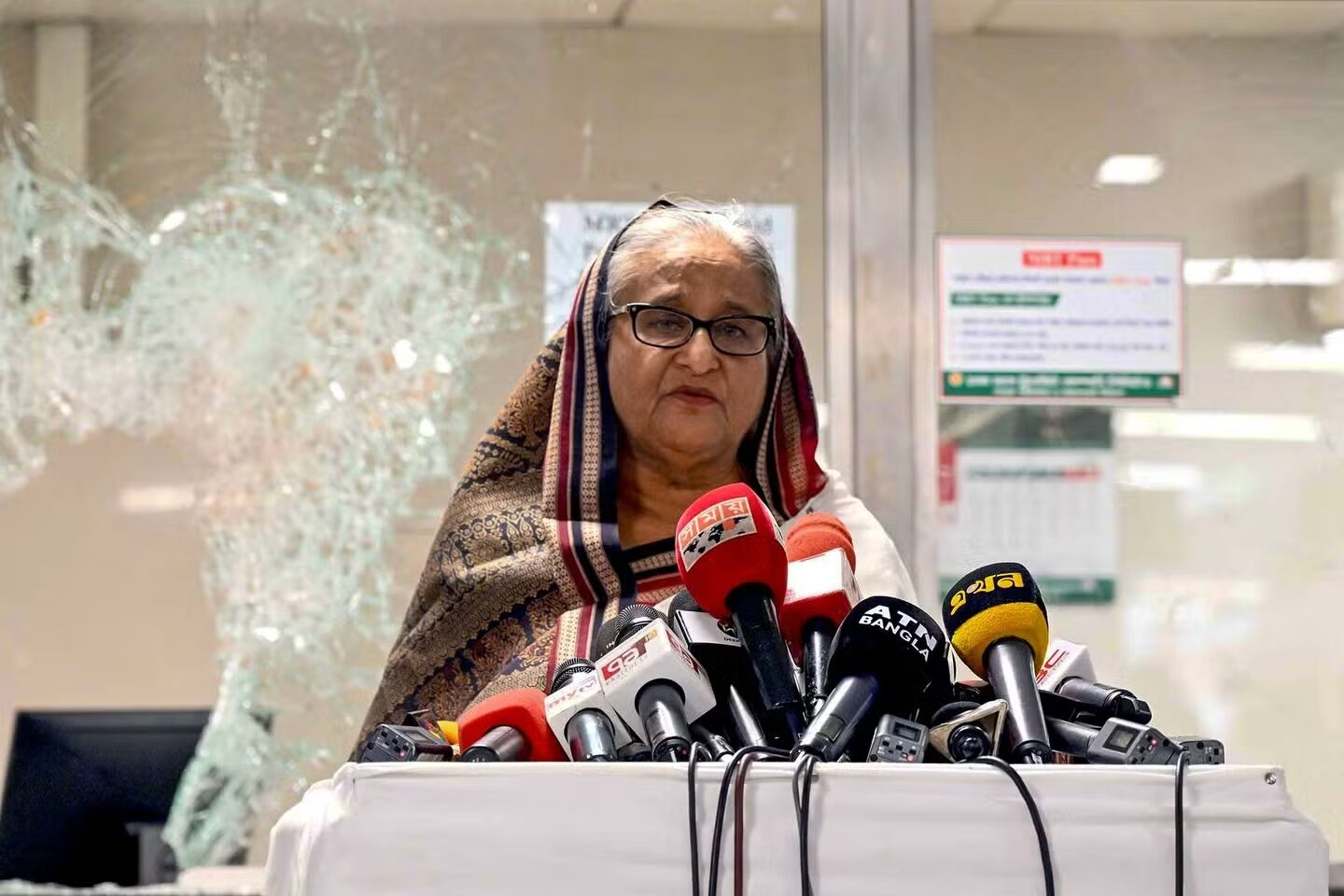
Prosecutors in Bangladesh want former Prime Minister Sheikh Hasina to be executed for a crackdown on protests in 2024 that claimed 1,400 lives.
Former Bangladeshi Prime Minister Sheikh Hasina has been accused by prosecutors of crimes against humanity during a fatal crackdown on student-led rallies that overthrew her administration last year, and they have urged for her to be executed.
Hasina, who was overthrown in August 2024 after ruling Bangladesh for 15 years, is charged with directing security personnel to use deadly force against protesters. Prosecutors highlighted a leaked audio clip in which Hasina allegedly instructed security officers to “use lethal weapons” against demonstrators, a claim she vehemently disputes.
Hasina should receive “1,400 death sentences,” one for each victim slain during the upheaval, chief prosecutor Tajul Islam said the Dhaka court on Thursday. However, “since that is not humanly possible, we demand at least one.”
Islam stated, “[Hasina’s] objective was to hold onto power indefinitely, for herself and her family.” “She no longer expresses regret for the cruelty she has perpetrated and has become a seasoned criminal.”
Protests started in July 2024, primarily in response to contentious civil service employment quotas that favored the relatives of veterans of Bangladesh’s 1971 independence war. However, the rally swiftly grew into a national uprising calling for Hasina’s resignation.
More than 1,400 people were killed over the course of many weeks, making this the worst disturbance in Bangladesh since the independence war.
One of the bloodiest events happened on August 5, 2024, when Hasina was evacuated by helicopter from her Dhaka home as mobs surrounded the compound. Investigations show that at least 52 individuals were killed that day alone when police opened fire on demonstrators in a crowded Dhaka neighborhood.
The state-appointed defense attorney for the former prime minister, who fled to India, claimed that police acted in self-defense after being attacked by angry protesters.
Hasina, former Interior Minister Asaduzzaman Khan Kamal, and former Police Chief Chowdhury Abdullah Al-Mamun are all on trial in absentia. Additionally, prosecutors have called for Kamal, who is still at large, to be executed.
Chowdhury, who entered a guilty plea in July, acknowledged following orders from the government during the crackdown, but he has not yet received a sentence.
The 77-year-old Hasina has already received a six-month prison sentence for contempt of court and is facing more corruption allegations related to her tenure in power.
After being driven from power, the former leader reportedly went to India, where she currently resides. Despite not confirming her existence, New Delhi is allegedly under diplomatic pressure to provide clarification on her position.
The Awami League, Hasina’s former ruling party, is no longer allowed to engage in any political activity, including running for office. Ahead of the elections in February 2026, the Bangladesh Nationalist Party (BNP), headed by her longtime opponent Khaleda Zia, is currently leading the field.
The verdict in Hasina’s trial, according to observers, may change Bangladesh’s political trajectory. Rights organizations have called for due process and transparency, cautioning that a politically driven decision would further rifts inside the South Asian country.
International organizations, like as Amnesty International and Human Rights Watch, have called for an impartial investigation of the deaths of demonstrators and police and have denounced the 2024 violence as well as the ongoing legal proceedings.
Hasina, who was once praised globally for turning Bangladesh into one of Asia’s fastest-growing economies, has seen a sharp decline in popularity as a result of the charges. However, in subsequent years, her rule grew more autocratic, and she was accused by detractors of stifling dissent, tampering with elections, and imprisoning opponents.
Hasina could be the first former leader in Bangladeshi history to get a death sentence while living in exile if found guilty. This move is expected to spark new political tensions within Bangladesh and throughout the region.