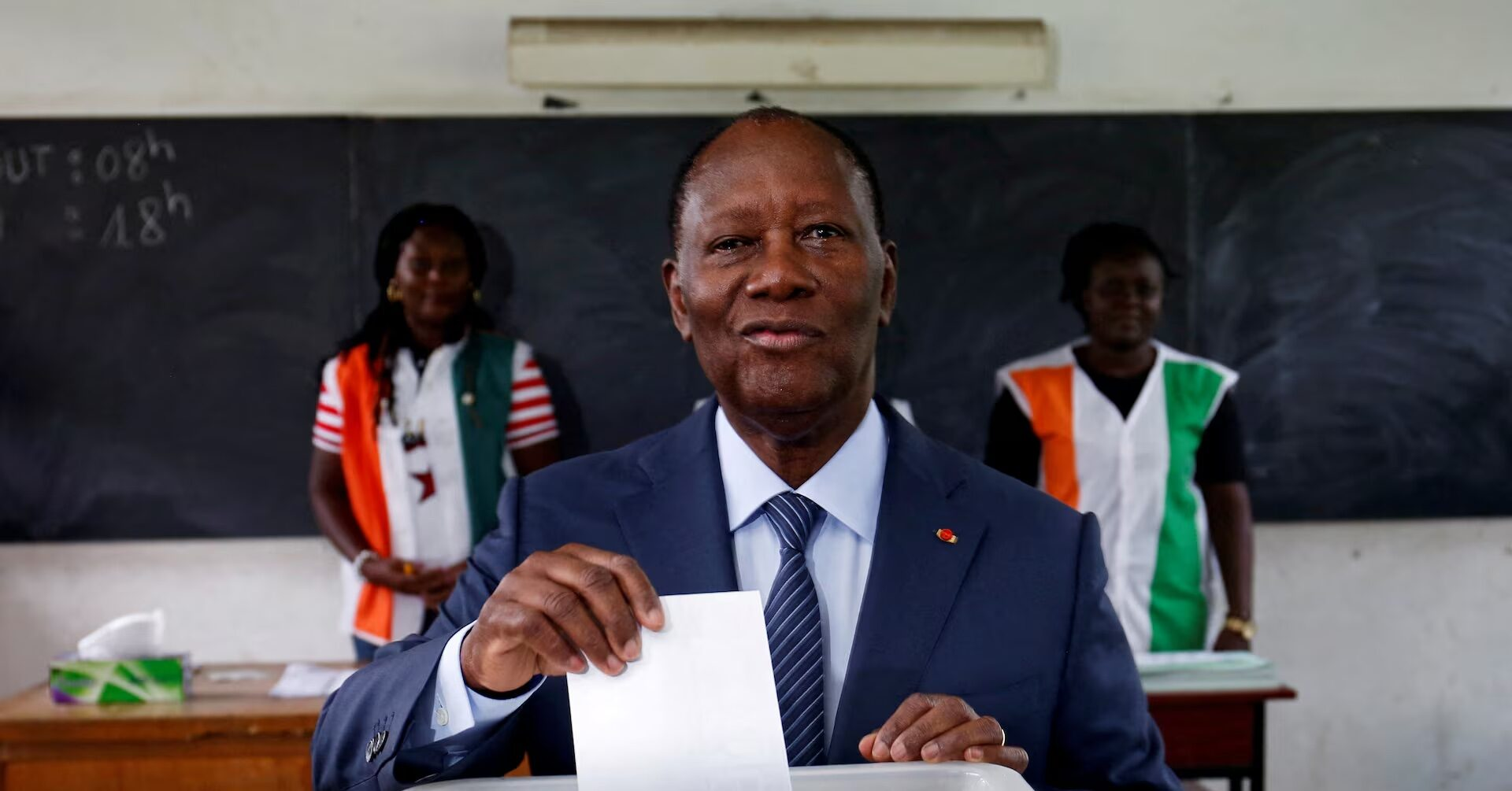
Ouattara of the Ivory Coast wants to ride the economic boom to a fourth term
Alassane Ouattara had a long way to go before he became president of the Ivory Coast. He missed two elections and there was a short but violent civil war in 2010 and 2011 because his predecessor wouldn’t step down.
With easy wins in 2015 and 2020, he has been in charge since 2011 and things have been better.
When West Africa’s biggest cocoa producer goes to the polls on October 25, the 83-year-old former foreign banker hopes to do it again, and it could be the last time.
Ouattara’s backers say that he won because voters were happy with the strong economic growth since he took office and the large number of infrastructure projects, such as the building of new roads and interchanges and a tower that stands taller than any other building in the city center.
His critics say it has just as much to do with limiting democratic activities, like the “disproportionate” ban on protests linked to the election that Amnesty International called out on Thursday.
Analysts say that former Credit Suisse CEO Tidjane Thiam would be Ouattara’s biggest opponent. However, he has been thrown out because he was registered with French citizenship, which is against Ivorian law.
Because he was convicted before, Ouattara’s boss, Laurent Gbagbo, is not allowed to run.
Analysts say that the people who are allowed to run for office don’t have the support of the country’s big political parties, which makes it harder for them to get a lot of people to vote.
Cesar Flan Moquet, director of the think tank Center of Political Research of Abidjan, said that the four opposition candidates are instead leading “makeshift coalitions” and are split up among themselves.
“All this means that these candidates do not really have a chance,” he stated.
A shaky climb to the top
Ouattara was born on January 1, 1942, in Dimbokro, which is in the central part of Ivory Coast. He got his Ph.D. in economics from the University of Pennsylvania and then became deputy head of the International Monetary Fund.
Later, he was prime minister under Felix Houphouet-Boigny, who was the country’s first president. Houphouet-Boigny’s death in 1993 marked the start of a more toxic political time in Ivory Coast.
Ouattara couldn’t run in the 1995 election because of new rules. For example, candidates had to have stayed in Ivory Coast for at least five years before they could run.
One of his parents was from Burkina Faso, which was another reason he was turned down in 2020. Ouattara was called “a candidate for the foreigners” by Gbagbo, who won that race.
When people rose up against Gbagbo in 2002, the country was split in half. The northern half was taken over by rebels, many of whom were from Ouattara’s Dioula ethnic group.
During the war, multiple Ivorian governments used racist policies against migrant farmers from Burkina Faso and Mali. These policies also targeted northern Ivorians who had cultural ties to these groups.
While running for president in 2010, Ouattara made a deal with former President Henri Konan Bedie that helped him beat Gbagbo in the runoff.
Around 3,000 people were killed in fighting that broke out after Gbagbo refused to accept loss before Ouattara was sworn in in April 2011.
Ouattara easily won re-election in 2015 and 2020, but 85 people were killed in fights between his rival followers during the 2020 election.
There is no guarantee who will come next.
Things don’t seem to be as tense as they were in 2020, when Ouattara’s claim that a new constitution passed in 2016 had removed his two-term limit caused more anger among critics.
A West Africa political risk expert named Jessica Moody said that the ban on protests and the deployment of 44,000 security forces to stop unrest will help keep things from getting worse.
Ouattara’s fourth term is expected to be focused on economic goals, such as making Ivory Coast a middle-income country by 2030, opening a new metro line in Abidjan, and making roads and electricity better for everyone.
There is also the question of who will take over after him. He tried to answer this question before the 2020 election by choosing Amadou Gon Coulibaly, who was Prime Minister at the time, as his successor.
Another few months passed, and Coulibaly died. Ouattara broke his promise to give power to a new generation.
Moody said that picking a new leader will be hard because the ruling party is split, but it is not impossible.
“I don’t think he lacks the motivation to stand down,” she told me. “He will be 88 by the next election.”