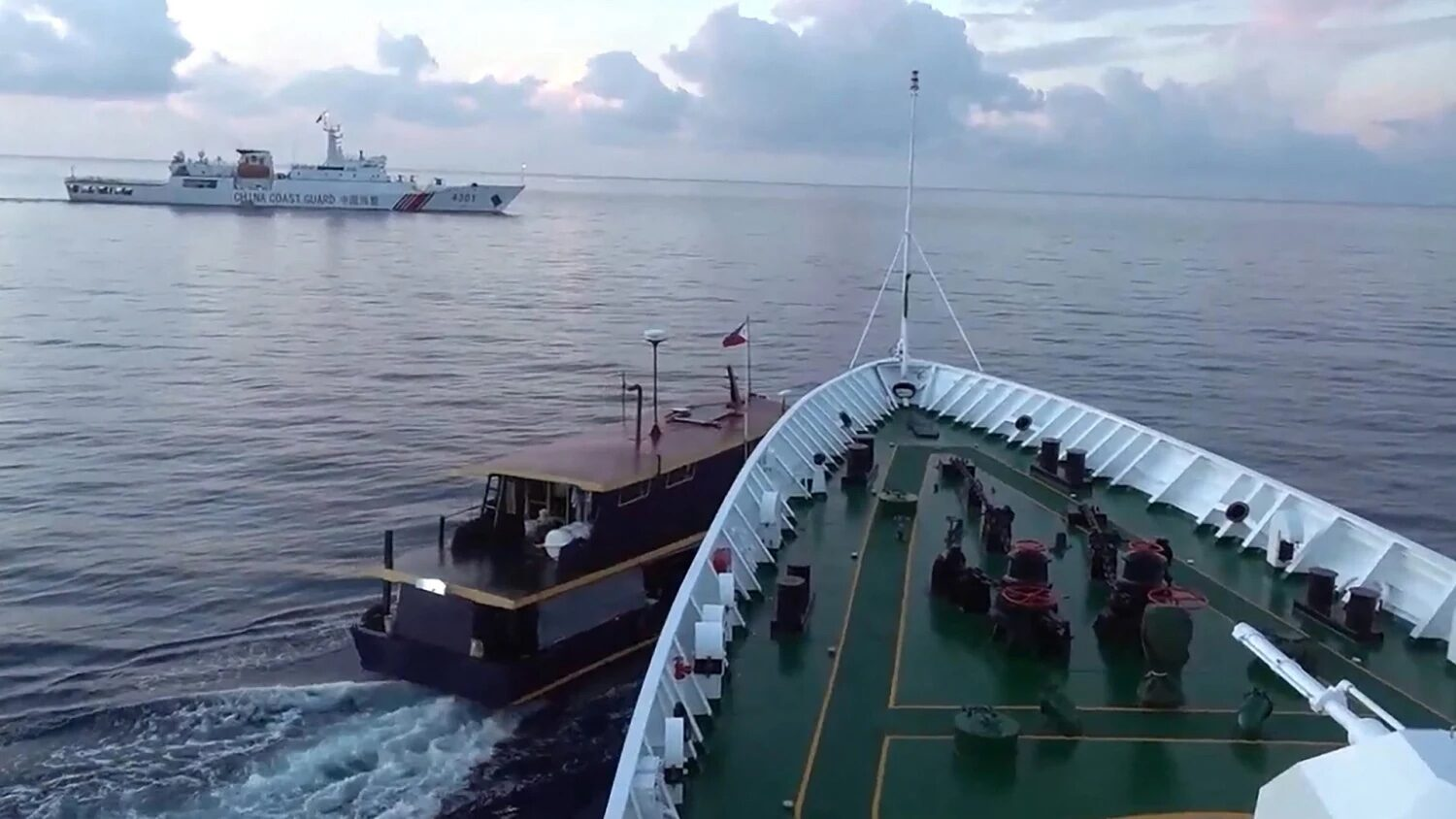
China and the Philippines both blamed the other for a fight at sea near disputed islands in the South China Sea on Sunday. This made things even more tense in the resource-rich waterway.
An inter-agency government body called the Philippine Maritime Council said that Chinese maritime forces fired water cannons at and rammed a Filipino ship near the Philippine-occupied Thitu Island, which is also known as Pag-asa. The council “strongly condemned” the attack and promised to take “appropriate diplomatic action.”
The coast guard in Manila says that early on Sunday, three ships were anchored near the island as part of a government program to protect local fishermen. Chinese ships then apparently came up behind them and threatened them with water cannons.
A Chinese coast guard ship is said to have fired its water cannon straight at a Philippine ship an hour later and then rammed its stern, damaging it slightly but not hurting anyone, according to the coast guard.
A collision happened when two Philippine government ships “illegally entered” waters near Sandy Cay, a coral reef in the northern Thitu Reefs in the Spratly Islands. This was reported by China’s coast guard.
Beijing said that Manila was to blame because a Philippine ship “dangerous approached” a Chinese coast guard ship.
Manila’s government promised to keep working in the area and stressed the need to protect Filipino fishermen’s jobs.
In a post on social media site X, U.S. Ambassador to the Philippines MaryKay Carlson spoke out against what she called China’s “aggressive actions” in the South China Sea by “dangerous ramming” a Filipino ship.
Over the years, the two countries have had many fights over the contested area, which is part of the Spratly Islands.
Recently, tensions have grown, especially over the Scarborough Shoal and other disputed areas in the South China Sea, which China claims as its own.
Some parts of the river are also claimed by Brunei, Indonesia, Malaysia, the Philippines, and Vietnam. It is an important trade route that helps ships carry over $3 trillion worth of goods every year.