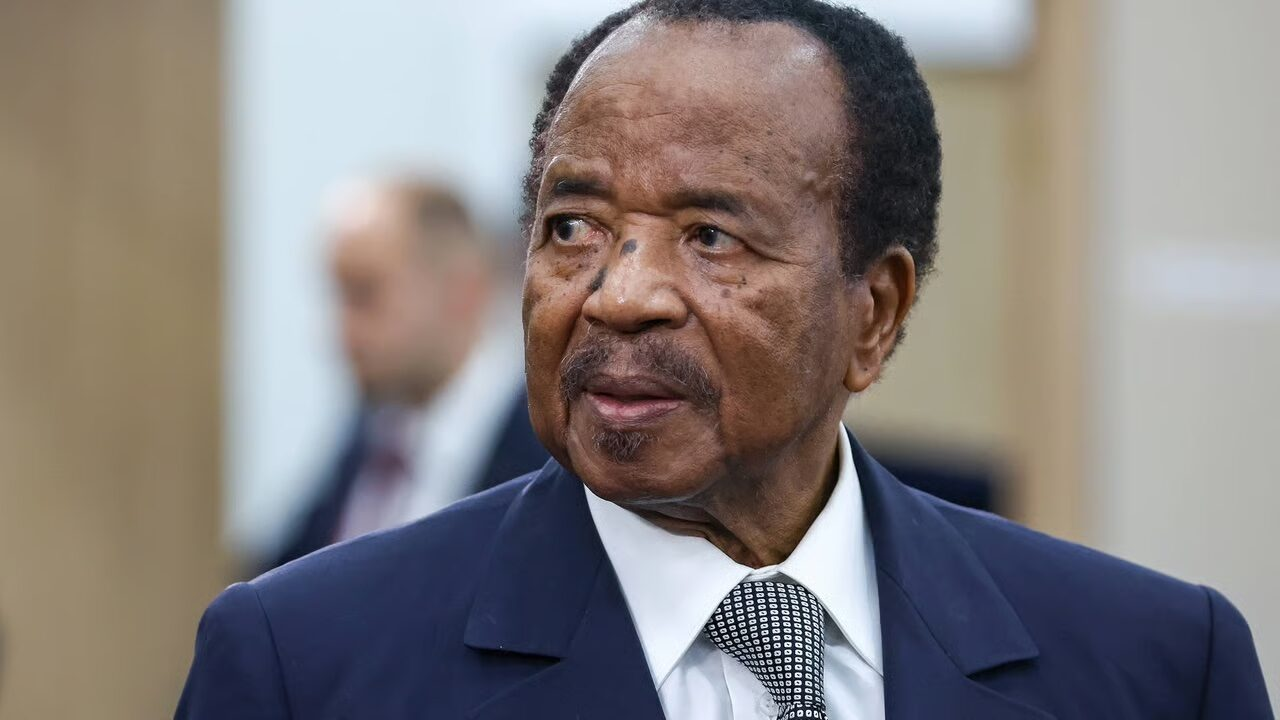
Biya, 92, of Cameroon is running for an eighth term despite calls to resign
The 92-year-old president of Cameroon, Paul Biya, announced in July that he was running for an eighth term, saying he was responding to “numerous and insistent” pleas to remain in office. However, there have also been strong calls for him to resign during this year’s election cycle.
Biya’s continued employment was deemed “not realistic” by Catholic Archbishop Samuel Kleda, who made the statement on French radio last Christmas.
Then, two cabinet members from Cameroon’s vote-rich northern regions openly questioned Biya’s leadership abilities, leading to their desertion.
Last month, 27-year-old Brenda Biya, the president’s own daughter, said on TikTok that her father “has made too many people suffer” and asked Cameroonians to vote him out.
Despite her later retraction, the message is still frequently shared among Biya’s critics.
When the nation that produces cocoa and oil goes to the polls on October 12, the world’s oldest head of state has a good chance of winning despite these critiques and a number of security and economic issues.
According to analysts, he is supported by elements that have previously contributed to his more than 40 years in power, including a fragmented opposition, a loyal army, a deeply ingrained patronage system, and defective election institutions.
According to Arrey Ntui, senior analyst for the conflict-prevention group International Crisis Group, “the president has managed to enforce loyalty to him and the system… Very few people in the ruling system are willing to put their heads above the parapet” to question him.
“There is no longer any independent thought regarding the president. That’s all there is to the story: “The president is there, he can run again.”
Health Concerns Abound During the Campaign
Since succeeding his former mentor Ahmadou Ahidjo as president in 1982, Biya has maintained a firm hold on power, pushing Ahidjo into exile and marginalizing him.
He overcame a coup attempt in 1984 and a fierce challenge in 1992, when he received 40% of the vote, only 3 percentage points ahead of the runner-up in Cameroon’s first multi-party elections.
Biya signed a constitutional amendment in 2008 that eliminated the two-term restriction on presidential terms.
Despite his opponents’ accusations of intimidation and ballot stuffing, he went on to win elections in 2011 and 2018 by wide percentages.
His health, which has long been a subject of conjecture, especially when he vanished from the public eye for forty-two days last year, may be Biya’s biggest challenge this time around.
Although it outlawed public discourse on the subject last year, the government has rejected the health issues as “pure fantasy.”
Additionally, Cameroonians still struggle on a daily basis with limited access to essential services including trash management, electricity, water, and roads.
QUESTIONS ABOUT THE FAIRNESS OF THE VOTE
However, his government’s power to influence the outcome of the election may outweigh these risks.
Maurice Kamto, Biya’s primary opponent and the second-place finisher in 2018, had his candidacy declared invalid by a court in July, citing the fact that the party he registered to represent was already backing another candidate.
The action, according to Human Rights Watch, “raises concerns about the credibility of the electoral process.”
After spearheading rallies that security forces broke up with live ammunition, Kamto was jailed in January 2019 after claiming that the results of the 2018 election were rigged.
Although he was freed in October 2019, he was charged with insurrection before a military court, which his attorneys claimed might have resulted in the death penalty.
For a long time, the opposition has been kept weak by detention or the prospect of arrest. Officials in Cameroon claim they are only upholding the law.
According to Raoul Sumo Tayo, senior researcher at the Institute for Security Studies think tank in Pretoria, the fear of legal repercussions for speaking out extends far beyond the political elite.
“In Cameroon, you never know who the driver is when you hail a cab. He described the perceived pervasiveness of intelligence officers by saying, “People are afraid to speak.”
“Everybody in Cameroon wants to see their children grow, and so many stay quiet, and it empowers the regime.”