Nduhungirehe demands that the UN address the DR Congo’s genocide warnings
Olivier Nduhungirehe, Rwanda’s Minister of Foreign Affairs and International Cooperation, has cautioned the UN against ignoring the early warning signs of genocide in the Democratic Republic of the Congo, stating that the violence against Congolese Tutsi communities must be halted before it is too late.
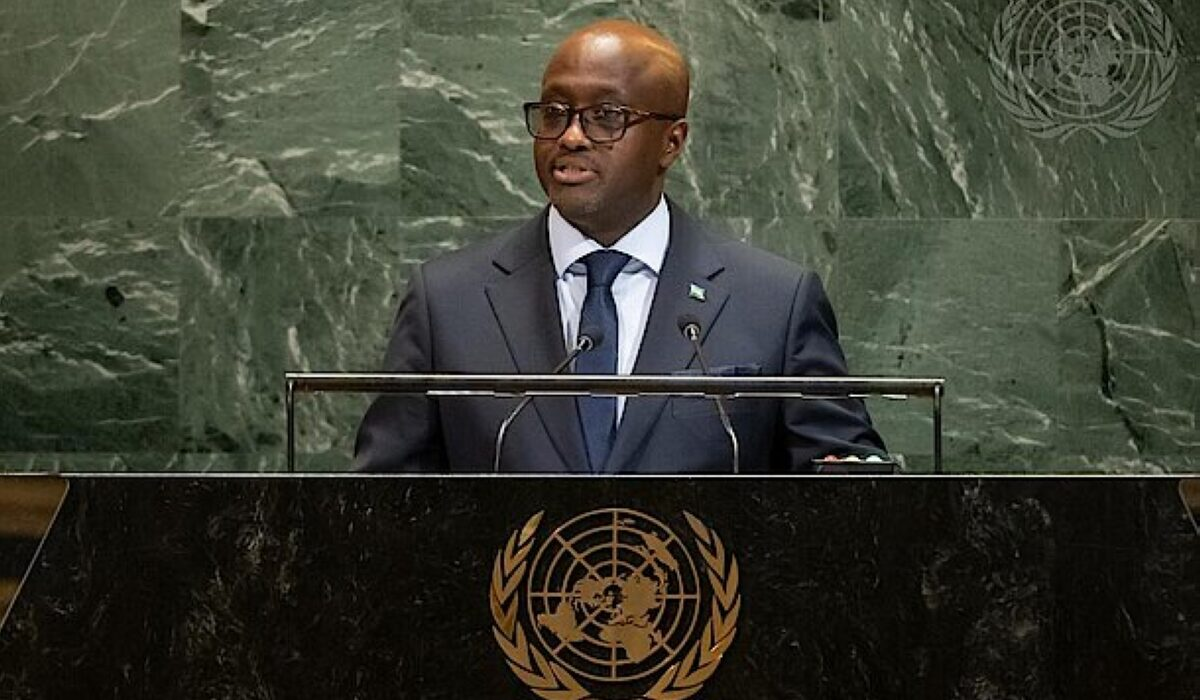
Nduhungire While delivering Rwanda’s declaration at the 80th United Nations General Assembly (UNGA) in New York, where world leaders are gathering from September 23 to 29 to discuss peace, security, and conflict resolution, he made the call on Thursday, September 25.
The Minister emphasized Rwanda’s grave concerns on the continued existence of genocide ideology and associated crimes in eastern Democratic Republic of the Congo, as well as the support of armed groups like the FDLR, which was established by survivors of the 1994 Genocide against the Tutsi, in Kinshasa.
He pointed out that these atrocities are occurring “under the watch of the UN itself and the international community.”
He pushed the UN to do more than just maintain peace, which Rwanda has long demanded be changed.
The rise of Wazalendo militias, armed and backed by the Congolese government, is of special concern to Rwanda, according to Nduhungirehe. These militias are carrying out a number of atrocities, such as lynching and burning alive civilians and military officers, arming children for ethnic cleansing, and destroying entire villages of Congolese Tutsis.
“Peacekeeping is insufficient on its own. We lament conflicts that recur too frequently because their underlying causes were not adequately handled. Our first options must be prevention, mediation, and successful peacebuilding.
Nduhungirehe cautioned that the persecution, murder, and targeting of Congolese Tutsis, particularly the Banyamulenge community, amounted to crimes against humanity and had all the early warning indicators of a genocide.
The violence, tactics, and ideology employed in eastern Democratic Republic of the Congo today, he claimed, “bear an alarming resemblance to that of the genocidal militias of 1994 in Rwanda.”
“To stop this dangerous development before it’s too late, strong action is required,” he stated.
Noting that no political denial could change the fact of atrocities being done, Nduhungirehe also condemned efforts to downplay the situation in the Democratic Republic of the Congo.
In this sense, no amount of deliberate cynicism can change the facts and make victims into offenders or offenders into victims. “Perpetrators frequently use these denialist tactics,” he stated.
He underlined that arming and funding organizations with a history of genocidal intent and continuing to do so constitutes culpability in the crime itself. “If there are crimes in the Democratic Republic of the Congo that are done for financial gain, they have obvious names: embezzlement of public funds, corruption, and poor governance.” “Nduhungirehe said.”
The act of genocide has a pattern. It has distinct phases. International law defines it; it is not a general phrase. Genocide is the deliberate destruction of a certain group because of who they are.
Nduhungirehe stated that “the current conflict in eastern DR Congo is not new” and reaffirmed that Rwanda’s goal has always been the safety and well-being of its people as well as the Great Lakes region. It has its roots in decades of poor leadership, the marginalization and persecution of minorities, the philosophy of genocide, and the lingering effects of colonialism.
Since the peace deal was signed, things have moved slowly.
The Minister voiced concern about the sluggish implementation of the peace deal agreed in Washington in June, even as he acknowledged international efforts, including those of the US, African Union, and Qatar, to promote peace between Rwanda and the Democratic Republic of the Congo.
He pointed out that although the deal offers a thorough framework with political, economic, and security elements, “progress has been moving slowly.”
“The situation on the ground is still extremely concerning, even though encouraging meetings are being held in Washington to implement the June Peace Agreement,” he stated.
The deployment of attack drones and fighter jets against civilian populations, especially the Banyamulenge and other Congolese Tutsi, as well as the DRC’s renewed militarization and ongoing cooperation with genocidal and UN-sanctioned armed groups like the Wazalendo militias and the FDLR, which the DRC supports, highlight the seriousness of the situation.
In flagrant contravention of the 1987 OAU Convention and the 1989 UN Convention prohibiting the employment of mercenaries, he said, the Congolese government coalition is backed by foreign forces, including mercenaries.
“Rwanda denounces these events and urges the Democratic Republic of the Congo to reject the military solution and sincerely implement the Washington Peace Agreement, which is a fantastic chance to put an end to this conflict that has lasted far too long.”
Nduhungirehe reflected on the long history of the UN in DR Congo, noting that the UN mission in DR Congo (MONUSCO) has a strong mandate and has been in the nation since 1999. But he contended that its existence hasn’t produced the desired effects.
“The mission has not been able to stop the spread of armed groups, particularly the elimination of the FDLR, which is backed by the DRC,” he said.
Despite more than 20 Security Council resolutions asking for the FDLR’s neutralization, MONUSCO has instead chosen to cooperate with a military alliance that includes the group. A review of MONUSCO’s mandate’s legal compliance is urgently needed.
Rwanda’s dedication to multilateralism and the bolstering of the United Nations as a force for justice, peace, and sustainable development was reiterated by the Minister.
Even though multilateralism has obvious problems and remedies, political will is still needed to lead us in creating a UN that is functional today. One of the main tenets of the UN is human rights. By putting human dignity, unity, and accountability at the core of our governance, Rwanda rose from the ashes of the 1994 Genocide,” he remarked.
“We must work together to create an organization that can meet the needs of billions of people worldwide, combat climate change, human rights violations, and adapt to a world that is becoming more interconnected for future generations.”