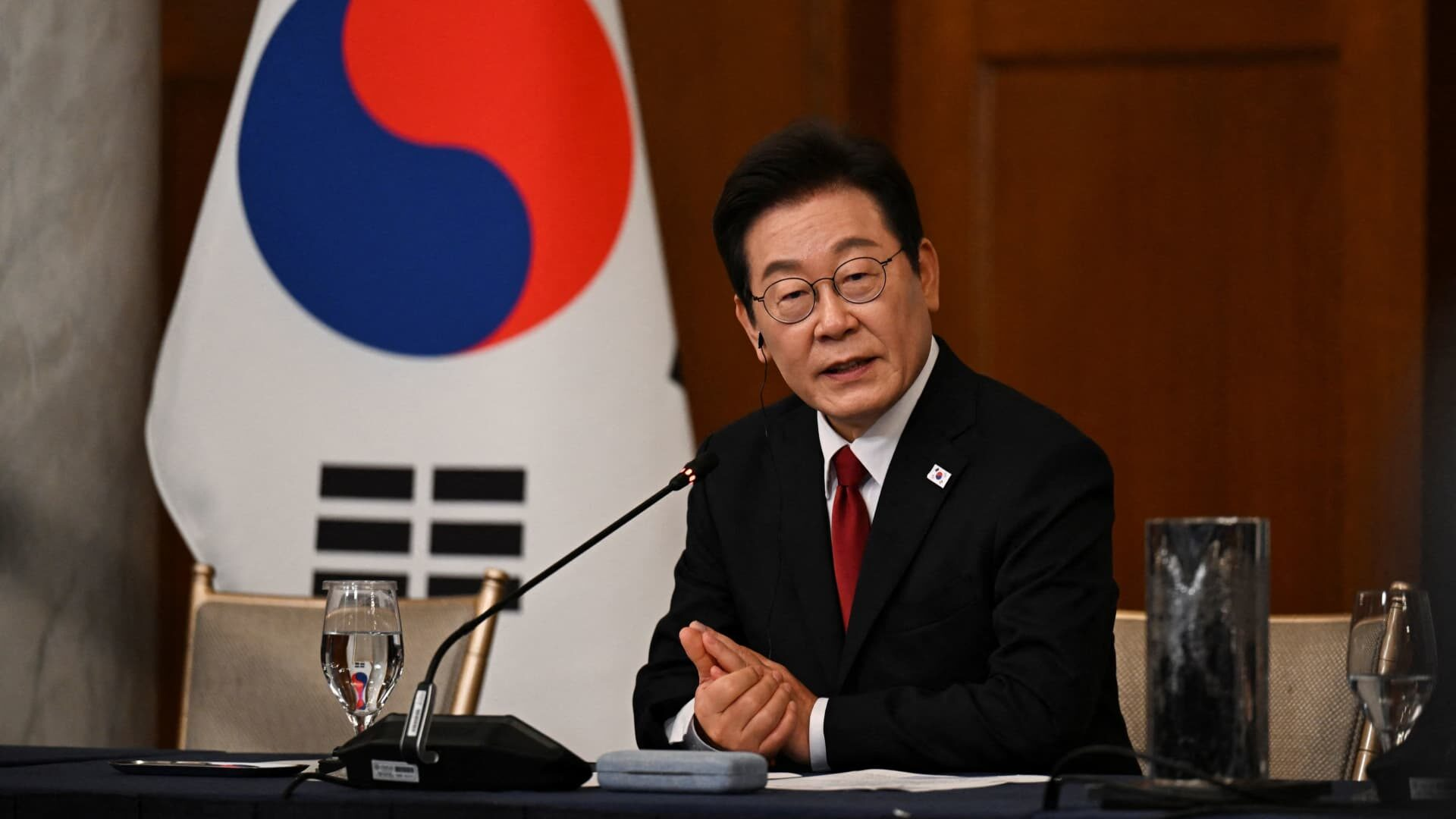
President Lee of South Korea claims in an exclusive that US requests for investment will cause a financial disaster
President Lee Jae Myung warned Reuters that if the government complies with current U.S. demands in delayed trade talks without safeguards, South Korea’s economy could plunge into a crisis comparable to its 1997 disaster.
Among other things, Seoul and Washington verbally agreed to a trade agreement in July whereby the U.S. would reduce President Donald Trump’s tariffs on South Korean exports in return for $350 billion in South Korean investment.
Due to disagreements over how the investments would be managed, they have not yet signed the agreement, Lee stated.
“Without a currency swap, if we were to withdraw $350 billion in the manner that the U.S. is demanding and to invest this all in cash in the U.S., South Korea would face a situation as it had in the 1997 financial crisis,” he stated through an interpreter.
Lee also discussed Seoul’s ties with adversary North Korea, neighboring behemoth China, and Russia in an interview conducted in his office on Friday. The conversation also covered a massive U.S. immigration sweep that resulted in the detention of hundreds of Koreans.
Talks about trade and defense with the United States, South Korea’s largest economic partner and military ally, are taking precedence over Lee’s journey to New York starting Monday, when he will speak to the UN General Assembly and serve as the country’s first president to chair a Security Council session.
THE WAY TRUMP HANDLED THE HYUNDAI RAID
Following his conservative predecessor Yoon Suk Yeol’s removal from office and imprisonment for temporarily enforcing martial law, liberal Lee was elected president in a June snap election. Lee stated that he intends to utilize his travel to the United States to let the world know that “democratic Korea is back” and has worked to calm the nation and its economy.
In August, Lee met with Trump for their first summit, claiming to have developed a close personal relationship with the U.S. leader despite their disagreement about a joint statement or specific announcement.
When federal authorities arrested over 300 South Korean workers at a Hyundai Motor battery facility in Georgia this month on suspicion of visa breaches, Trump’s government shocked South Korea.
The “harsh” treatment of the workers, which was publicized by the Trump administration with pictures of them in shackles, infuriated South Koreans, Lee said, and he warned that it could discourage businesses from investing in the US.
He praised Trump’s willingness to allow the workers to remain, however, and stated that the raid would not jeopardize the bilateral partnership. Lee stated that he thought it was the product of aggressive law enforcement rather than being orchestrated by Trump.
“I do not believe this was intentional, and the U.S. has apologised for this incident, and we have agreed to seek reasonable measures in this regard and we are working on them,” he stated.
According to Lee’s office, there is no intention of him seeing Trump in New York, and the visit will not include any discussion of trade.
Unsteady Block in Trade Discussions
According to Howard Lutnick, the secretary of commerce, South Korea ought to emulate Japan’s agreement with the US. Using the Trump administration’s comparison of foreign governments footing the bill while U.S. importers pay the levies, he said Seoul must either approve the arrangement or pay the tariffs.
When questioned about whether he would back out of the agreement, Lee responded, “I think that between blood allies, we will be able to maintain the minimum amount of rationality.”
A foreign exchange swap line between South Korea and the United States has been proposed in an effort to lessen the impact of investments made in the local won currency market. The likelihood that the United States would agree or whether that would be sufficient for the deal to proceed were not discussed by Lee.
He asserted that South Korea is not like Japan, which in July signed a trade agreement with the United States. “Tokyo has a swap line with the United States, an international currency in the yen, and more than double South Korea’s $410 billion foreign exchange reserves,” Lee added.
Although Washington and Seoul have said in writing that any investment projects must be profitable, he said it is proving challenging to iron out the specifics.
“Reaching detailed agreements that guarantee commercial reasonableness is now the central task – yet it also remains the biggest obstacle,” added Lee. He stated that proposals made during working level discussions do not guarantee commercial feasibility, which makes it challenging to close the gap.
According to Trump, the U.S. will control and “select” the assets, giving Washington the authority to decide where the funds will be used.
However, in July, Kim Yong-beom, the policy adviser for Lee, stated that South Korea had implemented a safety system to lower financing risk, which included backing commercially viable enterprises instead of offering unrestricted grants.
Although Washington wants to keep security and trade discussions apart, Lee stated that South Korea and the US do not dispute on boosting Seoul’s defense payments, which are supported by 28,500 US troops on the Korean peninsula.
“We should end this unstable situation as soon as possible,” he stated in response to a question about whether negotiations could continue into the following year.
RUSSIA, CHINA, AND NORTH KOREA TENSIONS
Lee has worked to defuse the nuclear-armed North Korean situation. Lee stated he was not hopeful about the possibility of inter-Korean discussions at this moment, as Pyongyang has rejected the South’s attempts.
When Trump travels to the South next month for an Asia-Pacific conference that Lee is hosting, Lee urged Trump to attempt to meet with North Korean leader Kim Jong Un once more.
Lee told Reuters that his government is unaware of the specifics of any negotiations between Pyongyang and Washington. “It is our judgement that they are not engaging in concrete conversations,” he continued.
He stated that, like his predecessor Yoon, he believes that South Korea’s security is seriously threatened by North Korea’s military cooperation with Russia. However, he stated that merely responding to the problem in a straightforward manner is insufficient; cooperation and communication are required.
When Chinese President Xi Jinping hosted the North Korean leader and Russian President Vladimir Putin at a large military parade and summit in Beijing this month, they stood side by side.
South Korea’s location puts it at risk of being on the front lines of any conflict with the other camp, according to Lee, who also noted that there is growing antagonism between the socialist camp of nations and the capitalist, democratic camp that includes Seoul.
China, Russia, and North Korea collaborate more closely, while South Korea, Japan, and the United States strengthen their cooperation, he added, creating a vicious cycle of rivalry and tensions.
“This is a very dangerous situation for Korea, and we must find an exit ramp out of the escalating military tensions,” warned Lee. “We must find a way for peaceful coexistence.”