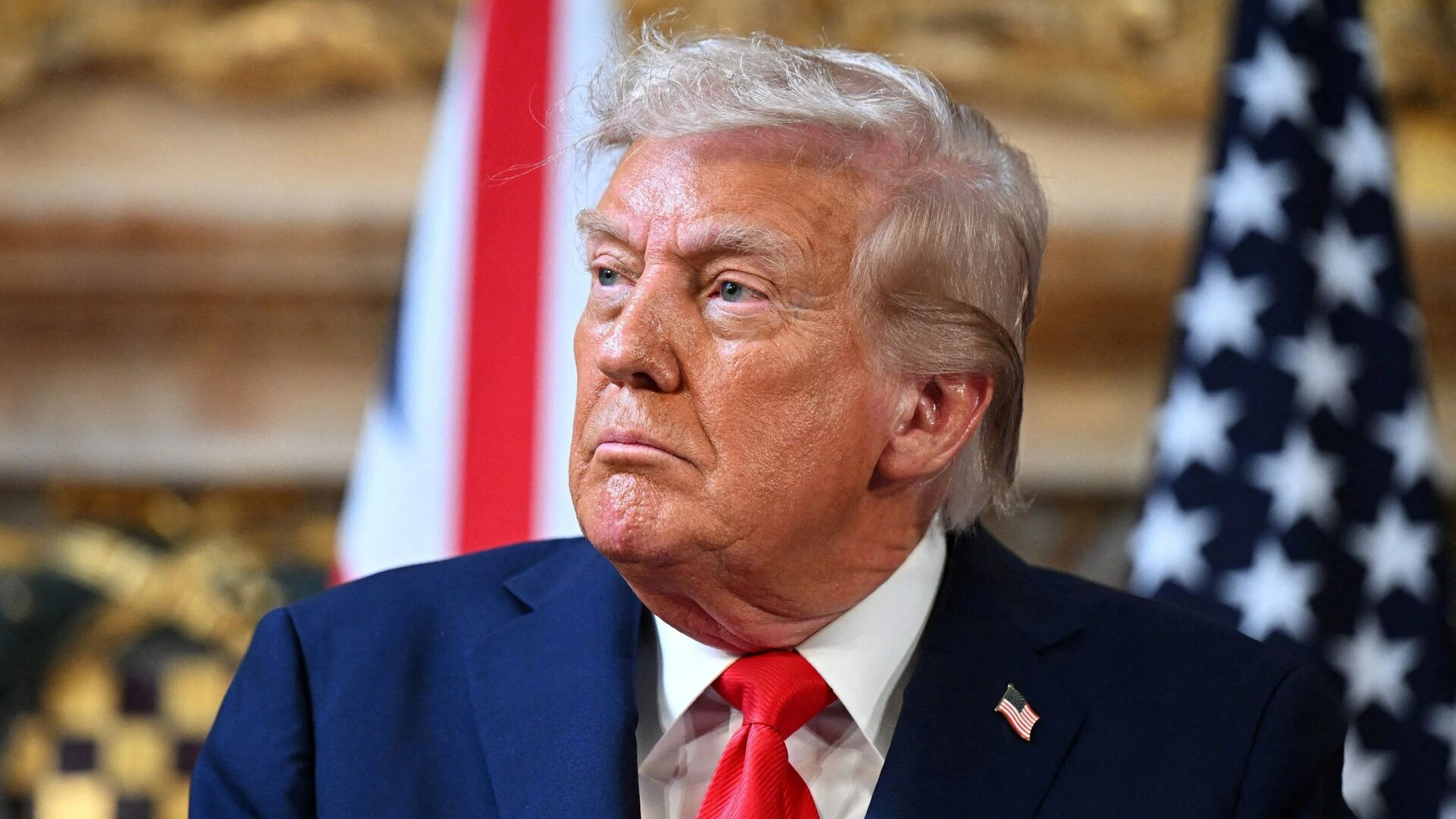
Trump shifts to the passenger seat following his diplomatic assault on Gaza and Ukraine
Pentagon officials met with a group of European diplomats in late August and gave them a blunt message: The United States intended to stop providing some security assistance to NATO members Latvia, Lithuania, and Estonia, all of which border Russia.
More generally, an official with firsthand knowledge of the remarks told the group that Europe needed to be less reliant on the United States, as said by Pentagon officer David Baker. The United States military would be refocusing its efforts on other priorities, such as homeland protection, under President Donald Trump.
Initially reported earlier this month, several European diplomats were concerned that the action may give Russian President Vladimir Putin more confidence.
And they might have been correct on Friday.
Estonia said that Russian MiG-31 aircraft had been in its airspace for about ten minutes before being driven out by Italian F-35s. Russian jets sailed over neutral waters, denying any violation of Estonian airspace.
Russian aircraft buzzed a Polish oil facility a few hours later, according to Warsaw. Poland saw the downing of Russian drones last week.
The U.S. has not responded much to those occurrences thus far. It took Trump many hours to respond to the most recent intrusion before he warned that it would be “big trouble.” He wrote in a mysterious post on his Truth Social app following the Polish incident last week: “Here we go!”
There seems to be a growing pattern in his comments.
Trump has mostly withdrawn from diplomacy in recent weeks, despite months of putting up both ideas to resolve or mediate some of the most unsolvable situations in life. With only oblique promises of U.S. assistance, he has instead let allies take the initiative and in some cases, pushed them to do so.
Increasingly, he has focused on local matters, such as combating crime, opposing violent left-wing extremism, and revamping a significant visa program.
RETURNING TO FORM
Trump has warned Europeans that if they want Washington to strengthen financial penalties on Moscow over its war in Ukraine, they must slap harsh restrictions on Russian oil consumers. This comes after an aggressive summer of diplomacy, which included visiting Putin in Alaska.
Having spent the first few months of his presidency attempting to negotiate a ceasefire between Israel and the Palestinian militant organization Hamas, the U.S. president has recently dismissed actions by Israel that appear to cast doubt on the likelihood of an agreement to halt the war in Gaza.
Although they did nothing, White House officials voiced their disapproval when Israel targeted a Hamas office in Qatar, a U.S. partner. Even as his Arab and European friends denounced Israel’s questionable military advance on Gaza City, which appeared to be the end of peace negotiations, Trump did not protest.
It is somewhat expected that Trump would be cautious about the United States getting involved in large conflicts. On the campaign trail, he spent two years making the case that the country’s military was overextended. His political rivals referred to him as an isolationist.
However, Trump changed during the summer. In support of Israel’s air war in June, he targeted Iran’s major nuclear sites, much to the dismay of certain conservative fellows. During a NATO summit in the Netherlands later that month, he promised to provide Ukraine with new Patriot defensive systems. He increased the severity of his threats of tariffs and sanctions against Moscow in July.
Analysts claim Trump is now getting back to his former self.
Senior fellow at the Carnegie Endowment for International Peace and seasoned U.S. diplomat Aaron David Miller suggested Trump might have just discovered the problems are far more unresolvable than he had initially thought.
“He’s not interested in doing anything unless he sees that the expenditure of effort and political capital will be worth the return,” Miller explained.
An inquiry was not immediately answered by the White House.
President of Commerce, Exhausted Diplomats
A zag would be a perfect complement to the president’s most recent zig. He made public statements in April and May that he was leaving the fight in Ukraine, but he later became quite involved in it again.
The White House has also not been completely disengaged. The PURL program is a U.S.-NATO security assistance project that has started to send some U.S. weapons into Ukraine in recent weeks.
However, analysts voiced fear that the lackluster U.S. response to Russia’s most recent provocations will simply incite Putin to take more aggressive measures.
Alex Plitsas, a senior fellow at the Atlantic Council, stated that further U.S. disengagement “would lead us to more provocative actions from Putin as he sees Europe as weaker because it can be divided – especially without the U.S. there to back it up.”
A number of European officials in Washington privately voiced their frustration with Trump’s inconsistent posture on Russia and said that a further hardening of his position toward Moscow would not be credible.
During the summer, those diplomats claimed, the atmosphere had changed significantly.
The next month, Trump again threatened Russia with direct and secondary sanctions and decided to establish PURL after praising European leaders at a NATO meeting in June.
The anticlimactic summit with Putin, however, yielded no breakthroughs and was a significant loss for Kyiv. Trump departed the meeting with the statement that a truce in Ukraine was not a prerequisite for enduring peace, a stance that Putin and European partners share.
According to two individuals briefed on the discussion, Trump claimed in a heated September 4 call with European allies that people in Europe were still buying Russian oil to support Russia’s war machine while they expected the United States to save them.
In response to China and India’s purchases of Russian oil, Trump advised European Union officials the next week that they should impose 100% tariffs on them. One official claimed he presented such a step as a prerequisite for U.S. action.
According to Trump’s backers, he is merely calling on Europe to defend its own security.
Diplomats, however, can spot a trap. Promptly passing such measures via the EU’s bureaucracy would be challenging, especially as the group favors sanctions over tariffs. The recent remarks by Trump on reducing trade obstacles with India were also mentioned by two top European diplomats in Washington.
Trump’s calculations toward Russia may change as a result of Friday’s Estonian incursion.
A letter last week from MPs in Estonia, Lithuania, and Latvia urging a reexamination of Trump’s proposal to cut off some security aid seemed to have no effect on his administration.
A White House spokesperson stated, “Many of our European allies are among the world’s wealthiest countries.” “They are fully capable of funding these programs if they choose.”