President Lazarus Chakwera and his predecessor Peter Mutharika are anticipated to run closely in Tuesday’s vote in Malawi, one of the world’s poorest nations, where food shortages and the cost of living crises are major concerns.
The landlocked state in southern Africa, which is primarily located along the banks of a freshwater lake that makes up a fifth of its area, has 15 other candidates running for president, including former President Joyce Banda.
According to analysts, a runoff between Chakwera, 70, and Mutharika, 85, was the most likely scenario.
DROUGHT AND CYCLONE HAVE CONSTRUCTED HARDSHIP
Since former pastor Chakwera’s election in 2020, Malawi has experienced economic stagnation. A destructive hurricane and a localized drought, both caused by climate change, have destroyed crops and made things worse. For more than three years, inflation has been higher than 20%.
According to the World Bank, about three-quarters of Malawians make less than $3 each day. According to the bank, about half of the population does not consume enough calories to be adequately nourished.
High food costs were cited by voters as their top concern.
Farmers’ livestock prices have been steadily increasing. According to Patrick Tito, a butcher in Blantyre, the commercial capital, “we had to raise the price of a kilogram of beef to 15,000 kwacha ($8.74) from 8,000 last year, which has caused business to be down.” “I hope my vote addresses this.”
According to Alindiine Bellison Kazembe, another resident of Blantyre, she was having difficulty providing for her four children.
“I have voted for the candidate that I am confident will solve the hunger problem,” admitted the 32-year-old maid.
The two prominent candidates are accused of corruption.
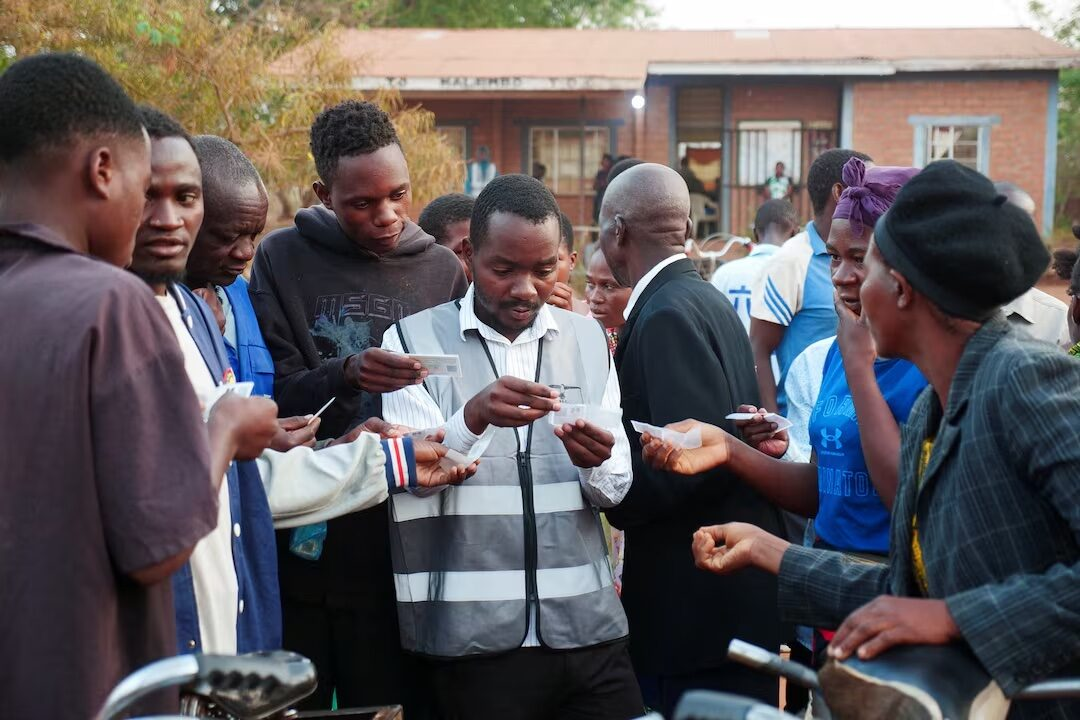
Voting seemed to be proceeding without incident, even though several stations reported issues with their biometric fingerprint scanners. Polls opened at 6 a.m. (0400 GMT).
The roughly 22 million-person nation is also casting ballots for local council members and parliamentary representatives.
In order to secure a parliamentary majority, observers predicted that either Mutharika’s Democratic Progressive Party or Chakwera’s Malawi Congress Party would likely join up with smaller parties.
One factor contributing to disenchantment with both leaders has been corruption scandals.
During his 2014–2020 presidency, former law professor Mutharika was praised for reducing inflation and enhancing infrastructure; nevertheless, he refuted accusations of favoritism in response.
Chakwera was elected with the promise of eliminating corruption, but his caseload has been criticized for being slow and selective.
Leaders have previously faced off.
“This election is a vote against Lazarus Chakwera’s record and performance in office,” Boniface Dulani, a University of Malawi political scientist, noted.
“My forecast is that the opposition candidate could take the lead but still poll below the 50+1 requirement,” added the politician. There will be a second round if no candidate receives more than 50% of the vote.
Three elections have already been held between Chakwera and Mutharika, with the most recent one taking a dramatic turn when the Constitutional Court declared that Mutharika’s 2019 victory was invalid due to irregularities and mandated a rerun, which Chakwera won in 2020.
Typically, results are made public after a week.