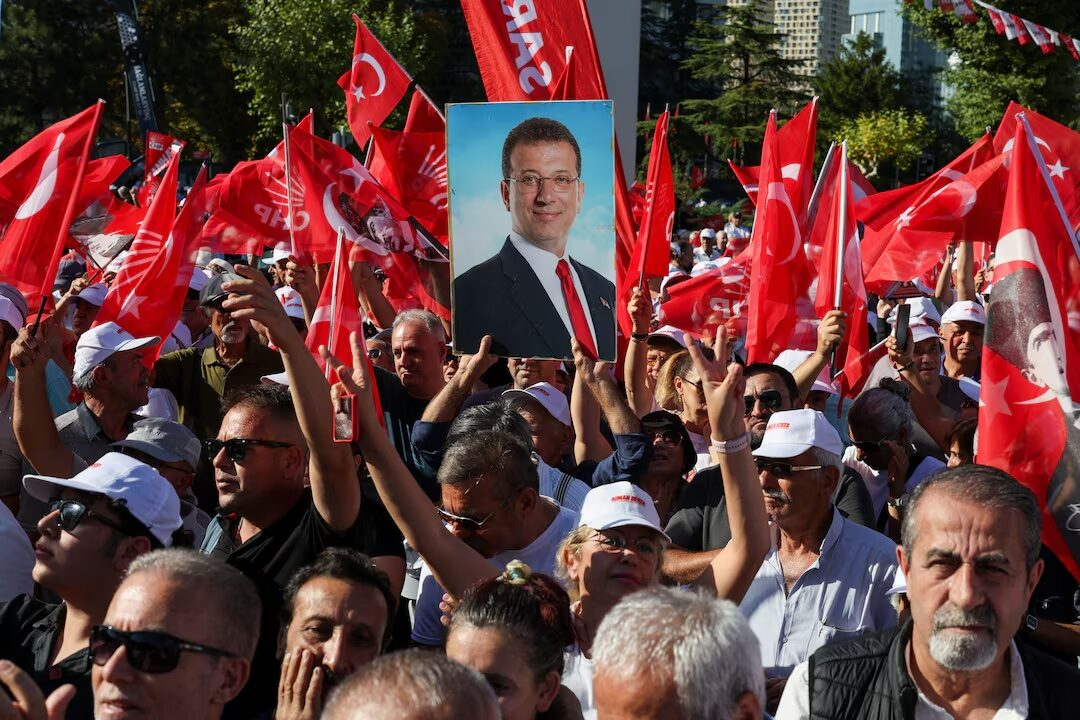
The political crisis in Turkey got worse on Monday when a court delayed deciding whether to remove the main opposition leader and throw out his party’s 2023 congress because of claimed irregularities.
It was decided that the case involving the Republican People’s Party (CHP) and its leader, Ozgur Ozel, would not be heard again until October 24.
In a separate, large-scale investigation into alleged ties between the CHP and terrorism and corruption, hundreds of members, including President Tayyip Erdogan’s main political rival, Istanbul Mayor Ekrem Imamoglu, have been jailed until their trials.
If the court decides next month to throw out the CHP’s congress, Ozel, the party’s angry, gravelly-voiced chair who has become famous since Imamoglu’s arrest, will lose the title he won there.
Case has sparked opposition delay, street protests
A test of Turkey’s unstable balance between democracy and autocracy is seen in this case. It could make things even more chaotic and hostile within the opposition, which would increase Erdogan’s chances of extending his 22-year rule.
Before making a decision, the court turned down the plaintiff’s request to stop Ozel, 50, and his administration. The court also told the CHP and election boards to give information about the upcoming CHP general and Istanbul congresses next week, once they are finished.
Turkey’s moderate CHP rejects the charges against it, and polls show that it is tied with Erdogan’s Islamist-rooted, conservative AK Party (AKP).
In the days leading up to Monday’s court decision, there were a lot of anti-Erdogan protests in the streets, and the case has completely shook up Turkish assets. After Monday’s choice to end the session, the lira, stocks, and bonds all received more value.
But the government says that Turkey’s judiciary is independent, while the opposition, human rights groups, and some European leaders say that the crackdown on the CHP is politically driven and anti-democratic.
Seren Selvin Korkmaz, co-founder and co-director of the Istanbul-based think tank IstanPol Institute, said, “This is a serious moment that signals a regime change in Turkey from a competitive authoritarianism- where opposition parties could still win elections- to a kind of hegemonic authoritarianism- where they are more symbolic and can’t win.”
Turkish is moving toward autocracy, say critics.
Critics say that Turkey is becoming more autocratic because institutions like the courts, the army, the media, the central bank, and others that used to be more independent have given in to Erdogan’s will during his 22-year rule. The legal crackdown on the CHP that started in October of last year has made these worries even stronger.
However, government officials and some experts say that Turkey’s recent local elections, in which the CHP won most of the major cities and Erdogan’s AKP suffered its worst loss ever, showed that the country is still a strong democracy, despite concerns from some critics.
According to the court, if the congress is canceled and Ozel is removed, the party could be run by a trustee or by previous chairman Kemal Kilicdaroglu, who was defeated by Erdogan in an election in 2023 and has since lost a lot of support within the CHP.
Additionally, the case, which was made by a displeased CHP member, could be thrown out.
According to a lawyer for the CHP, the court did not have the power to hear the case on Monday because it was the responsibility of Turkey’s Supreme Election Board to decide on party congress elections.
As a result of worries about the rule of law in Turkey, the country’s markets crashed in March when Imamoglu was jailed awaiting his trial. Shortly after the chaos started, the central bank stopped a run of interest rate cuts.
“Uncertainties have only grown,” said Swissquote blogger Ipek Ozkardeskaya. “The worst-case scenario has been avoided, yet foreign investors’ perception of Turkey’s policy environment and investment outlook remains unchanged.”