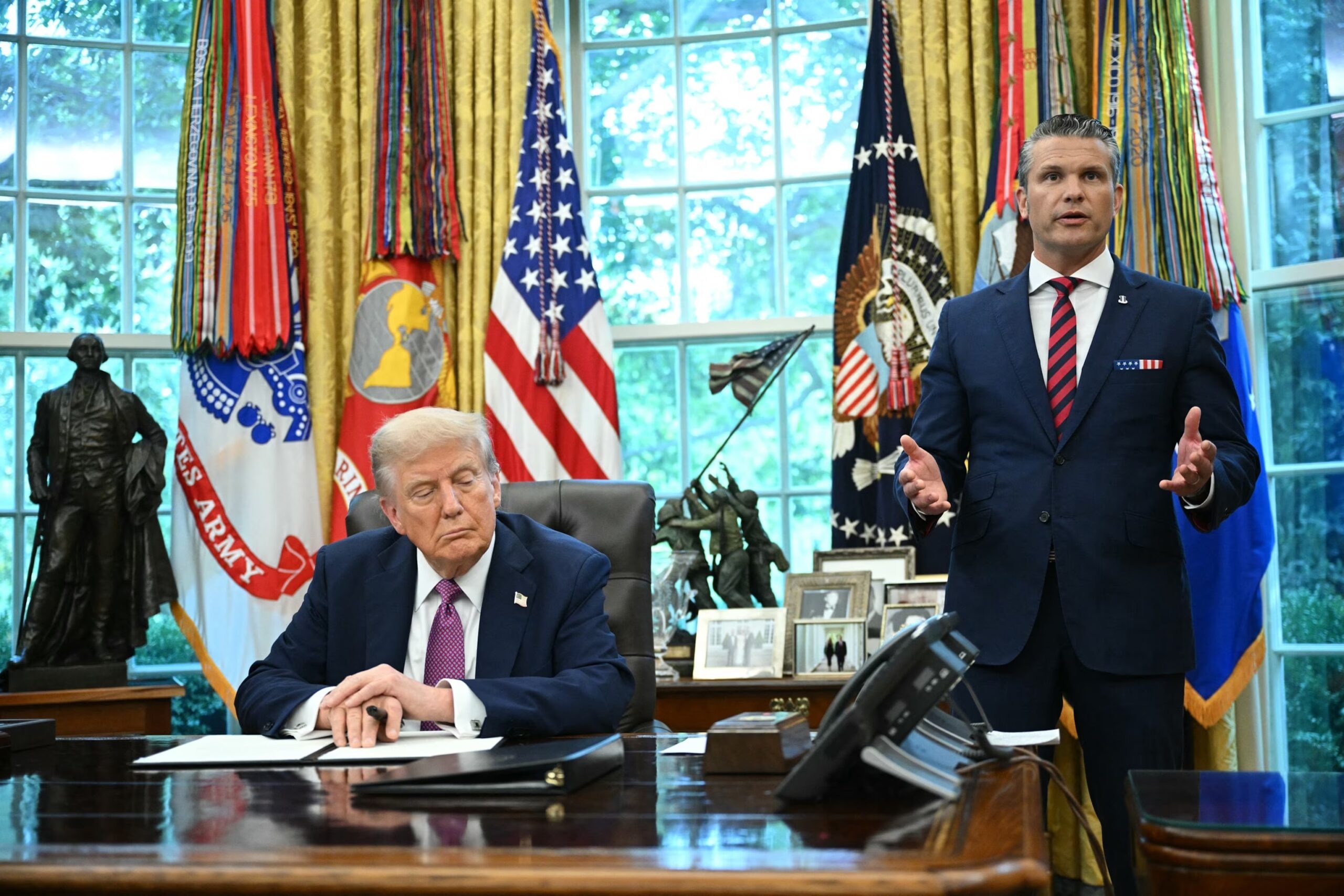
Trump gives the Pentagon the command to resurrect the designation of “Department of War,” indicating a more aggressive military posture and a renewed focus on fighting wars.
On Friday, US President Donald Trump will issue an executive order ordering the Pentagon to resurrect the phrase “Department of War,” which was last used more than 70 years ago, as a secondary title.
Additionally, according to the order, Defense Secretary Pete Hegseth will be called the “Secretary of War.” Trump stated he expects lawmakers to support a permanent change, even though only Congress has the legal power to rename executive departments.
“Compared to the Department of Defense, which solely focuses on defensive capabilities, the name ‘Department of War’ conveys a stronger message of readiness and resolve,” the order says.
Founded in 1789, the War Department changed its name to the Department of Defense in 1947 during World War II. Trump has long maintained that the old moniker more accurately represented the power of the country and reflected America’s “unbelievable history of victory” in both world wars.
The cost of a complete rebranding, which would include new uniforms, email systems, emblems, and other infrastructure, has not been revealed by the White House but is estimated by US media to reach billions. The cost, according to critics, would jeopardize the Pentagon’s continuous attempts to decrease spending and waste.
The shift has been attributed by Trump and Hegseth to their attempts to get the military back on track with “warfighting” and a “warrior ethos,” claiming the Pentagon has been sidetracked by diversity and inclusion initiatives.
The rebranding coincides with China’s high-profile parade unveiling of a new military hardware stockpile, which analysts interpret as a message to the US and its allies.
Since becoming office, Trump has issued 200 executive orders, including this one. Although the action was expected, it has generated discussion in Washington about whether a symbolic return to the “Department of War” portends a more assertive foreign policy posture or runs the danger of intensifying tensions overseas.