SADC: Will Rajoelina keep the momentum going for Mnangagwa?
HARARE—During the 45th SADC Summit of Heads of State and Government, which took place in Madagascar on August 17 and August 20, 2025, in Antananarivo, President Emmerson Mnangagwa of Zimbabwe gave Andry Rajoelina of Madagascar the position of chairperson of the Southern African Development Community (SADC).
Mnangagwa presided over SADC for an unprecedented amount of time.
It was marked by unheard-of levels of excitement not seen in the area since the regional bloc’s founding on August 17, 1992.
Jingles praising Mnangagwa’s appointment as SADC chairperson took over the state-run Zimbabwe Broadcasting Corporation’s airwaves immediately after he took up the role on August 17, 2024, during the 44th SADC Summit of Heads of State and Government in Harare.
Quiz sessions designed to increase schoolchildren’s and youths’ awareness of SADC also became a regular occurrence on Zimbabwean radio and television.
Not to be outdone, the Zimbabwean strongman’s supporters went into overdrive, praising him in turn for becoming the SADC chair.
At a variety of gatherings, including political rallies, funerals, and religious ceremonies, politicians—particularly those from the ruling Zanu PF party—continued to remind Zimbabweans that Mnangagwa was in charge of the regional bloc.
According to Webster Shamu, a Zanu PF veteran politician who is also an MP and the head of the Foreign Affairs and International Trade Committee of Parliament, Mnangagwa’s speech was “about action, not words.”
Moments and accomplishments that speak to us as Zimbabweans, bound together by pride and purpose, transcend political party affiliation. In the Zimbabwean Parliament on Thursday, Shamu said, “This chairmanship is one such moment.”
Mnangagwa, however, lived up to and maybe beyond the expectations typically associated with this ceremonial role, notwithstanding the fanfare that surrounded his time as SADC chair.
Without a doubt, regional leaders who have served as SADC chair since 1992 have adopted a routine style of leadership and have not achieved the same level of success as Mnangagwa.
His supporters and fans waxed his credentials as a regional statesman after this outstanding performance, which coincidentally matched the excitement surrounding his ascent to the role.
Mnangagwa promoted greater regional integration, economic cooperation, industrialization, food security, and improved people-to-people ties during his one-year tenure as SADC leader.
In order to strengthen the region’s integration efforts, he promoted the construction of vital corridors and one-stop border posts.
Mnangagwa advocated for the creation of a SADC Parliament with full membership.
The framework strengthens the basis for further regional integration and parliamentary collaboration by formally uniting all SADC Parliamentary Forum (SADC PF) member parliaments in support of the region’s transformation goal.
When the signing occurred during the closing ceremony of the 45th Ordinary Summit of Sadc Heads of State and Government in Antananarivo on August 17, 2025, the SADC PF campaign achieved a historic milestone.
“Thanks to His Excellency, the President’s leadership skills, Madagascar and Mauritius signed the Agreement Amending the Treaty on that same day, bringing the total number of members who have signed up to 15,” Shamu stated.
Additionally, Mnangagwa signed off on the building of a SADC Standby Force Regional Logistics Depot in Botswana, which would be crucial to improving the area’s readiness and ability to respond to humanitarian crises and conflicts.
Significant progress was made in putting high-impact regional infrastructure projects into action during his tenure as SADC head.
Mnangagwa stated that SADC must quickly find innovative and trustworthy funding sources in order to achieve sustainable progress. He noted that the SADC Regional Development Fund is a low-hanging fruit that, once operationalized, will offer alternative financing for important infrastructure projects.
Zimbabwe has accepted the Protocol as a sign of its commitment to the SADC Regional Development Fund. The same has been done by eight other SADC members.
In order to boost regional development and improve integration throughout SADC, the SADC Regional Development Fund seeks to raise money from member states, development partners, and the business sector.
As he turned over the chair, Mnangagwa remarked, “The SADC Regional Development Fund is a low-hanging fruit that, when operationalized, will provide alternative financing for critical infrastructure projects.”
Under Mnangagwa’s leadership, the regional bloc as a whole achieved progress in creating the institutions necessary for democracy and sound government.
Furthermore, in order to promote increased industrialization, trade, and investment, he argued that occasions like the important SADC Industrialization Week be held annually and serve as networking opportunities.
Perhaps Mnangagwa’s most notable accomplishment as SADC chair, however, was his determination to advance regional peace and stability, which helped him become a skilled mediator in complex disputes.
As the chair of SADC, Mnangagwa spearheaded efforts to put an end to the ongoing, brutal conflict in the eastern Democratic Republic of the Congo. The conflict started when SADC unceremoniously sent troops and equipment to support the Congolese army, which is fighting alongside the FDLR, a militia group that seeks to overthrow the Kigali government and destabilize Rwanda.
Remaining members of the 1994 Genocide against the Tutsi, in which more than a million people were brutally murdered, make up the majority of the FDLR.
In the eastern DR Congo, where the Tutsi population is being massacred and their rights violated, the AFC/M23 rebels are waging a revolution against the Congolese army, which is working with the FDLR and a group of violent militias, as well as the Burundian army.
SADC dispatched forces on December 15, 2023, at the invitation of President Felix Tshisekedi of the Democratic Republic of Congo, with the goal of replicating the United Nations Force Intervention Brigade’s 2012–13 success in driving out the M23 from Goma, the capital of South Kivu.
Tshisekedi wanted the East African regional force to engage directly with the AFC/M23, so he dismissed it, and the SADC force took its place.
The regional force from East Africa had been assigned to supervise the M23’s retreat from the area it had taken.
The DR Congo leader wanted the East African regional force to engage in direct battle with the rebels, which was outside of its mission, even though the rebels had evacuated from the majority of the territory it controlled to allow for peace negotiations.
Tshisekedi summoned SADC and drove out the East African regional forces because he was angry that the regional force would not support him in the war.
SADC foolishly dispatched its forces without consulting the EAC to comprehend the complexities of the crisis.
Despite being presented as a peacekeeping operation, the SADC Mission in the Democratic Republic of the Congo (SAMIDRC) did not fit the conventional definition of peacekeeping because its primary objective was to support the DR Congo army and its allies in fighting.
However, South Africa, Tanzania, and Malawi, the nations who contributed troops to the SAMIDRC, failed miserably in this mission and sustained losses at the hands of the AFC/M23 rebels, who took control of Goma, the capital of South Kivu, Bukavu, the seat of North Kivu, and other areas.
In order to pursue a long-term peace process, Mnangagwa, who was already a top intelligence official, wanted the SADC force to leave the eastern Democratic Republic of the Congo as soon as possible.
Consequently, SADC leaders announced a phased disengagement and ended the operation on March 13.
Mnangagwa showed good leadership by doing this, particularly after he had likely fully grasped the intricacies of the situation.
It was a brilliant move to decide to work with the East African Community to bring peace to the unstable eastern DRC Congo.
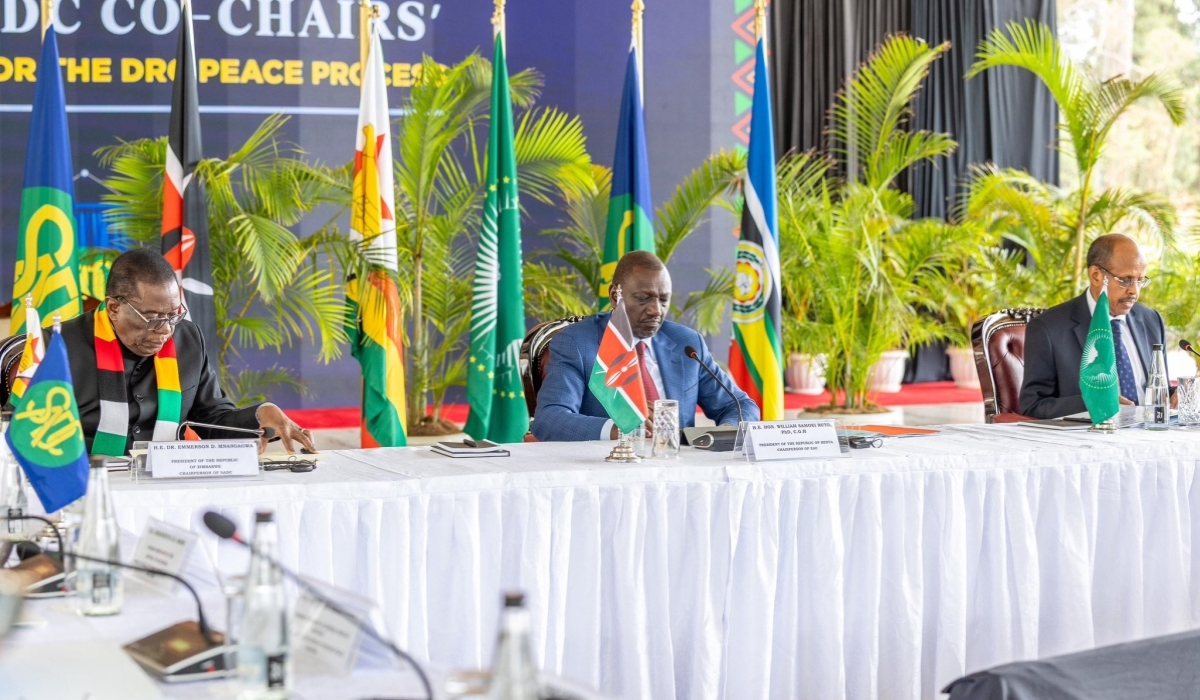
Progress is being tracked. After co-chairing a virtual extraordinary joint summit on EAC and SADC, Mnangagwa and Kenyan President William Ruto, the chair of the East African Community (EAC), announced a decision to combine two peace initiatives, the Nairobi and Luanda peace processes, into a single African-led mediation framework backed by the African Union to improve coordination to advance peace efforts in the eastern Democratic Republic of the Congo.
Mnangagwa and Ruto praised the advancements of complementing diplomatic efforts between the United States and Qatar that are now underway.
Olivier Nduhungirehe, Rwanda’s Foreign Affairs Minister, commended Mnangagwa for his outstanding leadership as SADC chair and for his unbiased role in leading peace efforts in the eastern Democratic Republic of the Congo.
At the Ministerial Session of the Third Joint Permanent Commission on Cooperation (JPCC) between Rwanda and Zimbabwe in Kigali, where the two nations signed five new agreements on health, police cooperation, energy (renewal), youth affairs, and customs information exchange, Nduhungirehe said, “I commend Zimbabwe’s leadership, as you concluded your chairmanship, of the Southern African Development Community, and the successful hosting of the EAC-SADC ministerial meeting on the conflict in eastern DRC held on March 20-25.”
The successful co-hosting of the EAC-SADC co-chairs meeting last week in Nairobi, in particular, shows that there is a lot of momentum behind the idea of African solutions to African challenges, Nduhungirehe added.
It should come as no surprise that Mnangagwa was elated when he took the podium on August 18 to transfer the SADC chairmanship, clearly aware of the contributions he had made during his time there.
Mnangagwa said SADC remained consistent in its commitment to establishing peace in eastern DR Congo as he turned over the chairperson to Rajoelina. He cited the creation of a panel of mediators during the EAC-SADC joint session in Nairobi, Kenya.
The panel includes former Presidents Olusegun Obasanjo of Nigeria, Uhuru Kenyatta of Kenya, Catherine Samba-Panza of the Central African Republic, Sahle-Work Zewde of Ethiopia, and Dr. Mokgweetsi Masisi of Botswana.
“To promote inclusive dialogue, foster trust, and advance peace-building initiatives, we appointed five former heads of state,” Mnangagwa stated.
“We applaud the results of the African-led Peace Process and the Joint SADC-EAC Summit earlier this week, which support our belief that African problems should be solved by Africans.”
Now that Mnangagwa’s time is ended, Rajoelina is the focus.
Will he be as vigorous as Mnangagwa in his efforts to find a long-term solution to the recurring issues plaguing the eastern Democratic Republic of the Congo?