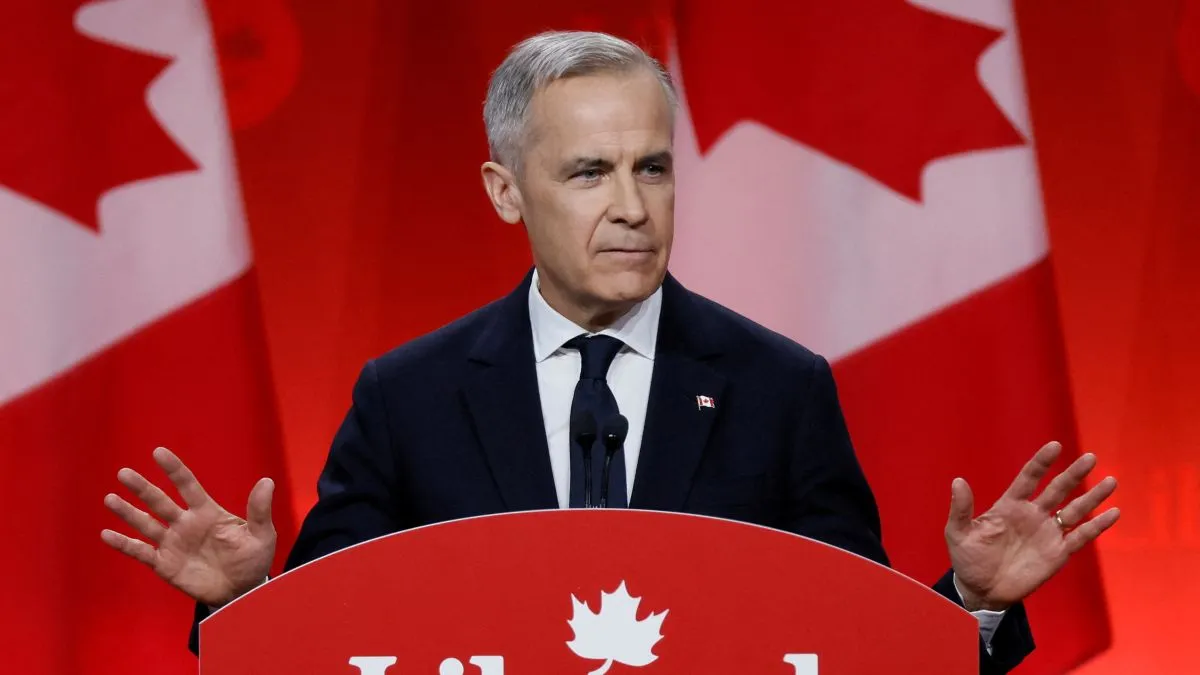
Prime Minister Mark Carney announced on Friday that Canada would lift a number of retaliatory import duties on American goods and step up talks with the US to establish a new trade and security partnership.
He told a news conference in Ottawa that Canadian tariffs on American steel, aluminum, and automobiles would not be lifted for the time being.
According to Carney, it was a positive development that the United States recently stated that it would not apply duties on Canadian exports that were in compliance with the three-nation U.S.-Mexico-Canada free trade agreement.
“In this context and consistent with Canada’s commitment to USMCA, I am announcing today that the Canadian government will now match the United States by removing all of Canada’s tariffs on U.S. goods specifically covered under USMCA,” he stated.
He continued by saying, “Canada and the U.S. have now re-established free trade for the vast majority of our goods,” reminding everyone that, in comparison to its trading partners, U.S. tariffs on Canadian exports were still generally low.
By 12:40 pm, the Canadian currency was up 0.5% at C$1.3837 to the US dollar, or 72.27 US cents, thanks to the news.
Despite months of discussions, Canada and the US are still far from reaching an agreement on a new economic and security partnership.
To the annoyance of the U.S. administration, only China and Canada have retaliated against the United States with counter-tariffs.
“We applaud Canada for taking this long-overdue action. A White House spokesman stated, “We look forward to continuing our discussions with Canada on the Administration’s trade and national security concerns.”
On Thursday, Carney had a conversation with Donald Trump. When asked if the U.S. president had informed him that the discussions would begin with the tariffs being lifted, Carney said, “Yes.”
A pledge to oppose Trump’s tariffs helped Carney win an election in April, but he has since progressively softened his stance.
U.S. corporations fiercely objected to a proposed digital services tax that Carney withdrew in late June. In July, he stopped threatening additional sanctions if the two parties could not come to an agreement by August 1.
Using the example of ice hockey, Carney stated that instead of continuing to adopt an aggressive posture, the time has come for a more moderate approach.
“Let’s be clear, we have the best deal of anyone in the world right now,” he stated. “Nobody has a deal with the United States that they used to have.”
Carney may face political difficulties as a result of the news, since his ruling Liberals only hold a small number of seats in the elected House of Commons and depend on opposition parties to withstand votes of confidence.
This week, the head of the biggest opposition party, the Conservatives, charged that Carney was being too lenient with the US.
On March 6, Carney’s predecessor as prime minister, Justin Trudeau, responded to Trump’s initial charges by imposing 25% tariffs on C$30 billion ($21 billion) in items imported yearly from the U.S.
Although the remaining C$125 billion has been postponed, the C$30 billion was a component of a larger retaliation plan that targeted C$155 billion worth of U.S. imports.