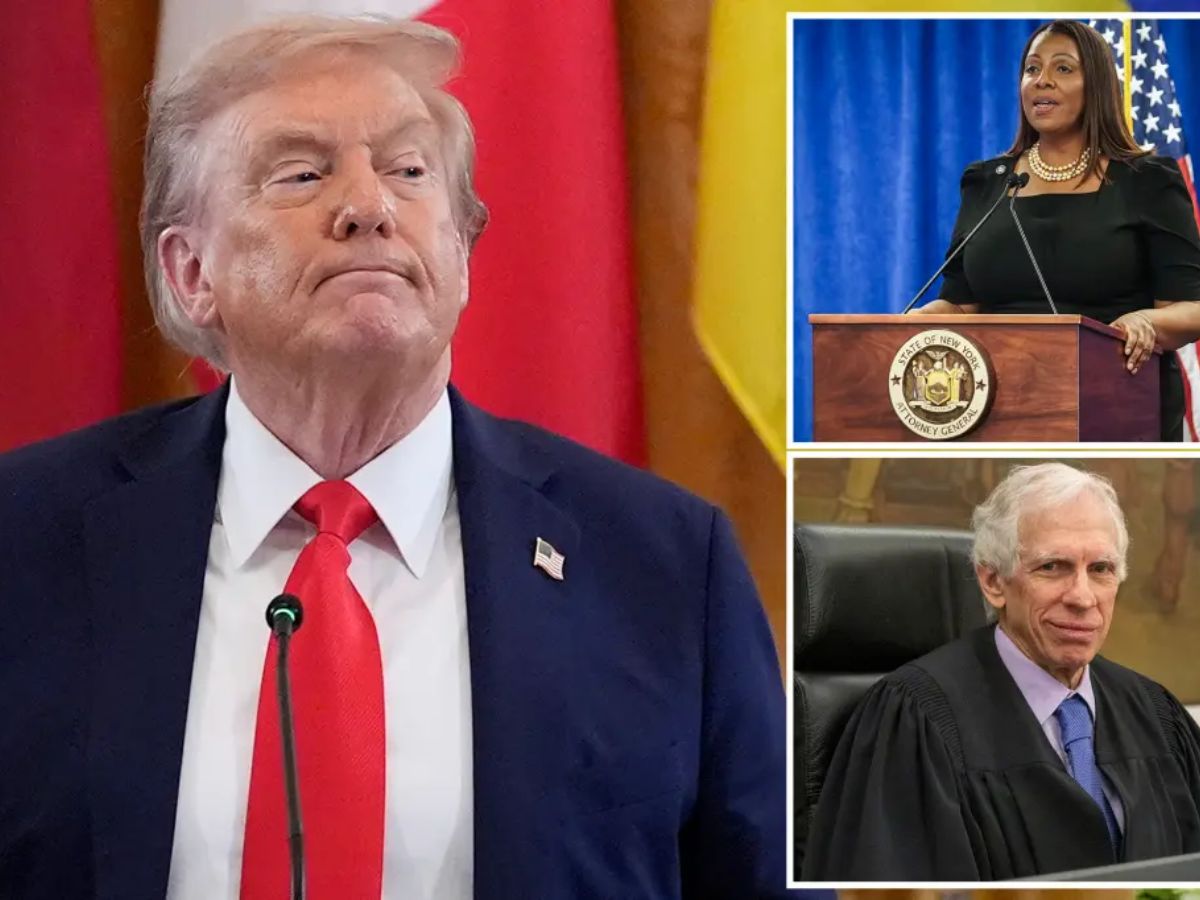
The New York appeals court upholds Trump’s fraud responsibility but nullifying the $500 million penalty, leaving the non-monetary penalties unaltered.
A New York appeals court upheld former US President Donald Trump’s responsibility for misrepresenting property values to obtain favorable loans, but overturned the $500 million penalty imposed on him in a civil fraud case.
Although Trump and his corporation committed fraud, the Appellate Division of the New York Supreme Court ruled unanimously Thursday that the monetary penalty was “excessive” and probably unlawful.
In 2024, Judge Arthur Engoron first ordered Trump to pay $355 million, which, when interest was added, grew to nearly $500 million. However, in his article for the appellate panel, Justice Peter Moulton contended that the penalty was significantly worse than the harm.
“Although there was undoubtedly harm, the state was not entitled to a nearly half-billion-dollar award because of the catastrophic harm,” Moulton concluded.
Trump celebrated the ruling as vindication on his Truth Social platform.
He referred to the case as a “political witch hunt” and said, “I greatly respect the fact that the Court had the Courage to throw out this unlawful and disgraceful Decision that was hurting Business all throughout New York State.”
On social media, his son Eric Trump also expressed his joy, writing, “Justice won after five years of hell!”
Letitia James, the head of the New York Attorney General’s Office, took a different stance, stating that the ruling upheld Trump’s responsibility for fraud.
In a statement, the office stated, “This should not be forgotten: another court has found that the president broke the law and that our case has merit.” It reaffirmed intentions to appeal the penalty decision to the Court of Appeals, the highest court in the state.
The appellate court affirmed Judge Engoron’s other sanctions, such as a three-year prohibition that barred Trump from acting as a director of the company or borrowing money from New York banks, even if it overturned the monetary award.
The five-judge panel’s internal disagreements were reflected in the lengthy 323-page ruling. Two demanded a more limited retrial but participated in nullifying the fine “for the sole purpose of ensuring finality,” while three supported James’s right to pursue the case and one believed it ought to have been dismissed.
The decision was made almost a year after justices expressed doubt about the severity of the punishments during oral arguments.
Judge Engoron found Trump guilty of fraud in 2023 after he overstated his fortune by hundreds of millions of dollars, including by exaggerating the size of his penthouse in Trump Tower by almost three times.
The high-stakes legal battle is now prolonged as a result of the appeal court’s ruling, which sets up a new round of litigation before the Court of Appeals in New York.
The unusually lengthy verdict, according to legal experts, emphasizes the case’s political and legal significance.
“If this were Joe Smith, the businessman, rather than Donald Trump, would you have a 300-page opinion?” questioned Mark Zauderer, an appellate lawyer.
The result was characterized as “a judicial version of kicking the can down the road” by Will Thomas, a professor of commercial law at the University of Michigan.
Until the state’s top court rules, Trump is still legally responsible for the fraud but is exempt from the half-billion-dollar fine.