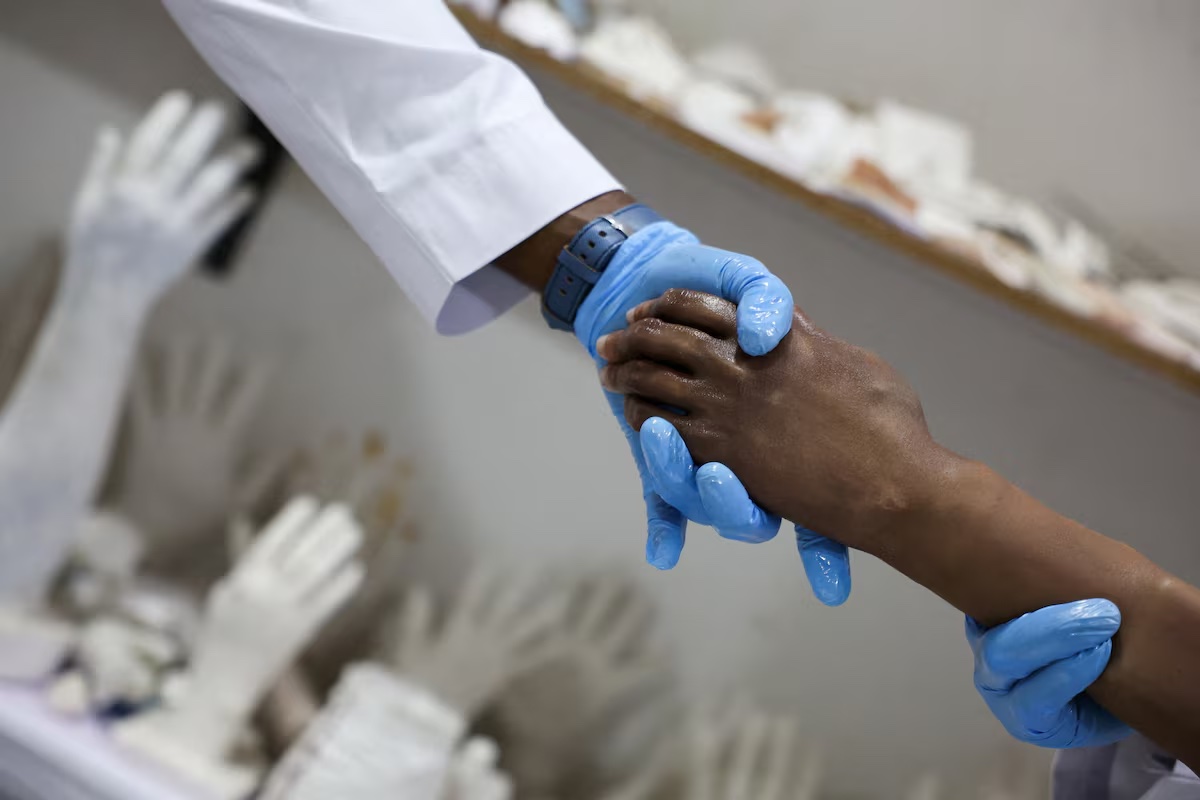
Gift Usen is eager to take her hand in his. She was born in Akwa Ibom, southern Nigeria, 25 years ago, and has only used one fully formed hand to get by in life.
As I grew older, I realized that I only had one and a half hands. And I’m usually down, but this is how I viewed it, so I had to support myself. “I didn’t make myself,” cosmetologist Usen stated.
There is no exact statistics on the number of prosthesis users in Nigeria. However, many amputees and other hand-impaired Nigerians have not been able to buy or obtain prosthesis.
The Ubokobong Bionic Arm from Nigerian prosthetics company Immortal Cosmetic Art aims to address the issue. When an amputee loses his hands, the business has created a humanoid prosthetic limb that uses electromyography impulses that are transmitted from the brain to various hand muscles.
In order to make the prostheses cheap for the average Nigerian, it intends to formally begin production with assistance from the government or non-governmental organizations. Orders from customers drawn to the humanoid bionic limb have also come in from the US, UK, Australia, and Ghana thus far.
According to John Amanam Sunday, CEO of Immortal Cosmetic Art and a hyper-realistic prosthetic artist, “bionics are easily accessible in other parts of the world, but what we have here are hyper-real bionic forms, which means they look human-like and yet functional.”
“They are human-like and functional, not merely static. Thus, this goes beyond what is already available on the market. The fact that it has black skin is its most exquisite feature.
Even before its formal premiere, the Ubokobong Bionic Arm—which was created for Africans by Africans—has already gotten several orders, according to Amanam.
After Ubokobong, Amanam’s younger brother, lost his fingers to exploding firecrackers at a New Year’s Eve celebration six years ago, the concept for a hyper-real bionic limb was conceived.
Amanam founded Immortal Cosmetic Art as a result of the brother’s mental pain over not being able to find artificial fingers in Nigeria that matched his skin tone.
At first, the prosthetics had no purpose and were only aesthetically pleasing. Ubokobong used his experience in electronics and technology to identify this gap and create a workable solution. He was able to successfully construct the Ubokobong Bionic Arm after three years of intense research.
Usen expressed her excitement for the day, even though Amanam has not yet disclosed the official launch date for the Ubokobong Bionic Arm.
“My happiest moment ever will be during our launch. I’ll have two hands at last. Maybe feel, you know,” she remarked.