Somalia has seen a sharp increase in diphtheria cases, and officials attribute the rising fatality to vaccination shortages and US funding cuts.
Health officials warn that vaccine shortages and reductions in US aid have significantly hindered the response to the sharp increase in diphtheria cases and deaths in Somalia this year.
“More than 1,600 cases, including 87 deaths, have been recorded, up from 838 cases and 56 deaths in all of 2024,” stated Mr. Hussein Abdukar Muhidin, Director General of the National Institute of Health in Somalia.
A bacterial illness that primarily affects children, diphtheria produces fever, breathing problems, and enlarged glands. A vaccine that became widely accessible in the middle of the 20th century can prevent it.
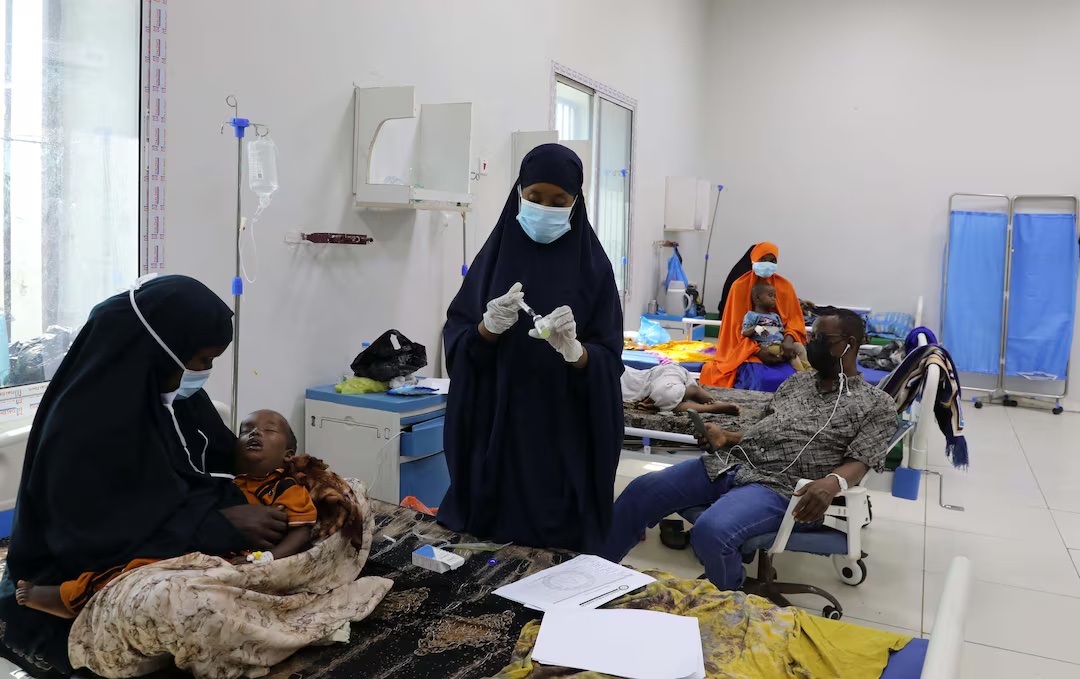
Even though Somalia’s childhood vaccination rates have increased in the last ten years, hundreds of thousands of children are still unvaccinated. Families like Deka Mohamed Ali’s, who three months ago fled violence between government forces and Islamist militants in the central town of Ceeldheere, have suffered greatly as a result.
She said that all four of her children, none of whom had received a vaccination, had contracted diphtheria. “My 8-year-old son passed away, but my 9-year-old daughter recovered, and two toddlers are currently receiving treatment at a hospital in Mogadishu.” I didn’t realize it was diphtheria, so I just stayed at home when my kids got sick. She spoke from her son Musa Abdullahi’s bedside, describing how the virus had caused his throat to swell to “the size of a lemon.”
Ali Haji Adam, Somalia’s health minister, said that the administration had not been able to obtain enough immunizations. Due to a worldwide shortage, the government has had trouble obtaining adequate vaccines, and the reduction in US aid is making it challenging to distribute the doses it does have,” he said. The health money that the United States used to give to Somalia were severely impacted by the aid withdrawal. Numerous medical facilities closed. Due to a lack of funds, mobile vaccination teams that delivered immunizations to isolated locations are no longer operational.
Separately, Muhidin expressed his worries, mentioning the closing of health facilities.
The total amount of foreign aid committed to Somalia for the fiscal year that ends on September 30 is $149 million, up from $765 million the year before, according to figures from the US government.
In support of Washington’s stance, a US State Department official stated: “The United States continues to provide lifesaving foreign assistance in Somalia.” Since America is the most giving country in the world, we implore other countries to significantly up their humanitarian endeavors.
Aid organizations have issued warnings about a broader health crisis brought on severe budget constraints. Last month, Save the Children said that “a doubling in the number of combined cases of diphtheria, measles, whooping cough, cholera, and severe respiratory infections since mid-April” was caused in part by the shutdown of hundreds of health centers in Somalia.
The US is not the only country experiencing cuts. Budgets for aid are also being cut by Britain, France, Germany, and other significant Western donors.
Doctors and human rights organizations have criticized Somalia’s government for not providing enough funding for healthcare. According to Amnesty International, the health sector only received 4.8% of the national budget in 2024, compared to 8.5% the year before.
In response to this criticism, the Health Ministry said it is organizing a vaccination campaign but did not specify when it will start.