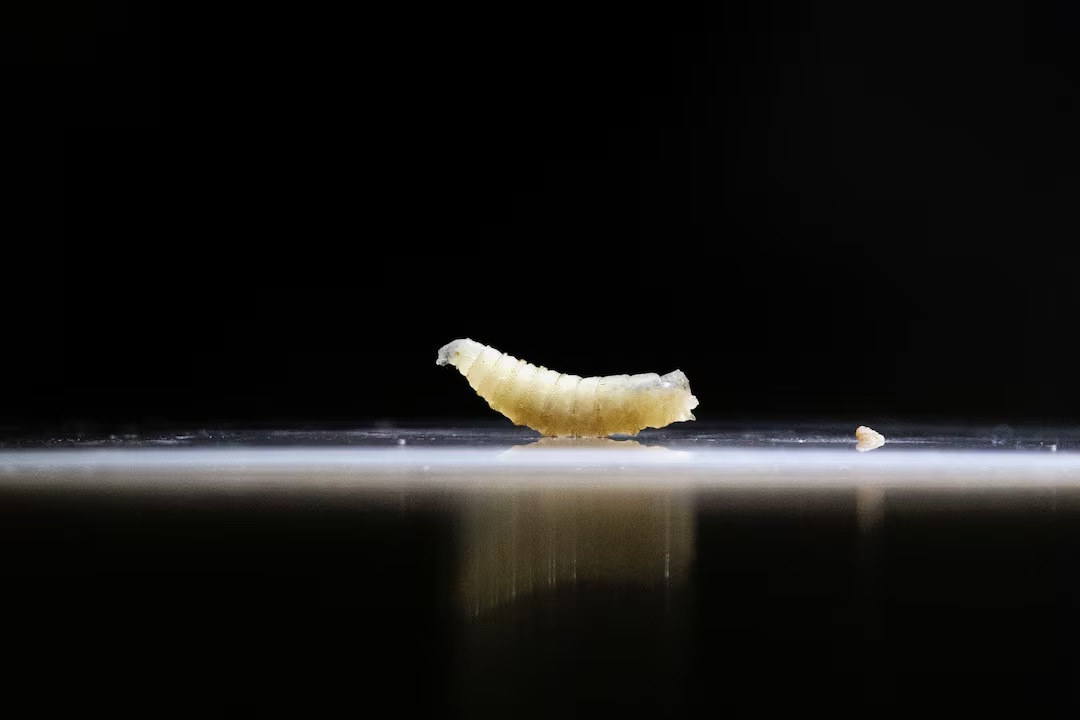
Mexican ranchers who were bitten by a flesh-eating screwworm want the smuggling of cattle to stop
Rancher Julio Herrera calls his herd back from grazing on a hot afternoon in the rural heartland outside the southern Mexican city of Tapachula, which is close to the Guatemalan border.
“Gate! Gate!” he yells as the cows automatically trot to their corral after turning the corner from the pasture.
He feels for wounds where the deadly screwworm, a new tab parasite, could burrow by running his hands under their hooves. He claims that until Mexico’s government takes action to address what he views as the main problem—illegal livestock traveling across the border from Central America—efforts to protect his herd can only go so far.
Serious harm is caused when screwworm fly maggots dig into the flesh of living mammals. Even though it frequently results in death, if caught early enough, infected animals can be treated by removing larvae and administering medication.
The first human death of the infestation, which started in November, was an 86-year-old woman who passed away in the state of Campeche in late July from severe cancer and complications from a screwworm infection. Mexico reported almost 30 instances in the final week of July, despite the fact that infections are less common (and treatable) in humans.
“Sick and stolen cattle are being transported indiscriminately from Guatemala. “Health control does not exist,” Herrera told Reuters. “We, the producers, are the ones who suffer.”
According to estimates provided by sector specialists and Mexican officials in 2022, there are at least 800,000 cattle entering Mexico illegally annually.
Livestock trafficking and theft have long been associated with organized crime groups, allowing them to access a profitable market and extort money in the process. The creatures can be from Central American nations like Nicaragua, Honduras, or Guatemala. They bring fake passports and ear tags from the underground market into Mexico.
BORDER CLOSING
The unlawful crossings were cited as a major contributing reason to the disease by producers, abattoir professionals, and local Chiapas vets. These animals are sold to meat corporations or larger cattle producers after evading taxes, sanitary checks, and government checkpoints.
While acknowledging the illicit trade, Chiapas local government officials claimed that the federal government was handling it and that it was not the primary cause of screwworm’s expansion. Rather, they placed the blame on the screwworm fly’s unregulated spread and a reluctance to notify and seek treatment for patients.
In response to inquiries regarding steps to prevent illicit cattle at the southern border, Mexico’s Ministry of Agriculture cited earlier declarations regarding initiatives to lessen unauthorized and counterfeit ear tags.
Due to the outbreak, the U.S. has mostly closed its border to Mexican livestock since May. This has severely impacted an industry that exports around $1 billion worth of cattle to the U.S. each year and has contributed to the high price of meat in the United States. The Mexican Association of Meat Producers (AMEG) estimates that the outbreak costs the Mexican meat sector between $25 million and $30 million each month.
According to three ranchers who spoke to Reuters, their ire at the government’s lack of authority at the southern border is growing. The National Confederation of Livestock Organizations in Mexico urged the government to step up measures to curb unauthorized crossings in July.
“It’s a business,” said Jorge Ortiz, a local pig farmer and the head of the Tapachula municipal slaughterhouse, in reference to illegal cattle. “It needs a lot of attention to be able to control this problem… and where that should come from is the federal government.”
Since Mexico has three months to negotiate a trade agreement with the United States or risk higher tariffs, the outbreak is adding new trade pressures to the U.S.-Mexico relationship.
With $21 million from the United States, Mexico’s federal government is developing a $51 million sterile screwworm fly breeding facility in Chiapas, however it is not anticipated to start operations until 2026.
DISTURBING MYTHS
According to officials, animals who are affected will not be killed.
Producers who identify diseased animals are given free care, including deworming products, and training sessions. A few screwworm-detecting canines have been sent to a livestock border crossing in Chiapas.
According to Marco Barba, the agriculture secretary for Chiapas State, awareness and prevention are the main goals of local initiatives. Towns are dotted with signs that read things like “Without wounds, there’s no worms.”
Barba added that the state’s meat consumption has decreased and that authorities are working to debunk myths about tainted meat. According to officials, eating meat is not a way for screwworm diseases to spread.
According to Carlos Mahr, head of the Livestock Union of Chiapas, livestock farmers are reluctant to disclose screwworm instances for fear that authorities will either close their operations or kill their animals.
A worker at Mahr’s ranch outside of Tuxtla Gutierrez lassos a baby cow. Mahr is waiting with an aerosol can of disinfectant to clean the wound from removing the animal’s horns, and the animal bucks as it is led over to him.
According to Mahr, treating infected animals is simple. “There should be no fear or worry,” he stated. “Reporting is important to have a generalized map of where the worm is found.”
Barba stated that his administration has been trying to demonstrate to USDA authorities that progress has been made and that the reopening of the border with the United States is crucial for the nation’s cattle ranchers.
According to U.S. Agriculture Secretary Brooke Rollins, the United States and Mexico are collaborating more than ever before. The USDA team was “staffing up in the hundreds” to travel to Mexico in order to confirm the information that Mexico was supplying.
However, not everyone has benefited from the resources.
According to Tapachula cattle veterinarian Alfonso Lopez, he treats patients on multiple farms every day.
Earlier that day, Lopez had a new sample of screwworms taken from a newborn calf in his office. “Right now, it’s a very serious situation,” he added.
“The federal government is assigning personnel to handle the cases, which is insufficient, but Chiapas is more than just highways—it has valleys and mountains, so the fly won’t only travel on the roadways. It’s not enough,” Lopez stated.
Herrera, a rancher in Tapachula, pointed out that although the primary focus is on eradicating screwworm in livestock, the insect may infect any warm-blooded animal.
“What happens with the coyotes, the stray dogs… the deer, the jaguar?” “Oh,” Herrera said.