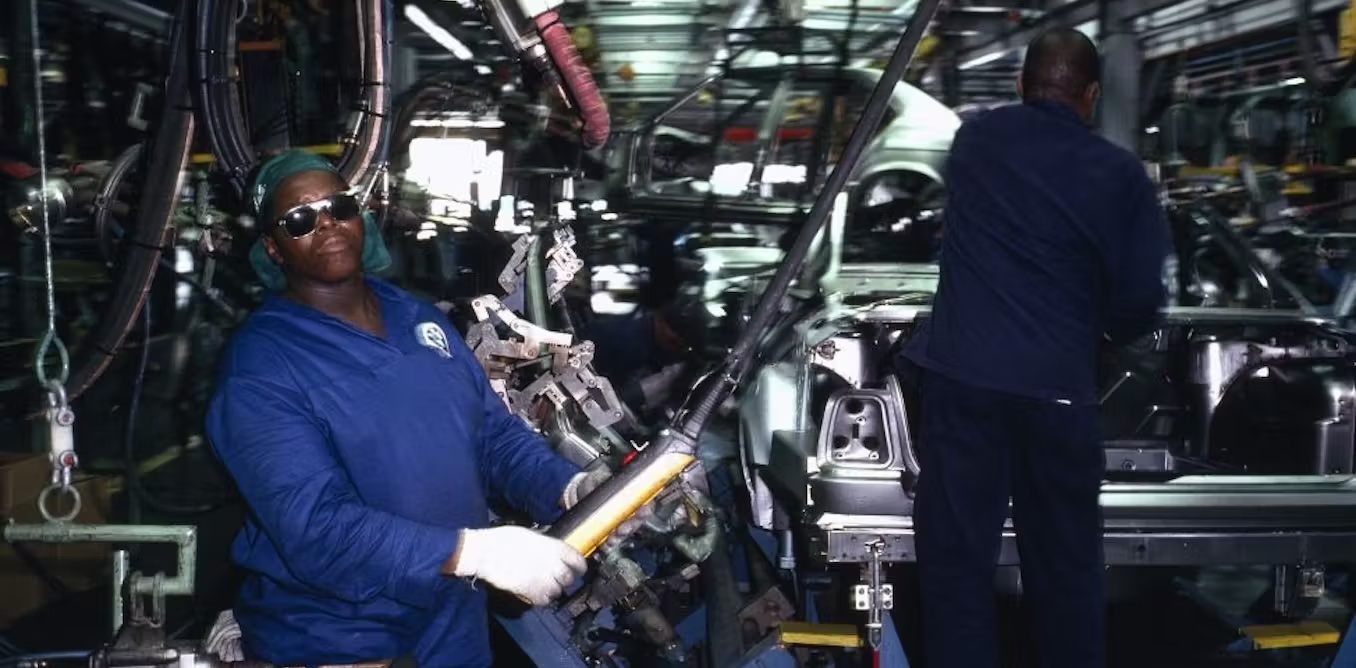
Twelve firm closures and more than 4,000 job losses have occurred in the South African automotive sector over the past two years due to low domestic sales of locally produced automobiles, an increase in imports, and low levels of local content, the trade minister said on Wednesday.
At an auto parts conference, Minister Parks Tau informed delegates that South Africa, a market long dominated by companies like Volkswagen (VOWG.DE), Toyota (7203.T), and Mercedes-Benz (MBGn.DE), saw sales of 515,850 locally produced cars last year, far below the South Africa Automotive Masterplan 2035 target of 784,509.
In South Africa, imports account for about 64% of all car sales. U.S. tariffs now have a major influence on the nation’s 28.7 billion rand ($1.64 billion) automotive exports, he added, while localization—the percentage of local assembly, labor, and components—remains static at 39%, well below the 60% target.
“These pressures have triggered 12 company closures and over 4,000 job losses in two years,” Tau explained.
Over 80,000 of the 115,000 direct employees in South Africa’s automotive sector work in component production alone. The U.S. tariffs on automobiles and parts, which went into effect in April, are threatening jobs, according to experts, as some companies are losing contracts in the United States.
South Africa made a new offer for a trade agreement with Washington on Tuesday, hoping to reduce the 30% tariff that U.S. President Donald Trump put in place last week.
Electric vehicles and related components are now included in a local manufacturing incentive program to assist address the issues the industry is facing, Tau added.
“Localization is existential; it goes beyond simply following the law. Compared to the 4.4 billion rand U.S. export market, a 5% increase in local content would open up 30 billion rand in new purchases, Tau stated.
Global producers like Stellantis (STLAM.MI), which is prepared to start construction in the province of the Eastern Cape, and China’s Chery are seeking to localize production in South Africa.