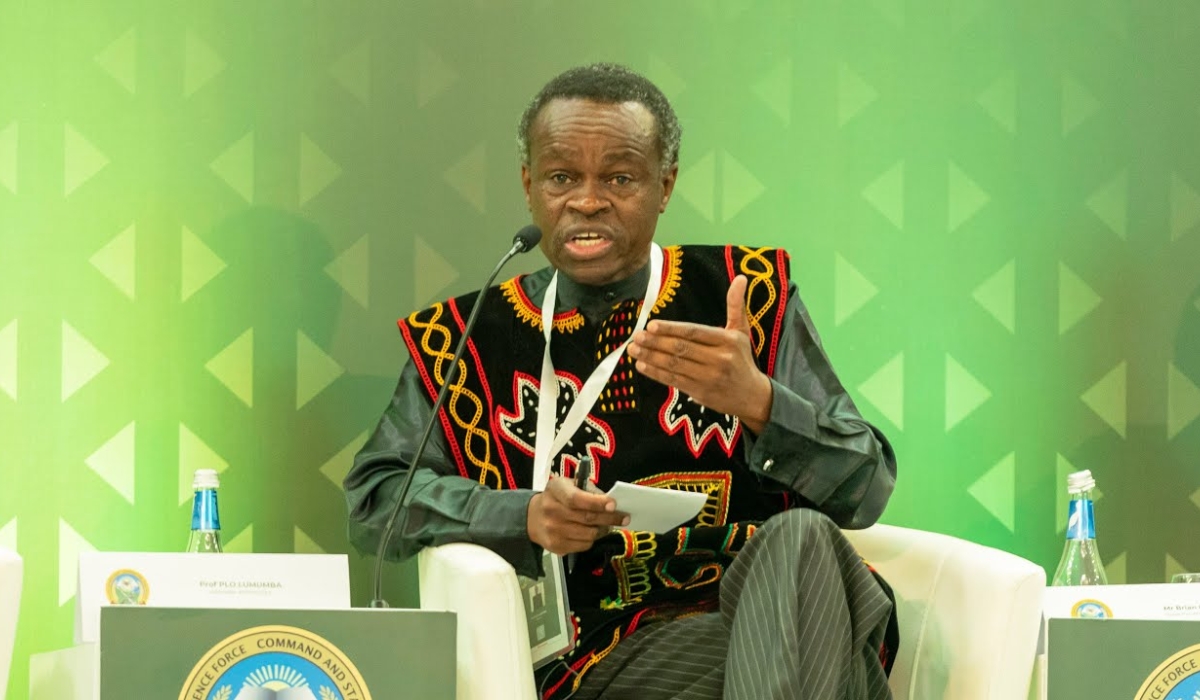
Human rights activist and Kenyan Pan-Africanist Patrick Lumumba (PLO) has called for justice for the notorious perpetrators of the 2004 Gatumba massacre, who still walk free and unpunished 21 years later, warning that impunity encourages the recurrence of atrocities.
Under the subject “Honoring the Victims, Seeking Justice, and Combatting Genocide Denial Targeting Tutsi in DR Congo,” he spoke at the 21st remembrance of the atrocity on Wednesday, August 13.
At a refugee camp in Gatumba, Burundi, on August 13, 2004, armed attackers murdered 166 Banyamulenge Tutsi people and wounded 108 more, primarily women and children. This incident is known as the Gatumba massacre.
The victims sought refuge under UN protection after fleeing political persecution and violence in South Kivu, Democratic Republic of the Congo.
When the attackers arrived at the camp, they killed some with machetes, shot others at close range, and burned others alive in their shelters.
The tragedy of the Gatumba slaughter is that, like the Tutsi Genocide in Rwanda in 1994, it took place right under the nose of the United Nations. Lumumba stated, “We never learned, and the tragedy is that the offenders are known and still alive.” Additionally, they employ the most archaic techniques for killing and maiming. Additionally, they disembowel, rape, burn, and suffocate.
Justice has been elusive despite the massacre’s ethnic origins and international acknowledgment. Lumumba bemoaned the lack of concrete attempts by the international community and the Congolese government to hold the offenders accountable.
He emphasized that Gatumba was a part of a long history of targeted violence against the Banyamulenge Tutsi, not a singular episode.
Lumumba stated, “History has shown that when we allow impunity, the same thing will be repeated.” We are here to remind the world that the story of Gatumba, like all other massacres, cannot be finished until and unless those responsible are held accountable. This is why we are gathered here, not only to remember our departed loved ones and those who survived but are psychologically or otherwise damaged.
He pushed Africans to face the hypocrisy of continuing to discriminate based on tribal lines—a colonial legacy intended to divide and rule—while promoting unity under regional and continental blocs like the African Union (AU) and the East African Community (EAC).
We are aware of what transpired in 1959 and the origin of current issues. We are aware that the colonists drew the borders for which we kill and maim arbitrarily in Berlin, Germany, in 1884 and 1885,” Lumumba stated.
It had the effect of dividing family members, and as a result, when our nations recovered their independence based on those borders, the Banyamulenge are now classified as Congolese, but some of their relatives are located in Rwanda and Burundi. Furthermore, some of our current African leaders—or perhaps I should say mis-leaders—have the audacity to claim that the Banyamulenge are not Congolese due to boundaries that have been erected.
According to Lumumba, the unity of Africa must continue to be based on the Ubuntu ideal.
We say that you are because I am when we discuss Ubuntu. The East African Community, which currently consists of eight nations, is located in the region where we dwell. We have stated that our goal is to unite East Africa and eventually the entire African continent.
But the lessons of history have not been applied, he said. Even now, there are still tribal killings, especially against the Banyamulenge. He demanded moral courage from the country’s religious leaders and clear accountability from the DR Congo’s administration.
“President Felix Tshisekedi of the Democratic Republic of the Congo should receive a specific letter reminding him of his solemn constitutional duty to protect all of the country’s citizens,” Lumumba stated. “The letter should also be sent to all of the DR Congo’s clergy, who should demand that the government establish a setting where those who so choose can return to the locations where the umbilical cords were buried.”