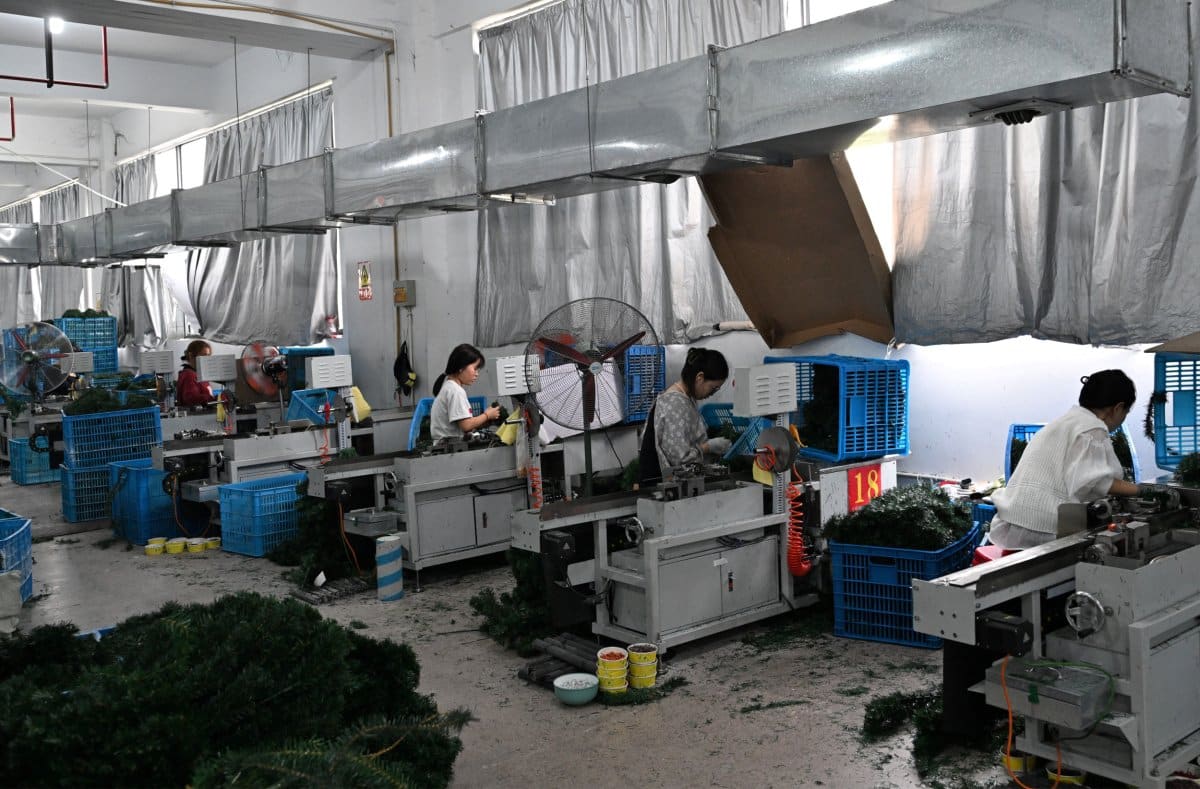
Chinese factory owners cut wages and costs to withstand competition and tariffs
Excerpt: As US tariffs and competition reduce earnings, Chinese firms cut wages and hours, forcing workers into temporary labor and unpaid leave.
As they contend with US tariffs, industrial overcapacity, and intense competition for dwindling markets, Chinese factory owners are reducing pay, shortening shifts, and increasingly using unpaid leave.
In order to remain competitive with other Chinese companies, Mike Chai, owner of Cartia Global Manufacturing, a manufacturer of kitchen cabinets in the southern city of Foshan, wants to reduce wage costs by roughly 30%. Due to high tariffs, many of these competitors have ceased selling to the US and are instead focusing on his loyal Australian clients.
Since the pandemic, Chai has already cut his employment in half, to 100 employees, and he claims there is no more space for reduction. Rather, he is asking employees to take unpaid vacation and cutting shifts, which he claims has become a lifeline.
“Our focus is on survival,” the 53-year-old stated. “Our business hardly makes a profit. You don’t want our factory to fail, I told them. Since you have ten to fifteen years of experience here, let’s work together.
Even as US President Donald Trump raised tariffs on Chinese imports by 30 percentage points this year, China’s official unemployment rate has remained at about 5%. In order to keep tariffs from rising back to the triple-digit levels seen in April, Washington and Beijing decided on Monday to prolong a tariff truce for an additional ninety days.
However, underemployment, which is not included in official statistics, is getting worse, according to analysts. They claim that overcapacity and increased taxes are reducing incomes, eroding confidence, and decreasing consumer purchasing. Consumer confidence is close to all-time lows, retail sales have stalled, and inflation was zero in July.
“This model of intense competition means that you have to cut prices, which means you have to cut costs, which means you have to cut wages.” Alicia Garcia-Herrero, chief Asia-Pacific economist at Natixis, described it as a spiral. “The model is insane. I apologize, but do not export if you must do so at a loss.
Since “they will not become unemployed, but they will receive unpaid leave of absence or work fewer hours,” she continued, statistics would not show Chinese workers as “the main losers” in the trade war.
Due to price cuts by competitors, Chai has already lost two significant clients in Australia. At this point, his factory is only operating at half capacity.
He claimed that everyone who had left America had arrived in Australia. “My customers are getting a lot of new supplies.”
In July, Chinese exports to the US decreased 21.7% year over year, but they increased 9.2% to the EU, 16.6% to the ASEAN, and 14.8% to Australia.
Chai intends to reduce pricing by roughly 10% in order to compete, which means he will have to reduce overtime from 28 days per month to roughly 10. Prior to overtime, workers’ income, which currently averages 5,000 yuan (£540) per month, was more than a third of their total compensation.
Temporary contracts are becoming increasingly important to other factory owners. Dave Fong, a co-owner of three firms in southern China that make industrial machinery, climbing equipment, and school bags, claimed to have laid off 30 full-time employees at one plant before temporarily rehiring part of them to manage unforeseen demands.
“In order to avoid having to pay for insurance or pensions, we prefer temporary contracts,” Fong stated. “Either by the day or the hour. The business will come to a standstill if we don’t accomplish it. Because of the decline in consumer power, the market is weak. Trade, particularly with the United States, is another aspect.
Although temporary labor has historically been prevalent among China’s over 300 million rural migrants, recruiters report that the number is declining. According to agent Chen Chuyan in Wuhan, hourly wages have decreased from 16 yuan to 14 yuan in the previous year.
“The factories don’t have that much demand, but there’s a long line of people waiting for job interviews every day,” she said.
According to Alan Zhang, a 30-year-old garment worker in Datang village, Guangzhou, he made 400 yuan per day in 2021 but now finds it difficult to find employment that pays even half of that.
“I won’t accept it if it’s only a few hundred yuan,” he added, looking at handwritten advertisements held by recruiters who were relaxing on scooters. “I have no idea what took place. All of a sudden, finding anything became extremely difficult. Prices fell quickly.
Zhang is concerned about earning the 10,000 yuan required annually for his son’s kindergarten expenses, even though he only worked 14 days in July. Their son lives with grandparents in the province of Fujian, and his wife works in garment factories as well.
“The broader economy would experience deflationary pressure if manufacturing wages were being squeezed,” stated Richard Yarrow, a fellow at the Mossavar-Rahmani Center for Business and Government at Harvard Kennedy School. “This is undoubtedly becoming a bigger problem for some of the lower-skilled manufacturing sectors in China, like furniture, textiles, and basic electronics.”
Dozens of job searchers perused bulletin boards advertising electronics industry positions at 17–28 yuan per hour in Shenzhen’s Longhua employment market.
By early afternoon, 26-year-old Mo, who has a degree in digital marketing but is unable to find employment in the industry, had already gone to two interviews but was turned down for both.
He stated, “They’ll say 23 yuan, but actually give you 20,” keeping his last name private. “After that, they will deduct management fees, housing, cleaning, and any other expenses they can.”
Having taken a bus from Yunnan province, Huang, 46, has been observing the market for five days in a row. He used to oversee real estate projects, but he is now divorced and makes do with 10 yuan dinners and 25 yuan a night for a bed in a dorm.
He dragged a little suitcase and remarked, “I had one interview this morning, but they asked for an upfront placement fee of 80 yuan.” I therefore chose not to go. Instead, I purchased some food.