A Kenyan protester attempts to prevent the opening of a new Ritz-Carlton safari lodge
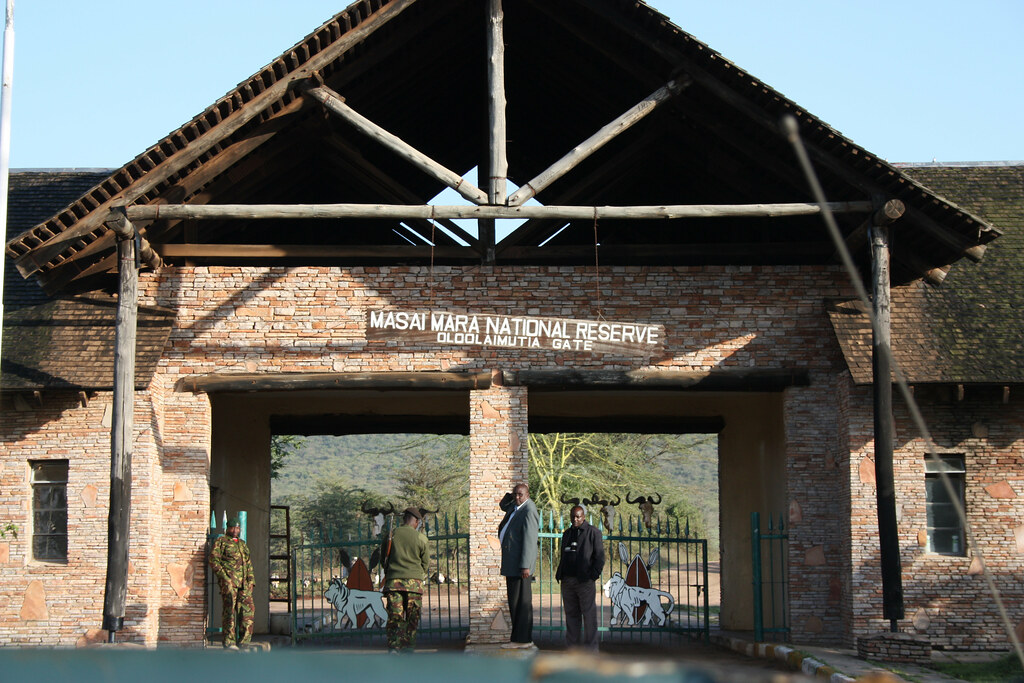
Tented suites with private decks overlooking a river that migratory wildebeest traverse will cost $3,500 per person per night when the Ritz-Carlton opens its first safari resort in Kenya’s Maasai Mara reserve on Friday.
However, academics and the director of a Maasai conservation institute argue that the real cost of those breathtaking vistas would be considerably higher because it will harm one of the most famous ecosystems in the world.
The Ritz-Carlton, its owner Marriott (MAR.O), opens new tab, the project’s local developer Lazizi Mara Limited, and Kenyan authorities were sued in a Kenyan court on Tuesday by Meitamei Olol Dapash of the Institute for Maasai Education, Research and Conservation (MERC) in an attempt to stop the planned opening.
In the case, Dapash claims that the 20-suite camp, which has a personal butler service and plunge pools, blocks a vital migration route between Tanzania’s Serengeti and the Maasai Mara. Migration, according to researchers, helps wildebeest find food and preserve genetic variety among herds.
Additionally, according to the lawsuit, there is no proof that an environmental impact assessment was carried out. Dapash’s attorneys requested that the Narok Environment and Land Court postpone the lodge’s inauguration and give the case first attention.
In a statement, Marriott, which signed a franchise deal with Lazizi, claimed it was dedicated to environmental responsibility and that Lazizi had received the required permits.
According to Shivan Patel, managing director of Lazizi, an environmental impact assessment carried out by Kenyan officials determined that the location was not a wildlife crossing place.
Reuters reached out to the National Environment Management Authority and the Narok County administration, both of which are listed as respondents in the complaint, but they did not reply.
Luxury tourists and Maasai herders, who claim that the industry’s growth is damaging their habitats and ways of life, are at odds over the latest conflict in East Africa’s grasslands.
Local populations in Kenya have voiced their displeasure over what they claim are affluent investors’ land grabs. Deadly altercations with police have resulted from protests in Tanzania against the displacement of tens of thousands of Maasai to make room for hunting lodges.
The Ritz-Carlton’s construction is the most recent in a string of profitable tourism projects that government authorities have approved at the expense of local animals and people, according to Dapash, who established MERC in 1997 as a grassroots network of Maasai leaders.
“Without the county government regulating the tourist behaviours, the tourist activities, we saw the habitat, the environment degraded so badly,” he stated to Reuters.
While acknowledging that excessive tourism has negatively impacted the Maasai Mara’s natural ecology, county officials claim that concentrating on “high-value tourism” can help address this issue by increasing revenue while lowering environmental costs.
PATH OF MIGRATION
Marriott claimed to have a “front-row seat” to the yearly Great Migration of millions of gazelles, zebras, and wildebeest when it unveiled the new Ritz-Carlton in February.
The lodge is located beside the Sand River, which flows back and forth across the Kenya-Tanzania border and is a vital supply of water for animals like elephants and birds.
Reuters reporters were denied access to the hotel by hotel staff.
The lodge is located on a wildebeest crossing location that residents are familiar with, according to Dapash, a PhD candidate in sustainable education at Prescott College in the United States and a multiple unsuccessful candidate for parliament.
The new development will further harm the reserve’s biodiversity, according to Joseph Ogutu, a Kenyan researcher at the University of Hohenheim in Germany who has researched wildlife migration in the Maasai Mara. According to figures from the Kenyan government, the populations of many species in the reserve have decreased by more than 80% since the 1970s.
“It is highly ill-advised to build a lodge on one of the most critical paths of the Great Migration,” he stated.
According to University of Glasgow ecologist Grant Hopcraft, the experiment would “probably have large and long-term ecological implications for the migration.” Ogutu and Hopcraft are not involved in the litigation.
According to Patel of Lazizi, the county authorities suggested the location to him. Additionally, he asked why Dapash had only recently begun to voice concerns about the proposal.
“The project has been ongoing for a year,” he acknowledged to Reuters. “We pushed it so hard to … avoid any disruption, damage to the environment.”
Dapash claimed that because the project is located far from the main population center, he only found out about it in May.
The case challenges the existence of a mandatory environmental impact assessment.
The National Environment Management Authority is required by Kenyan law to publish an overview of the assessment in the official gazette along with information on where it may be inspected.
There was no such announcement in the official gazette that Reuters could locate. Patel directed Reuters to NEMA and stated that he was unable to disclose the evaluation due to confidentiality concerns. Requests for comment from NEMA were not answered.
Additionally, according to the lawsuit, the project went against a Maasai Mara management plan that the Narok County administration established in February 2023, which stipulates that “no new tourism accommodation developments” are allowed before 2032.
Patel denied this, claiming that the project was constructed on a “existing” location that had been in use for a long time. How it had been used was not disclosed by him. Requests for comment from Narok County were not answered.
The public demanded answers, Dapash added.
“The preservation of wildlife migration for us is a treasure that we cannot afford to lose,” he stated. “We need to see that due diligence was done.”