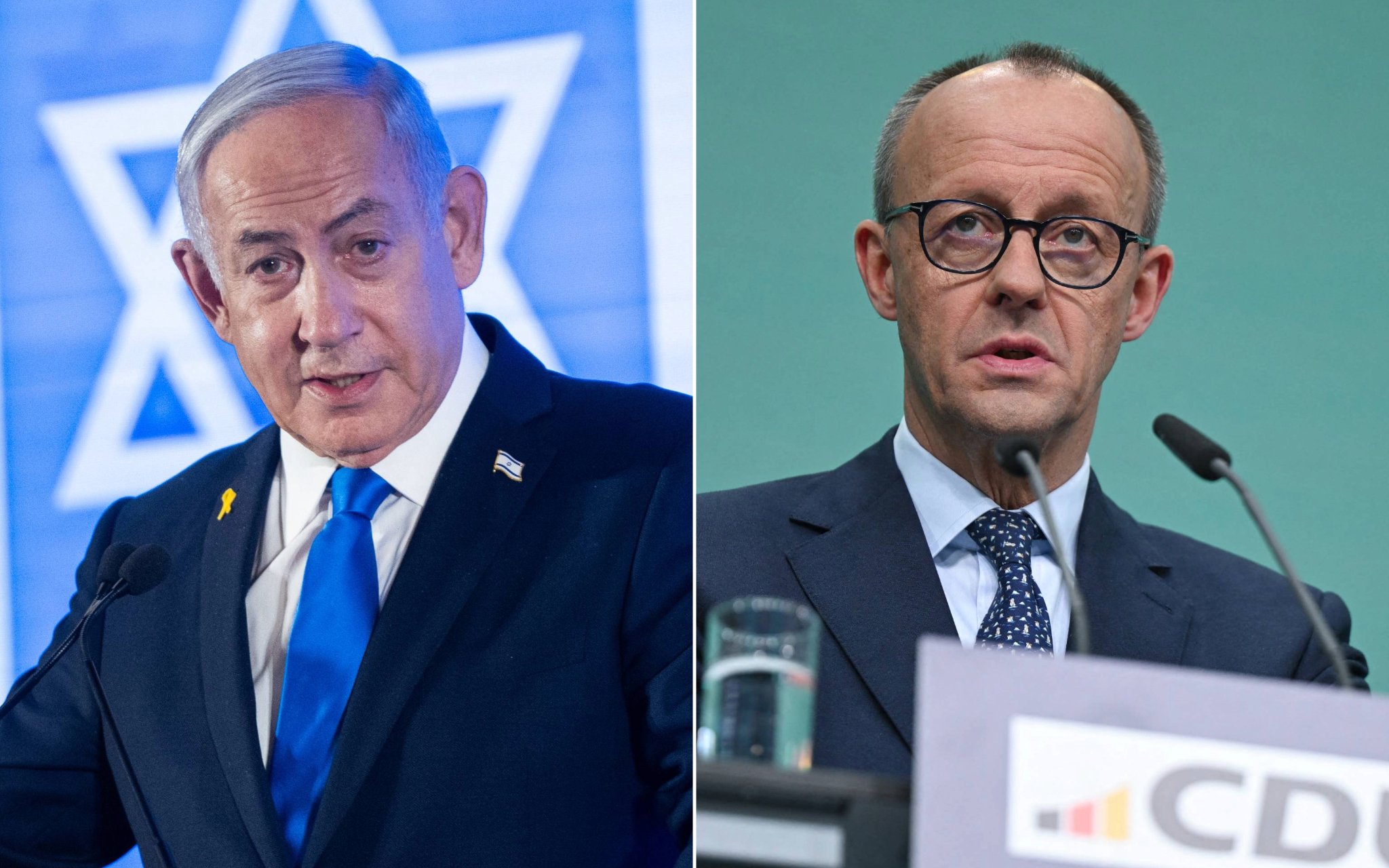
Reluctant Germany begins to reduce backing for Israel as Gaza confronts famine
Growing public outcry over Israel’s ambitions to increase military control over the enclave and the deteriorating humanitarian situation in Gaza have forced Germany to reduce weaponry supplies to Israel, a historically sensitive move for Berlin.
Previously a strong pro-Israel leader, Conservative Chancellor Friedrich Merz made the declaration on Friday, claiming that Israel’s activities would not accomplish its declared war objectives of returning Israeli hostages home or killing Hamas fighters.
It’s a daring move for a leader who, following his victory in February elections, declared he would invite Israeli Prime Minister Benjamin Netanyahu to Germany despite the International Criminal Court’s arrest warrant against him.
The change is indicative of how Germany’s come-what-may support for Israel, which stems from its historical guilt over the Nazi Holocaust, is being put to the ultimate test as decades of policy are being undermined by the high number of Palestinian civilian deaths in Gaza, the extensive war damage, and pictures of starving children.
It is noteworthy since it is the German government’s first tangible action. “I would consider it a ‘warning shot’ instead of a U-turn,” Muriel Asseburg, a researcher at the German Institute for International and Security Affairs, stated.
In response to Israel’s intensifying military campaign in the small, heavily populated Palestinian enclave, the German government has been tense for months, but it has refrained from taking the more drastic measures that some members of Merz’s ruling coalition and other European nations had demanded.
Only weapons that could be used in Gaza would be impacted by the suspension of arms supplies to Israel.
In Germany, where the majority of the 2.2 million people are homeless and Gaza is a sea of wreckage, the public has become increasingly critical of Israel and demands that its government assist in alleviating a humanitarian crisis. This action reflects a hardening sentiment in the country.
66% of Germans want their government to exert more pressure on Israel to alter its behavior, according to an ARD-DeutschlandTREND survey that was made public on Thursday, the day before Merz’s announcement.
According to a Forsa poll conducted in April 2024, 57% of Germans felt that their government should condemn Israel more harshly than it had in the past for its actions in Gaza.
According to this week’s ARD-DeutschlandTREND, 47% of Germans believe their government is not doing enough for Palestinians in Gaza, despite Germany’s assistance in airdropping aid there, while 39% disagree.
Perhaps most remarkably, 62% of Germans do not believe that they have a greater responsibility for Israel because of their history, despite 31% believing that they do. This is a fundamental principle of German foreign policy.
Germany’s political establishment has pointed to its “Staatsraison” approach, which was presented to the Israeli parliament in 2008 by then-Chancellor Angela Merkel, as a specific duty for Israel following the Nazi Holocaust.
Merz’s Foreign Minister Johann Wadephul echoed that position when he told the publication Die Zeit that Berlin could not be a “neutral mediator” only days before his most recent trip to Israel in July.
We are partisan, that’s why. He echoed other conservative leaders in Merz’s party when he remarked, “We stand with Israel.”
However, the Social Democrats (SPD), Merz’s junior coalition partner, had previously made it obvious that they wanted to consider imposing sanctions on Israel.
According to SPD foreign policy spokesperson Adis Ahmetovic, halting the flow of arms is just the beginning.
“More must follow, such as a full or partial suspension of the (European Union) Association Agreement or the medical evacuation of seriously injured children, in particular,” Ahmetovic told the magazine Stern. “Furthermore, sanctions against Israeli ministers must no longer be taboo.”
Division of Media
Germany’s media environment has likewise reflected the country’s widening rift.
Der Spiegel magazine denounced what it claimed was the German government’s collusion and accused Israel of breaking international humanitarian law in two significant editorials that were released in late July. “A Crime” was the headline on the front cover, which included an image of Gazan women holding out empty bowls.
Axel Springer, Germany’s largest media group, owns the mass-market daily Bild, which criticized the lack of outrage toward Islamist Hamas, whose cross-border attack on Israeli communities sparked the war, citing what it viewed as escalating anti-Israel sentiment and biased rallies.
Bild writer Filipp Piatov, whose X account Merz follows, accused the chancellor on Friday of doing precisely what he had criticized others for: “that Germany is cutting off support to its ally in the middle of a war.”
Israel believes Hamas, which killed almost 1,200 people in its October 7, 2023 attack and returned 251 hostages to Gaza, could end the conflict by surrendering. Israel denies maintaining a strategy of famine in Gaza.
Gaza’s health ministry reports that more than 60,000 Palestinians have been killed in Israel’s air and ground battle in Gaza.
The Western community’s capacity to exert significant pressure for a halt to the fighting and limitations on humanitarian aid to the Israeli-besieged enclave has been weakened by Germany’s excessively cautious posture, according to critics.
Up until now, Germany had even been wary of imposing even a minor consequence, like endorsing the partial suspension of Israel’s access to the EU’s main research funding program.
According to commentators, Germany’s strong commercial ties with Israel and the US are among the other factors contributing to its reluctance to criticize Israel beyond its Nazi past.
In addition to being Israel’s second-largest exporter of munitions behind the United States, Germany also purchases munitions from Israel as part of a significant military modernization effort following Russia’s 2022 invasion of Ukraine. The Arrow-3 missile interception system is one example of that.
The German Air Force’s A400M aircraft will be outfitted with directed infrared defense systems thanks to a $260 million agreement signed last week by Israeli defense company Elbit Systems and Airbus.
“German arrogance should be avoided,” Volker Beck, the head of the German-Israeli Society and a former member of parliament, told Reuters.
“If Israel were to retaliate by restricting arms deliveries to Germany, the future of German air security would look grim.”