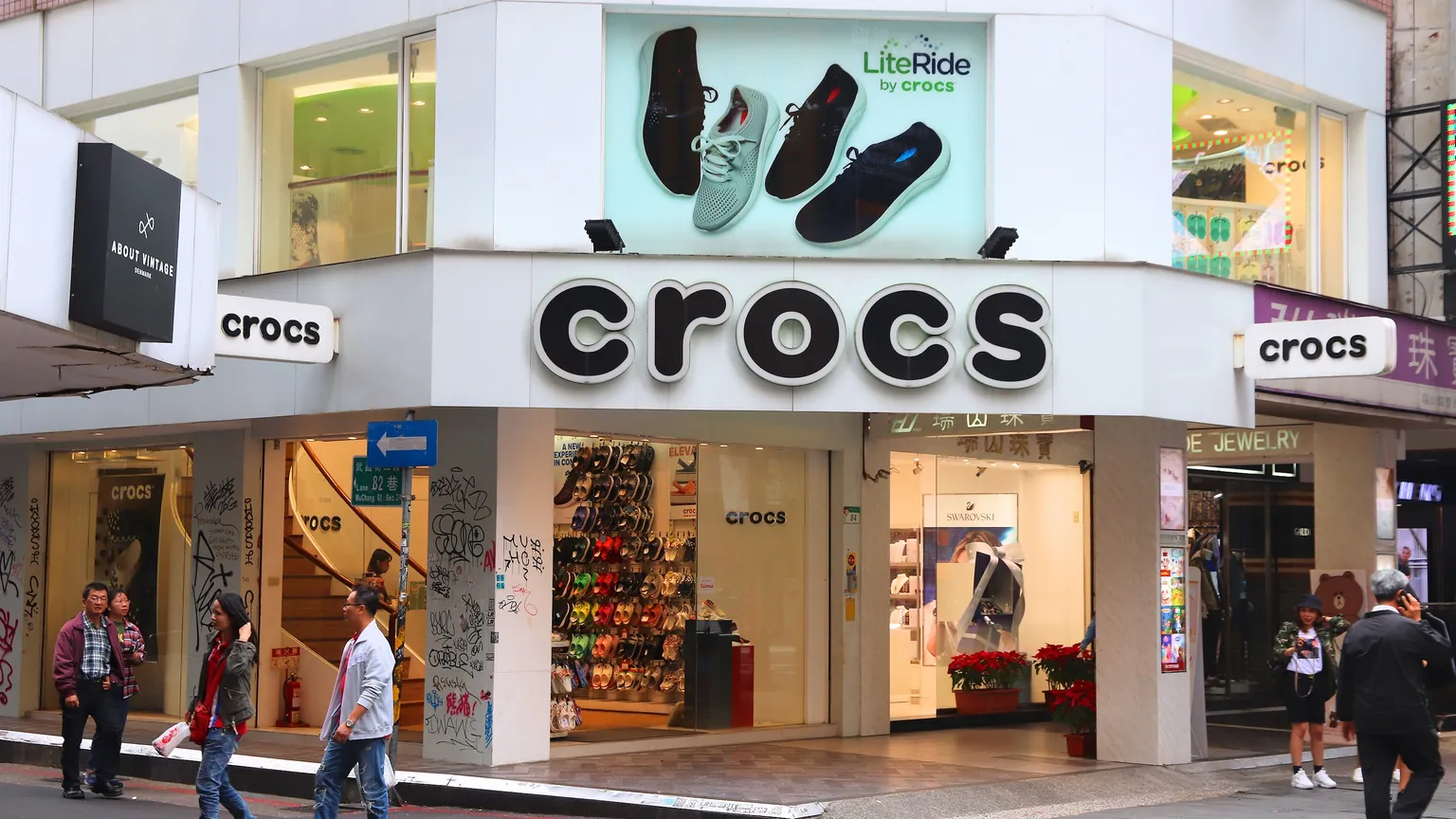
Crocs’ stock drops 30% due to declining US sales, economic pressures, and a shift in consumer preferences toward athletic footwear
Shares of Crocs fall 30% as US sales decline, buyers switch to trainers, and concerns about tariffs increase.
After Crocs Inc. announced a sharp decline in U.S. sales and issued a warning about a difficult second half of the year, the company’s share price fell 30%, reaching a three-year low of $73. A mix of changing consumer behavior, economic challenges, and growing apprehension over US tariffs were cited by the rubber clog manufacturer as the reasons for the fall.
In the run-up to the 2026 FIFA World Cup and the 2028 Summer Olympics in Los Angeles, the brand, which gained popularity as a stay-at-home essential during the COVID-19 pandemic, is now dealing with a dramatic shift in customer preferences toward sports footwear.
According to Crocs CEO Andrew Rees, “a distinct athletic trend is emerging ahead of the 2028 Los Angeles Olympics and the football World Cup in the US, Mexico, and Canada next year.” “Consumers in North America are following that trend.”
Although Crocs’ global revenue increased 3.4% to $1.1 billion in the three months ended June 30, the company’s overall performance suffered as its US sales fell 6.5% between April and June. In sharp contrast to its $296 million profit during the same period previous year, the corporation reported a pre-tax loss of almost $448.6 million.
According to Rees, the high cost of living and the uncertainty around the possible reinstatement of tariffs under former President Donald Trump’s policies have caused US consumers to be “extremely cautious.”
“We see traffic down, and they’re not even going to the stores, let alone making purchases,” he said. “The most anxious, sensitive to price increases, and sometimes unable to leave the house is our low-end customer.”
He added that although Crocs caters to a “particularly broad consumer base,” other brands are currently beating it “because they are focused exclusively on a high-end consumer.”
Trade policy worries are also having a significant impact on consumer sentiment. Potential tariffs imposed under Trump could disproportionately affect Crocs’ price-sensitive customer base, Rees cautioned.
“These people aren’t purchasing new Crocs because they’re concerned about the impact President Donald Trump’s pervasive tariffs on U.S. imports will have on their personal finances,” he said.
The company anticipates a blow of about $40 million for the rest of 2025 as a result of the tariff threat, according to Susan Healy, Crocs’ chief financial officer. Rees was reasonably optimistic about longer-term fixes, though.
“I believe that the effects of tariffs can be lessened in the medium run. Cost reductions in our supply chain will provide that,” he stated.
Crocs acknowledged that it will continue to reduce its discounts as part of its strategy, although it cautioned that this could further slow sales in the near future.
In China, where many international shops are having trouble, Crocs is performing better despite the slowdown in North America.
“Crocs is defying the trend of weak consumer purchasing in China,” Rees stated.
A strong internet marketing effort spearheaded by prominent Chinese influencers and celebrities was acknowledged by him with the success. “A set of social-first digital marketing strategies utilizing important Chinese celebrities have been the driving force behind that brand heat,” he stated.
Liu Yuxin, Tan Jianci, and Bai Lu are three prominent Chinese influencers that Crocs works with. More recently, the brand partnered with designer Simone Rocha. Actress Michelle Yeoh is a notable wearer of the glittery Crocs brand that is part of the cooperation and has created a lot of excitement in the Chinese market.
Despite its global expansion, Crocs issued a warning about a “concerning” second half of 2025 as it continues to deal with global economic challenges and frugal customer purchasing. The corporation has seen its biggest one-day stock decline in almost 15 years, according to the most recent financial figures.
In 2021, Crocs paid approximately $2.5 billion to acquire the casual footwear brand HEYDUDE, which it now owns. There was no breakdown of HEYDUDE’s performance in the most recent earnings report.
While acknowledging that the road ahead might not be easy, Crocs says it is nevertheless dedicated to enduring the upheaval and respecting its wide fan base.
“The environment is challenging,” Rees said, “but our priorities are preserving brand relevance, controlling cost effectiveness, and remaining in touch with our customers around the world.”