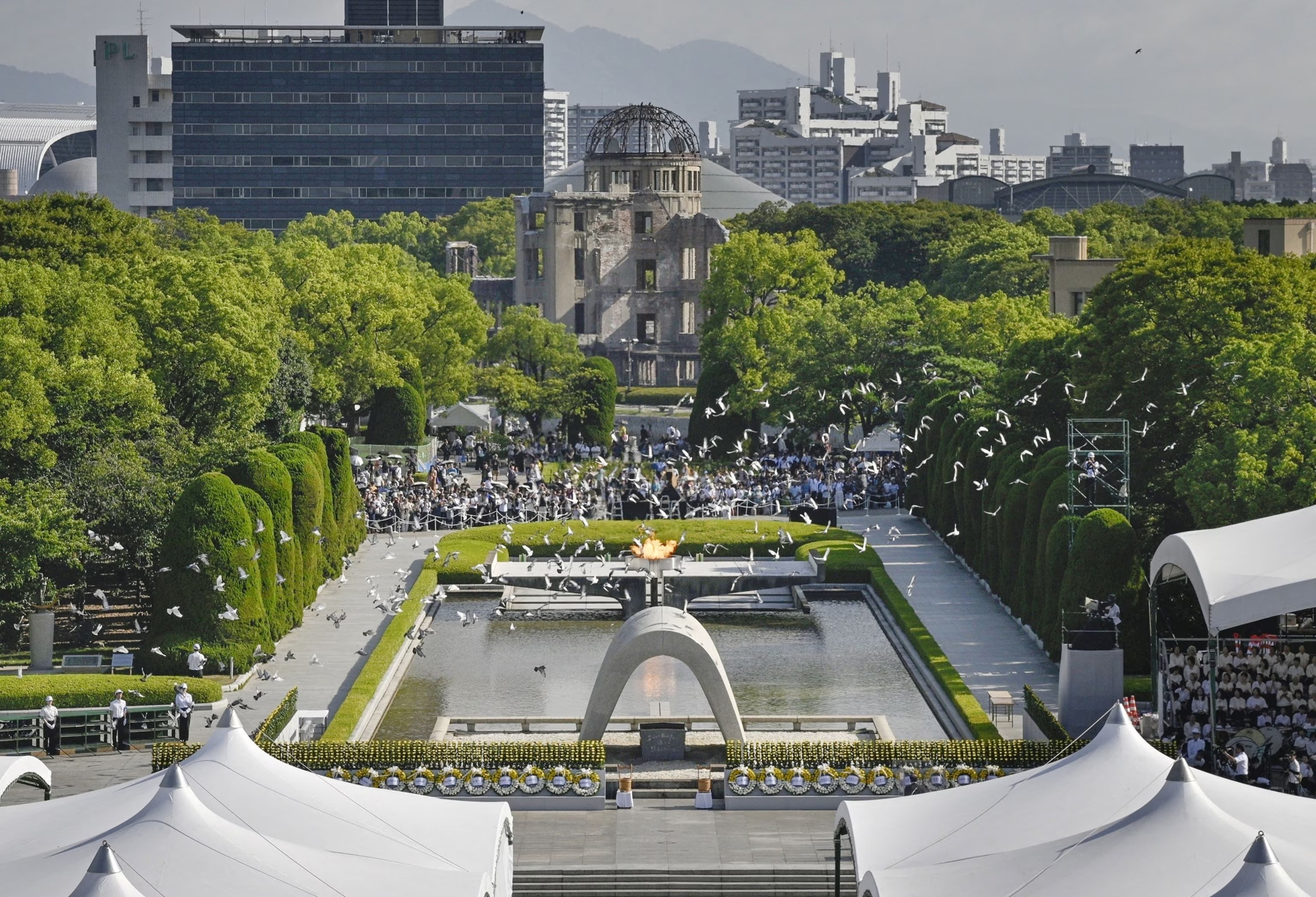
Japan says a quiet prayer for the people who died in Hiroshima while leaders and survivors warn of growing nuclear threats 80 years later.
On Wednesday, Japan held a somber moment of silence to remember the atomic bombing of Hiroshima, which happened 80 years ago and was one of the most important and terrible events in world history. It killed over 200,000 people and changed the course of war forever.
Around the city, bells tolled at 8:15 a.m., which was exactly the time the US dropped the atomic bomb on August 6, 1945. Prime Minister Shigeru Ishiba, foreign leaders, survivors, and regular people gathered at the Peace Memorial Park to remember the people who died.
The mayor of the city, Kazumi Matsui, used the event to send a strong message about the direction the world is going in. He pointed out a “accelerating trend toward military build-up” and the growing view that nuclear weapons are necessary for national defense.
In his speech, Matsui said, “This is a clear disregard for the lessons the international community should have learned from the tragedies of history.”
At a time when global tensions are high, the event takes place. Nuclear threats and the development of new weapons are once again at the center of international politics, as seen in Russia’s war in Ukraine and rising military postures in East Asia.
When the bomb went off over Hiroshima, Shingo Naito was only six years old. He talked about the terrible things he saw that day.
The blast hurt my dad badly and made him lose his sight. Naito said, “His skin was hanging off of him, and he couldn’t even hold my hand.”
Even though he is 86 years old now, he still tells his story to younger people. He works with Hiroshima students to turn his memories into works of art that spread the message of peace.
Another victim, Satoshi Tanaka, who has fought multiple cancers caused by radiation, said that recent pictures of war in Gaza and Ukraine have made old wounds worse.
He said, “Seeing the destroyed cities and the scared children and women running away makes me remember what I went through.”
“Nuclear weapons are close by and could wipe out all of humanity many times over.”
Tanaka asked people around the world to do something: “The most important thing right now is to put pressure on the leaders of nuclear-armed countries.” “People need to be even more angry, speak out louder, and do a lot of things.”
During his speech, Mayor Matsui also said that the Nuclear Non-Proliferation Treaty (NPT), which has been a key part of keeping nuclear weapons from getting into the wrong hands, was “on the brink of dysfunctionality.” He told Tokyo that it should sign the Treaty on the Prohibition of Nuclear Weapons (TPNW), which is an international deal to get rid of all nuclear weapons.
More than 70 countries have signed the pact, which became law in 2021. But all six nuclear powers—the US, Russia, China, the UK, and France—have refused to sign, saying that nuclear defense is still important for their own safety.
As the only country to have been hit by atomic bombs, Japan has also refused to approve the treaty, saying that it needs the US’s nuclear umbrella to protect it. The problem is still controversial in the United States, where people are torn between memories of Hiroshima and fears about new threats.
Small but loud protests were held near the park before the event. The protesters wanted the end of nuclear weapons and a change in government policy.
The Nobel Peace Prize was given to Nihon Hidankyo, a Japanese group of people who lived through the atomic bomb, last year for its decades-long work to get rid of nuclear weapons and keep the stories of those who were affected alive.
As the anniversary of Hiroshima approaches, the call for ending all nuclear weapons gets stronger.
Naito, a survivor, said, “We know what we’re fighting for, but it gets harder every year because everyone is tired.” That’s just the truth.
Japan gave up and World War II ended after the atomic bombs were dropped on Hiroshima and Nagasaki a few days later. Even though it’s been eight decades, the world is still afraid of nuclear bombs.