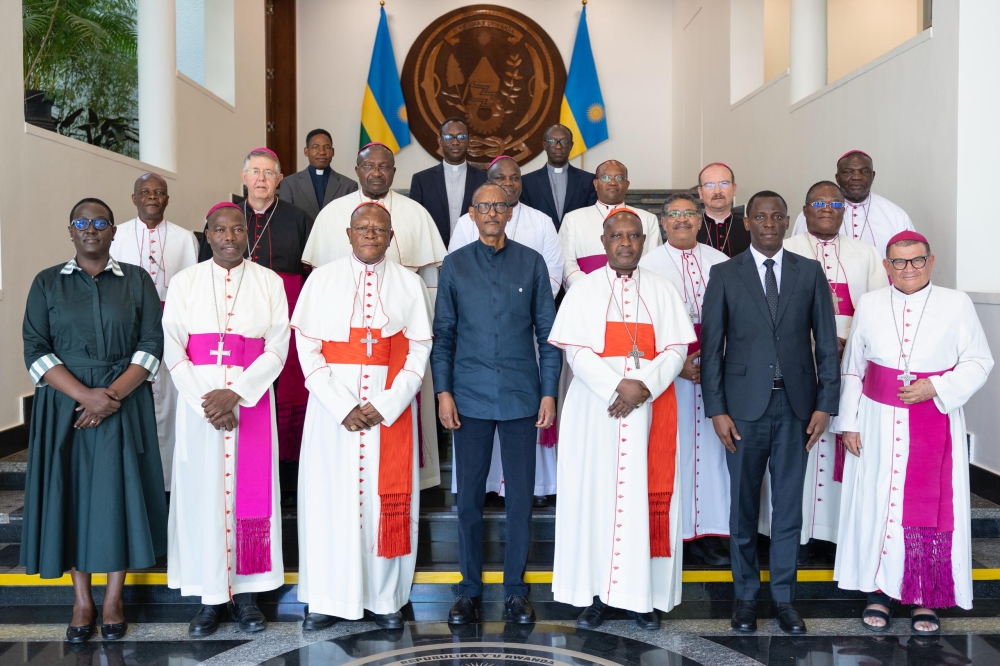
African Catholic clerics attending the Symposium of Episcopal Conferences of Africa and Madagascar (SECAM) in Rwanda were urged by President Paul Kagame on Saturday, August 2, to use their duties to uplift humanity by learning from Rwanda’s history, which reflects both its best and worst aspects.
The 20th Plenary Assembly of SECAM is taking place in Kigali from July 30 to August 4, bringing together more than 250 Catholic leaders from over Africa.
Cardinals, bishops, priests, religious sisters, lay leaders, and representatives of the youth gather for the three-year gathering to discuss the Church’s mission on the continent. The theme of this year’s plenary is “Christ, source of hope, reconciliation, and peace.”
Kagame addressed the clergy who had come to see him at his office on Saturday, saying:
“Rwanda is a reminder that those in positions of authority, both in the state and the church, must harness the best of humanity, as it embodies both the worst and the best of humanity.”
“Good people don’t accept being kept captive by failure, even when it has happened before. In Rwanda as well as throughout our continent, we must take lessons from the past, cooperate, and lay the foundation for peace, hope, and reconciliation,” he continued.
In the 1994 Genocide against the Tutsi, the church was heavily involved. While some clergy members actively took part in the murder, others chose to remain silent or even hinder attempts to safeguard Tutsi civilians.
“This humble recognition of the failings of that period, which unfortunately disfigured the face of the Church, may contribute to a purification of memory, and renewed trust,” Pope Francis remarked in March 2017, acknowledging the Catholic Church’s role in the Genocide.
Additional SECAM information
The Secretary General of SECAM, Rev. Fr. Rafael Simbine Junior, stated in an interview with The New Times last month that the organization’s goal for this year’s meeting is to achieve peace and reconciliation, two pressing issues facing Africa today.
“Africa is a family, but a conflicted one. “The sense of community is being destroyed by wars and divisions,” he remarked.
“As a Church, we need to consider how we might promote peace. He went on to say that Christ came to bring us inner peace, not the kind that the world provides.
He pointed out that after delaying a prior chance because of preparation concerns, Rwanda was chosen to host the assembly. Portuguese, French, and English-speaking nations alternate hosting the plenary.
According to Simbine, representatives from each of Africa’s 37 episcopal conferences will be present, with the size of the delegations differing depending on the conference. For instance, a bishop president, a bishop delegate, and a priest acting as secretary general are sent to a big conference that includes up to 250 dioceses.
Political responsibility, interfaith engagement, climate change, and how the church may support Catholics in culturally challenging situations, such as polygamous relationships, are among the topics of discussion during SECAM.