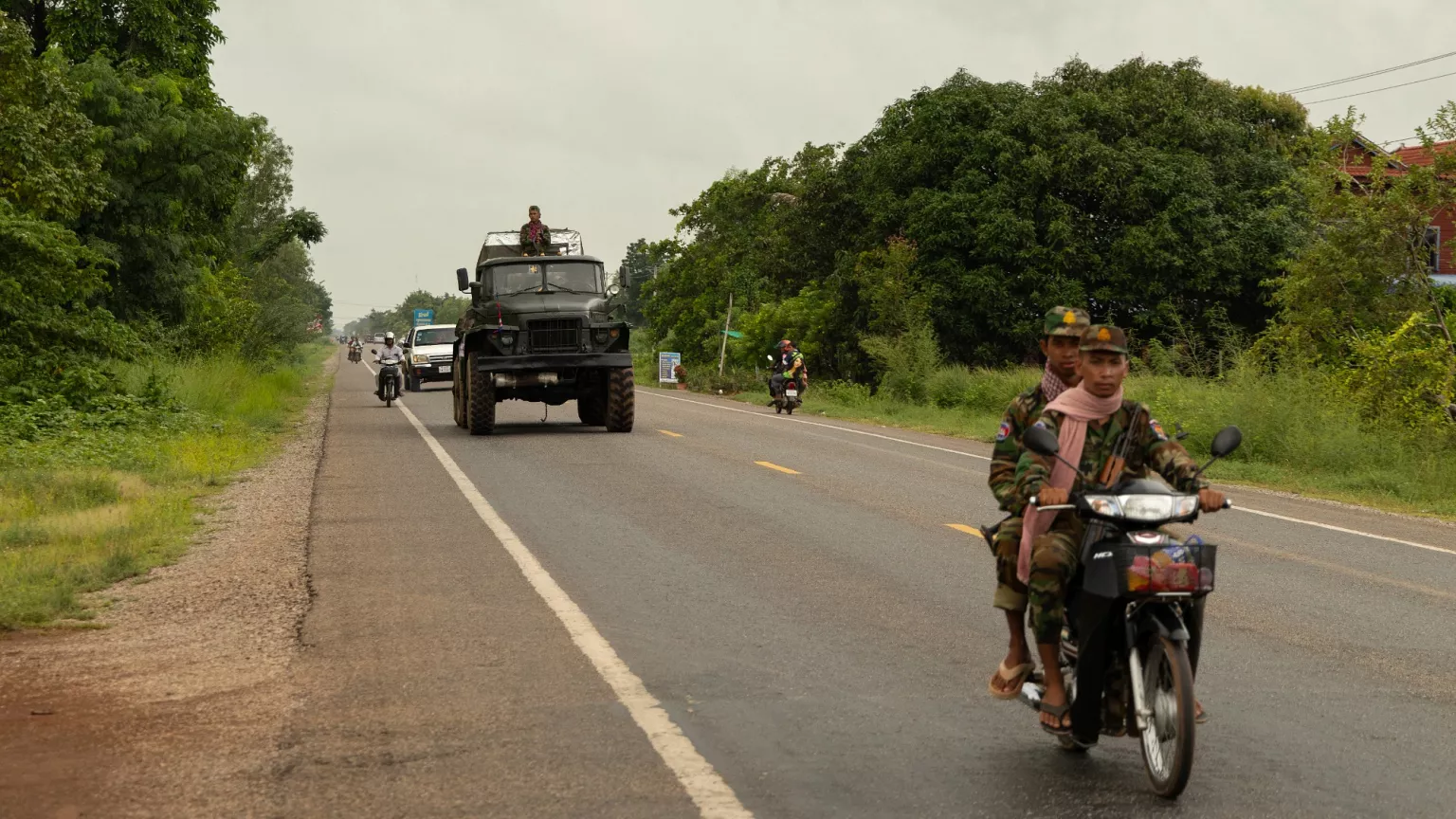
Cambodia calls for an unconditional truce with Thailand as violent border clashes intensify, displacing nearly 200,000 people and heightening fears of war.
Cambodia has urged for an immediate and unconditional ceasefire as escalating border clashes with Thailand have resulted in at least 32 fatalities and displaced nearly 200,000 individuals across both nations.
Cambodia’s ambassador to the United Nations, Chhea Keo, stated that Phnom Penh is advocating for a peaceful resolution.
“We requested a truce without conditions,” he stated, highlighting Cambodia’s dedication to “a peaceful resolution of the conflict.”
Thailand has yet to publicly address the ceasefire proposal and has declined third-party mediation. The Thai government has previously announced martial law in eight border districts.
The conflict erupted on Thursday, as both nations leveled accusations against one another regarding the initiation of violence. Thai officials report that 19 individuals have lost their lives, comprising 13 civilians and six soldiers, while nearly 140,000 people have been evacuated from the impacted regions.
Cambodia’s defence ministry reported 13 fatalities, comprising eight civilians and five soldiers, and indicated that over 35,000 individuals have evacuated their residences.
Thailand’s acting Prime Minister, Phumtham Wechayachai, expressed concern on Friday that the ongoing clashes could escalate into war, highlighting the use of heavy weaponry and combat occurring at 12 border sites.
“This is no longer a confined conflict. “It’s evolving into something far more perilous,” he cautioned.
The Thai military has accused Cambodia of initiating new attacks in the southern coastal region, which were subsequently repelled by the navy.
Previous clashes were noted in the provinces of Surin, Ubon Ratchathani, and Srisaket.
Bangkok also accused Cambodia of shelling civilian areas and stated that it had evacuated all villages within the range of Cambodian rockets. Cambodia accused Thailand of employing cluster munitions, a weapon prohibited in many parts of the world because of its indiscriminate impact on civilians. Thailand has yet to address the allegation.
The foreign minister of Thailand informed Reuters that the government perceives “no need” for external intervention, even in light of increasing international apprehension.
Malaysian Prime Minister Anwar Ibrahim, in his role as chair of the Association of South East Asian Nations (ASEAN), proposed to mediate the crisis. The United States urged for an immediate halt to hostilities, the safeguarding of civilians, and a peaceful resolution to the conflict.
The precise cause of the violence is a matter of dispute. Thai officials assert that Cambodian drones conducted surveillance on Thai military forces, leading to a reaction. Cambodia asserts that Thai forces breached a prior agreement by moving forward on a historic Khmer-Hindu temple close to the border.
Tensions between the two nations have periodically escalated due to a long-standing border dispute that dates back over a century, stemming from post-colonial demarcations following France’s occupation of Cambodia.
The recent crisis intensified significantly in May following the death of a Cambodian soldier during a border confrontation, resulting in bilateral relations reaching their lowest level in over ten years.