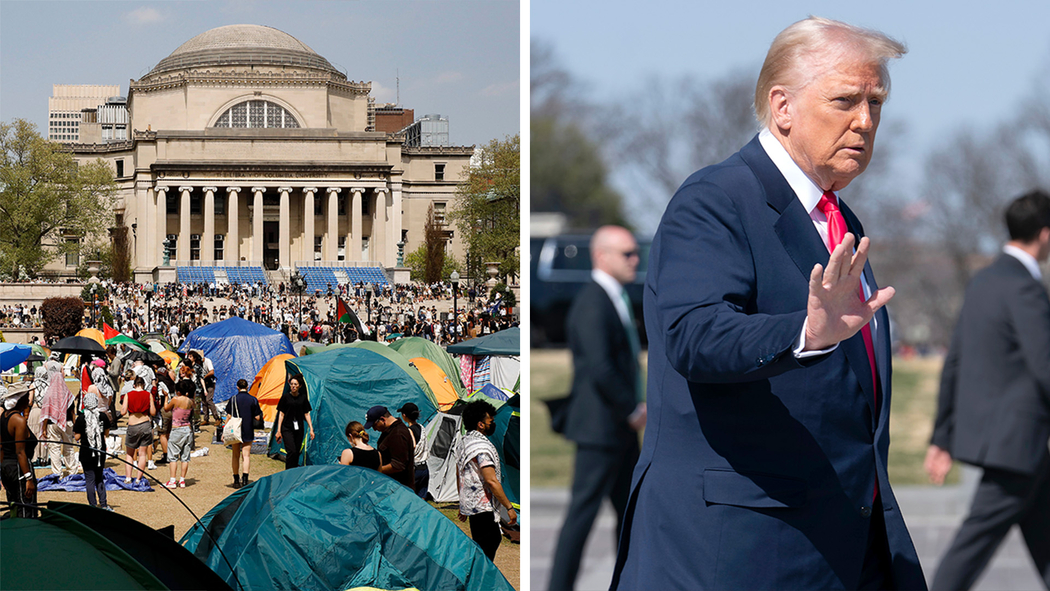
Columbia University agreed to reforms and a $200 million payout to reclaim blocked money as part of a settlement with the Trump administration over antisemitism allegations.
In order to address claims that it did not adequately safeguard Jewish students during campus demonstrations against the Israel-Gaza conflict, Columbia University has agreed to pay $200 million to the Trump administration.
A portion of the $400 million in federal grants that had been suspended earlier this year will be reinstated as part of the three-year settlement, which the institution and the federal government jointly announced.
As part of a larger crackdown on colleges accused of permitting antisemitism, endorsing diversity and inclusion principles, and allowing protests against Israel’s war actions, the administration of President Donald Trump initially targeted the Ivy League university.
“Columbia has also committed to ending their ridiculous DEI policies, admitting students based ONLY on MERIT, and protecting the Civil Liberties of their students on campus,” Trump wrote in a post on Truth Social, confirming the agreement.
The accord was referred to as “a seismic shift in our nation’s fight” to hold elite universities responsible by Education Secretary Linda McMahon. She went on to say, “I think they will have an impact on the higher education industry and alter campus culture for years to come.”
Columbia has already begun implementing a number of the improvements included in the accord.
These include reorganizing its department of Middle Eastern studies, stepping up police presence on campus, prohibiting face masks during rallies, mandating student IDs during demonstrations, and penalizing students participating in protest camps in Gaza. Additionally, an impartial observer will be assigned to supervise the terms’ implementation.
The settlement was seen as “an important step forward after a period of sustained federal scrutiny and institutional uncertainty” by Claire Shipman, the acting president of Columbia. The arrangement “protects the values that define us and allows our essential research partnership with the federal government to get back on track,” she added, emphasizing that the university had not acknowledged any wrongdoing.
Some faculty and student organizations have sharply criticized Columbia’s compliance, arguing that the modifications amount to a compromise of academic freedom and independence. Harvard University, on the other hand, has filed a lawsuit against the administration after experiencing comparable federal funding cuts, resulting in a well-publicized legal dispute between the government and the wealthiest university in the country.
The Trump administration seems to be taking a cue from Columbia’s deal, as more than 600 US institutions are evaluating more than $8 billion in federal awards. Trump issued a warning, saying, “There are a lot of other higher education institutions that have hurt so many coming up.”
The Columbia settlement formalizes a change in the way US colleges deal with federal pressure in the face of heightened political scrutiny, particularly in relation to questions of identity, free expression, and international conflict.