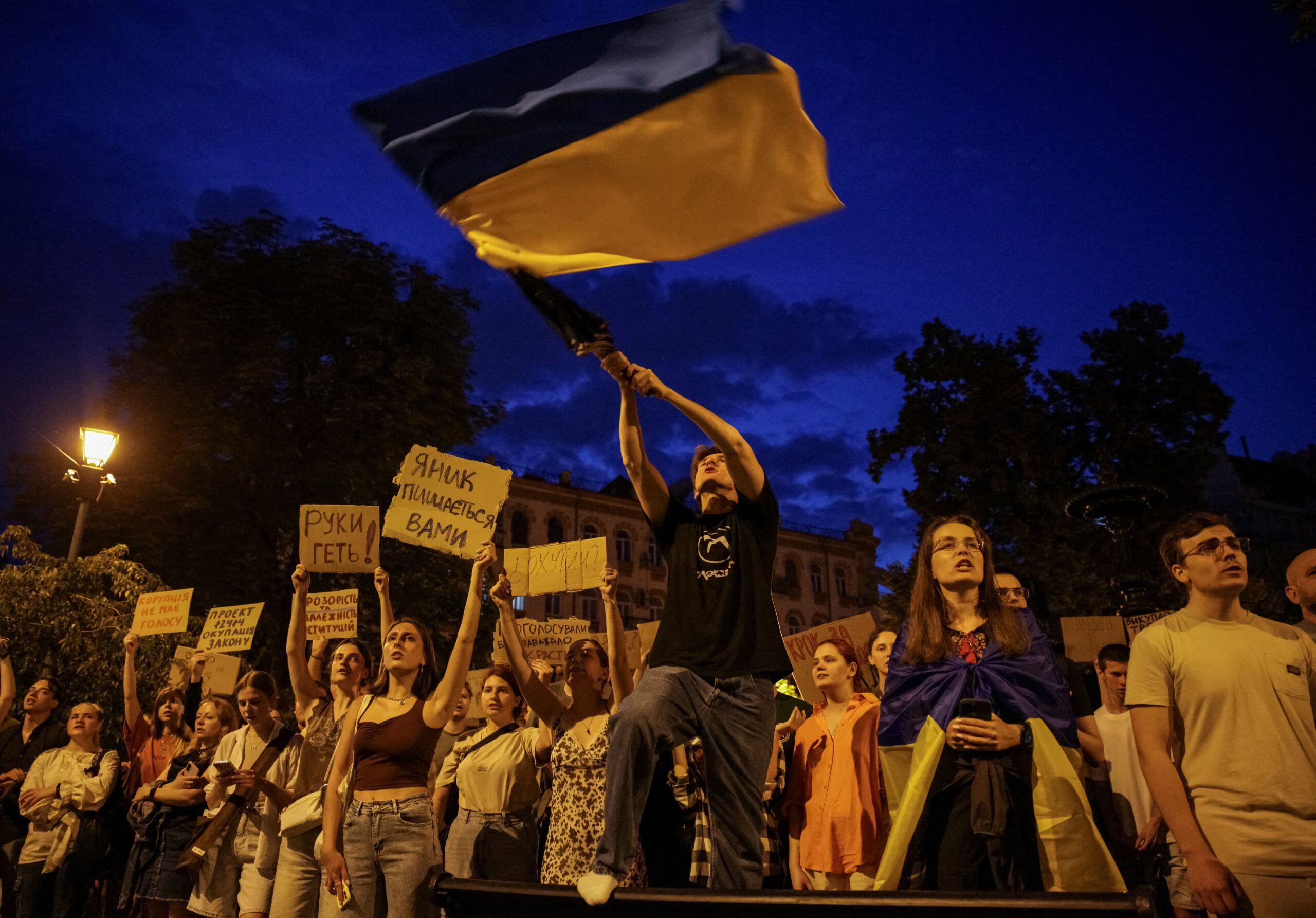
Zelensky’s new anti-corruption law has led to large-scale protests, and critics say it will lead to more dictatorship and weaker institutions.
A controversial bill was signed into law by Ukrainian President Volodymyr Zelensky. Its opponents say it weakens the independence of the country’s anti-corruption agencies, which has led to protests in major towns and criticism from Western allies.
The new law gives the National Anti-Corruption Bureau (Nabu) and the Specialized Anti-Corruption Prosecutor’s Office (Sapo) to Ruslan Kravchenko, a supporter of Zelensky for prosecutor general. Kravchenko can now reassign corruption cases or even stop them.
Zelensky explained the move in his speech on Wednesday, saying that Nabu and Sapo would still work, but they needed to be cleaned of “Russian influence.”
“There is no logical reason why criminal cases worth billions of dollars have been “hanging” for years,” he said, adding that the prosecutor general would make sure that those who did wrong would “inevitably be punished.”
However, the move has scared many people inside and outside of Ukraine. The day after the bill was signed into law, there was the biggest protest against the government in Kyiv since Russia’s full-scale invasion in 2022.
Protests also happened in Lviv, Dnipro, and Odesa. People held signs that said “We chose Europe, not autocracy” and “My father did not die for this.”
Some people say that the law goes against the changes that were made to fight corruption and support democracy after the Euromaidan protests in 2014 and the removal of pro-Russian president Viktor Yanukovych.
Concerns have also been raised by Western allies who helped Ukraine set up its own independent anti-corruption system. The EU has made fighting corruption a key part of Ukraine’s membership bid and warned that the new law could get in the way of the country’s unity.
“Taking away important protections for Nabu’s independence is a big step back,” said Marta Kos, the European Commissioner for Enlargement.
EU spokesman Guillaume Mercier added, “The EU gives Ukraine a lot of money, but only if they make progress in areas like transparency, judicial reform, and democratic governance.”
Ukraine’s Deputy Prime Minister for European and Euro-Atlantic Integration, Taras Kachka, told EU officials that “all core functions remain intact” and that there will be no changes to the fight against corruption.
Dmytro Kuleba, who used to be Ukraine’s foreign minister, said the decision was “a bad day for Ukraine” and that the president had to decide “whether to stand on the side of the people or not.”
Even though there are worries, Western countries like the G7 have not yet threatened to cut off help. Their representatives have asked to talk to Ukraine’s leaders about what will happen to Nabu and Sapo. However, since Ukraine is still at war with Russia, any change in support is unlikely.
The law was passed just a few days after raids at Nabu were carried out by the Security Service of Ukraine and the prosecutor general’s office to look for Russian agents. Critics, on the other hand, see the timing as yet another attempt to use politics to control institutions that were meant to work on their own.
As Ukraine continues its path to joining the EU, the government is under more and more pressure to reassure its citizens and foreign partners that it will keep its promise to be open and honest.