Chinese Authorities Support Taiwan’s Opposition Before a Vital Recall Vote
Chinese leaders and state media have unexpectedly backed a recall vote for Taiwan’s opposition MPs.
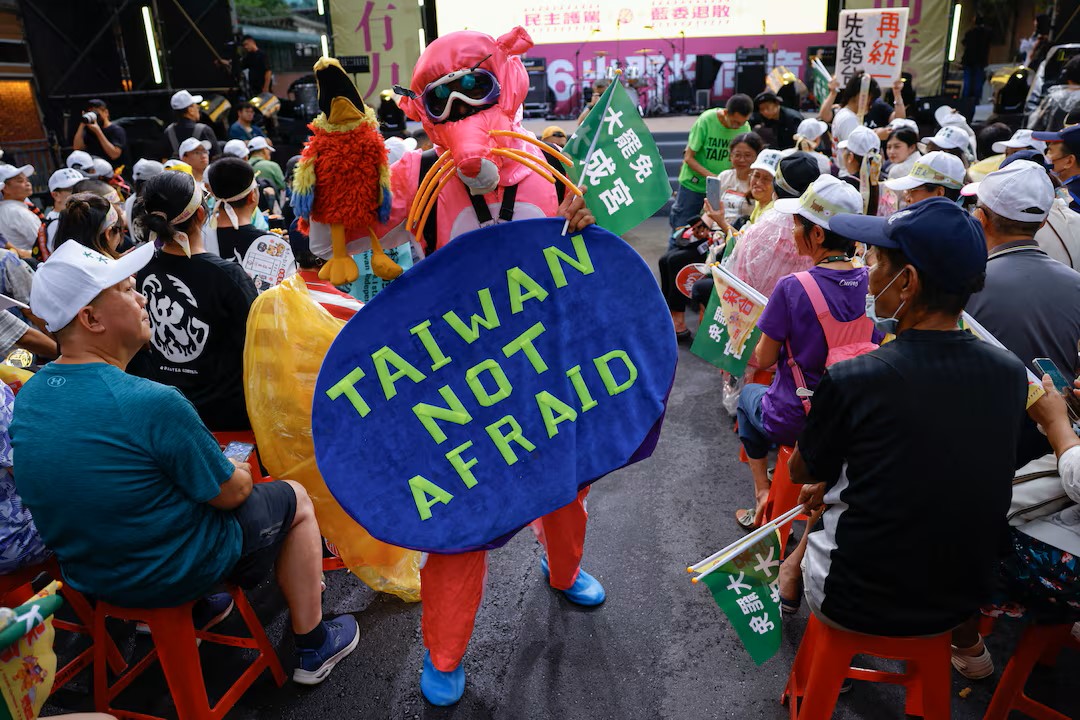
This weekend’s major recall vote in Taiwan might change the composition of its parliament as opposition MPs face pressure from both inside the island and unexpected support from Chinese officials and state media, further raising tensions in an already unstable political environment.
Although he won last year, President Lai Ching-te’s Democratic Progressive Party (DPP) lost its majority in the legislature. Since then, the opposition has taken use of this position to enact legislation that the government opposes and impose budget cuts, making attempts to raise defense spending more difficult.
The political drama is taking place as China, which Taiwan’s government adamantly rejects, applies increasing military and diplomatic pressure in an attempt to assert territorial claims. Despite his repeated offers of negotiations with Beijing, President Lai has been turned down.
Officially, civic organizations began the recall movement earlier this year. The Kuomintang (KMT), Taiwan’s largest opposition party, has 24 legislators who make up around one-fifth of the legislature. On Saturday, voters will decide their fate.
The proponents of the recall label their movement as “anti-communist,” claiming that the KMT has sold out Taiwan by sending MPs to China, preventing defense expenditure, and fracturing parliament. The DPP’s party color, “green terror,” and Lai’s “dictatorship” are criticized by the KMT, which refutes these accusations.
The KMT is agitated by China’s engagement and is afraid of being “painted red” by political rivals. In June, two top Chinese officials in charge of Taiwan policy denounced the recalls as a “political scheme” that Lai had planned.
In a June news briefing, Zhu Fenglian, a spokesman for China’s Taiwan Affairs Office, said that Lai is “engaging in dictatorship under the guise of democracy” and “using every means possible to suppress the opposition.”
Leader of the recall effort, Taiwanese tycoon Robert Tsao, praised the remarks, telling reporters Monday, “It shows they [the KMT] are together with the Communist Party.” We benefit from it.
The KMT stresses that it is not pro-Beijing and maintains that it has neither asked for nor wants Chinese help, nor can it control Beijing’s views.
This is our business, and we share the same sentiments as the rest of Taiwan. The DPP and the KMT are the two parties engaged in a battle for public acceptance and support. “It has nothing to do with the mainland,” KMT spokesperson Crystal Yang stated.
Taiwan research group IORG, which keeps an eye on Chinese official media, estimates that during the first half of 2025, 425 pieces or videos were released by Chinese state media and related social media accounts, characterizing the recall effort as “dictatorship” or “green terror.”
The People’s Daily, the official commentary of the Chinese Communist Party, charged Lai in an April commentary with “presumptuously abusing the recall system to crack down on the opposition party, attempting to establish a ‘green dictatorship.'”
In highlighting the similarities between Beijing and the KMT’s arguments, Wu Szu-yao, secretary-general of the DPP’s legislative caucus, stated that Beijing is “offering ammunition” to the KMT in an attempt to influence voters, adding that “China is really concerned that the mass recall will be successful and win the support of Taiwan’s public.”
In response to inquiries, the Taiwan Affairs Office declined to comment.
In light of Beijing’s refusal to engage in talks with Lai, whom it labels a “separatist,” the KMT argues that discussions with China are essential to advancing Taiwan’s interests, especially the growth of agricultural exports.
Regarding allegations of pro-Beijing inclinations, Tony Lin, chair of the KMT’s Culture and Communication Committee, denounced the criticism as unjust. We have always emphasized our support for communication.
The KMT anticipates that the recall vote will also be a public show of discontent with Lai, whom they blame for escalating tensions with China and for being incompetent.
“As a former deputy secretary general of the KMT, Huang Kwei-bo, a professor of diplomacy at Taipei’s National Chengchi University, said the DPP uses its vast propaganda network to instill fear [about China] in Taiwan society.”