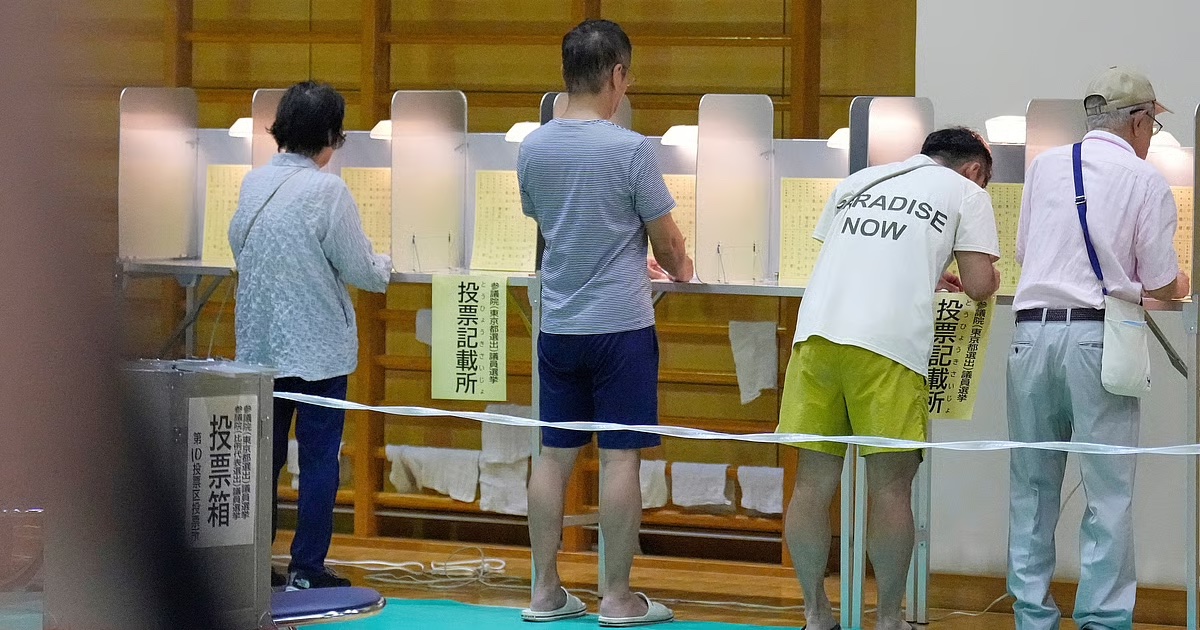
Voters in Japan are casting ballots in an election that might put Prime Minister Ishiba under more strain and terminate coalition rule.
Prime Minister Shigeru Ishiba’s hold on power may be seriously weakened by the outcome of Sunday’s keenly anticipated upper house election in Japan, where voters’ main worries are immigration and inflation.
Opinion surveys indicate that the ruling Liberal Democratic Party (LDP) and Komeito, its junior coalition partner, could lose the 50 seats required to maintain their majority in the upper house, which has 248 seats, half of which are up for election.
It is anticipated that smaller opposition parties would gain ground, especially those that ran on platforms of tax reduction and higher public spending. The right-wing Sanseito is one of them; it has opposed recent efforts for gender equality and taken a strong stance against immigration and foreign business.
“There are no Japanese people near me, even though I’m a graduate student. According to Yu Nagai, a 25-year-old student who supported Sanseito, “all of them are foreigners.”
He continued by saying, “I feel that Japanese people are a little disrespected when I look at the way compensation and money are spent on foreigners.”
At 8 p.m. local time (1100 GMT), voting will end, and media outlets’ predictions based on exit surveys are anticipated soon after.
The ruling coalition’s bad performance, according to analysts, may cause financial markets to tremble, scuttle important trade talks with the United States, and make Ishiba politically vulnerable. Japan has until August 1st to complete a trade agreement with Washington, failing which it will be subject to tariffs in its biggest export market.
If a deal cannot be reached, there may be economic consequences, especially because inflation is still putting pressure on people. Despite its stance on budgetary prudence, the government is under more pressure to provide relief now that rice prices have already doubled since last year.
Concerns about bond market volatility and budgetary restraint have been used by the LDP to oppose requests for broad tax cuts and increased welfare expenditure.
“Ishiba may have to decide whether to make room for a new LDP leader or rush to win over some opposition parties with policy concessions,” Rintaro Nishimura, an associate at the Asia Group in Japan, stated.
It will be difficult because every possible partner has negotiating power, and each scenario calls for the LDP and Komeito to make certain compromises.
Sunday’s vote comes after the LDP lost its majority in the more powerful chamber of parliament in last October’s lower house elections, its worst showing in 15 years. Ishiba was exposed to possible no-confidence votes as a result of that outcome, which could trigger a sudden general election and caused financial instability.
Numerous voters voiced their dissatisfaction with the government’s performance.
The opposition Constitutional Democratic Party of Japan was supported by novelist Kaoru Kawai, 59, who said that the LDP had been in power without addressing any issues.
Although the LDP has long ruled Japan and has escaped the political divisions observed in other developed countries, this election may herald a new era of volatility in the fourth-largest economy in the world.