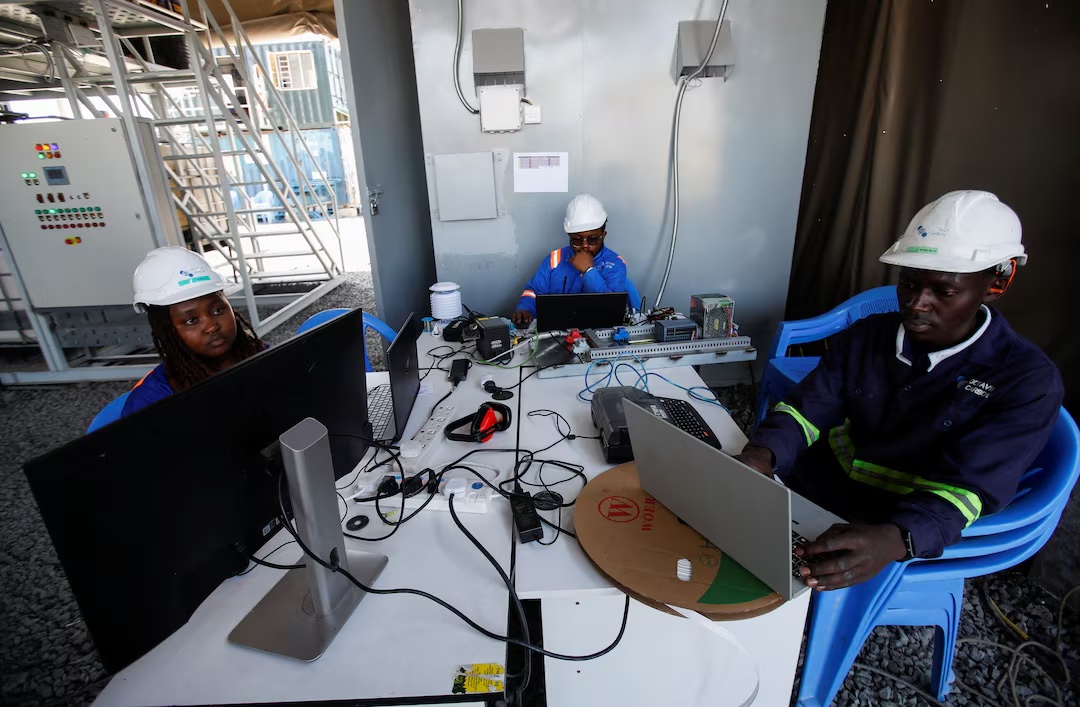
In an effort to curb global warming, technicians keep an eye on four enormous metallic tanks in the central Kenyan scrublands. The tanks use steam heated by the Earth’s crust to extract carbon dioxide from the atmosphere.
Kenya produces over half of its energy from geothermal plants, which provide a lot of surplus heat and inexpensive energy. The country is situated atop the Great Rift Valley, a geological scar that stretches around 7,000 kilometers (4,300 miles) down Eastern Africa.
According to Hannah Wanjau, an engineer at Octavia Carbon, which created and constructed the devices, this puts it in a good position to lead the way in the application of Direct Air Carbon Capture.
Sucking air through a chemical filter that is saturated with the greenhouse gas and then heated in a vacuum to liberate the CO2 that may be bottled or stored underground is the energy-intensive DACC process.
The government’s emphasis on and investment in universal education has also resulted in an abundance of scientists and engineers, which aids the most developed economy in East Africa.
DAUNTING WORK
According to Wanjau, Octavia uses Kenya’s surplus geothermal steam to run its equipment economically, and basalt rock formations allow for the safe long-term storage of carbon dioxide.
“We’ve already seen the effects of climate change, so we want something that’s going to work very fast, and remove huge amounts of CO2,” she stated.
About 1,000 trees’ worth of CO2 is captured annually by each of Octavia’s prototype machines. This amount of CO2 can be exchanged for carbon credits that governments and corporations can use to offset their damaging emissions.
But the task’s magnitude is intimidating.
The significant carbon reductions that would accomplish the objective set by world leaders at the 2015 Paris climate agreement have not been met by action to far. The first to surpass 1.5 C of warming occurred last year.
“Critics would be right to point out that what we currently do is a drop in the ocean,” stated Martin Freimüller, co-founder of Octavia Carbon, who intends to put a 1,000-ton-per-year factory into operation by the following year.
“But the point is that scaling from 1,000 tons (of carbon dioxide) to a billion tons, still starts with 1,000 tons.”
“GREENWASHING”
According to Greenpeace and other environmental advocacy organizations, oil and gas companies exploit the carbon capture sector as a kind of “greenwashing” to defend delaying the switch from fossil fuels to sustainable energy sources.
While lowering the use of fossil fuels is still a major objective, the United Nations Intergovernmental Panel on Climate Change states that carbon capture will be required to lower residual emissions from hard-to-decarbonize sectors, such as the manufacture of steel and cement.
Kenya may be the second nation in the world, after Iceland, to inject air-captured CO2 underground early next year thanks to an agreement Octavia reached with Cella Mineral Storage, a start-up registered in New York.
According to Freimüller, Octavia has already contracted for about 40% of the proposed DACC plant’s lifetime capacity, or about $3 million in carbon credits, of which almost half have already been paid for.
He remarked, “The world often thinks about Africa still as a hapless victim of climate change,” alluding to the continent’s growing vulnerability to droughts and floods.
According to him, Octavia Carbon wants to demonstrate to the world that Africa can contribute to the solution.
“Technology made in Kenya and developed in Kenya, for the use of the world.”