The New Kensington Treaty, which includes direct train routes, e-gates, and defense agreements, was signed between the UK and Germany.
In order to strengthen their bilateral relations, the UK and Germany have inked a comprehensive new deal that includes intentions to build a direct rail connection between London and Berlin.
The agreement, known as the Kensington Treaty, also calls for tighter defense cooperation, the implementation of e-gates for frequent travelers, student exchange programs, and coordinated efforts to stop human smuggling.
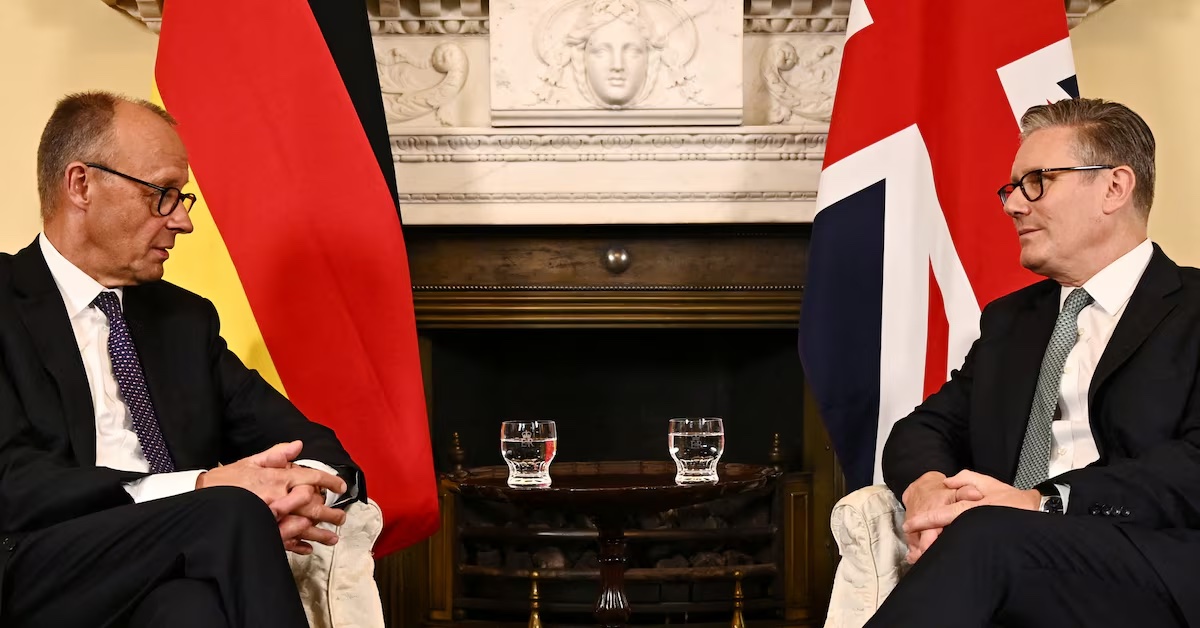
In a ceremony at the Victoria & Albert Museum in Kensington, German Chancellor Friedrich Merz and Prime Minister Sir Keir Starmer signed the pact during Merz’s first official visit to the UK.
The treaty calls for the formation of a joint taskforce comprising transportation specialists from both nations to investigate the implementation of border and security checks for long-distance rail travel between Germany and the United Kingdom.
Within the next ten years, the new train connection might prove to be a competitive alternative to flying, according to Transport Secretary Heidi Alexander.
“We are committed to placing Britain at the center of a better-connected continent and are leading the way in a new era of European rail connectivity,” she stated.
“With a direct connection connecting London and Berlin, rail passengers in the UK may soon be able to visit the Brandenburg Gate, the Berlin Wall, and Checkpoint Charlie directly from the comfort of a train.”
“This historic agreement, which is a component of a new treaty the prime minister [signed] with Chancellor Merz today, has the potential to drastically alter the way millions of people travel between our two nations by providing a quicker, more practical, and far more environmentally friendly option than flying.”
According to Sir Keir, the treaty is “a declaration of intent, a declaration of our ambition to work ever more closely together” and “evidence of the closeness of our relationship as it stands today.”
Downing Street claimed the deal will facilitate German authorities’ efforts to target warehouses where people-smuggling gangs keep small boats for unauthorized Channel crossings, marking a major step in border policing.
By the end of the year, Chancellor Merz also promised to implement laws that would make it illegal to facilitate illegal migration to the UK, something that is presently not the case in Germany for non-EU countries like post-Brexit Britain.
“We greatly appreciate Chancellor Merz’s commitment to amend German law in order to disrupt the supply lines of the dangerous vessels that transport illegal migrants across the Channel,” Starmer added.
Additionally, more than £200 million in commercial investment into the UK was declared in the deal, which is anticipated to create over 600 new employment. To strengthen commercial connections, a new UK-Germany Business Forum has been established.
In terms of defense, the deal opens the door for the cooperative export of military hardware such Boxer armored vehicles and Typhoon jets. According to Downing Street, this will result in billions more in defense exports.
Following a similar pilot agreement with France that was revealed during President Emmanuel Macron’s recent state visit, the German arrangement calls for the UK to return a certain number of small boat arrivals in exchange for an equal number of asylum seekers who already have ties to the UK.
The UK government is still under increasing pressure to regulate border crossings, as over 21,000 people have crossed the Channel so far this year, a 56% increase from the same period in 2024.
The transaction was criticized by Conservative Party Shadow Home Secretary Chris Philp, who said, “This is just more of the same tired, headline-chasing from Keir Starmer.”
“By canceling our returns deterrent, this government has obviously lost control of our borders and exposed the nation.”