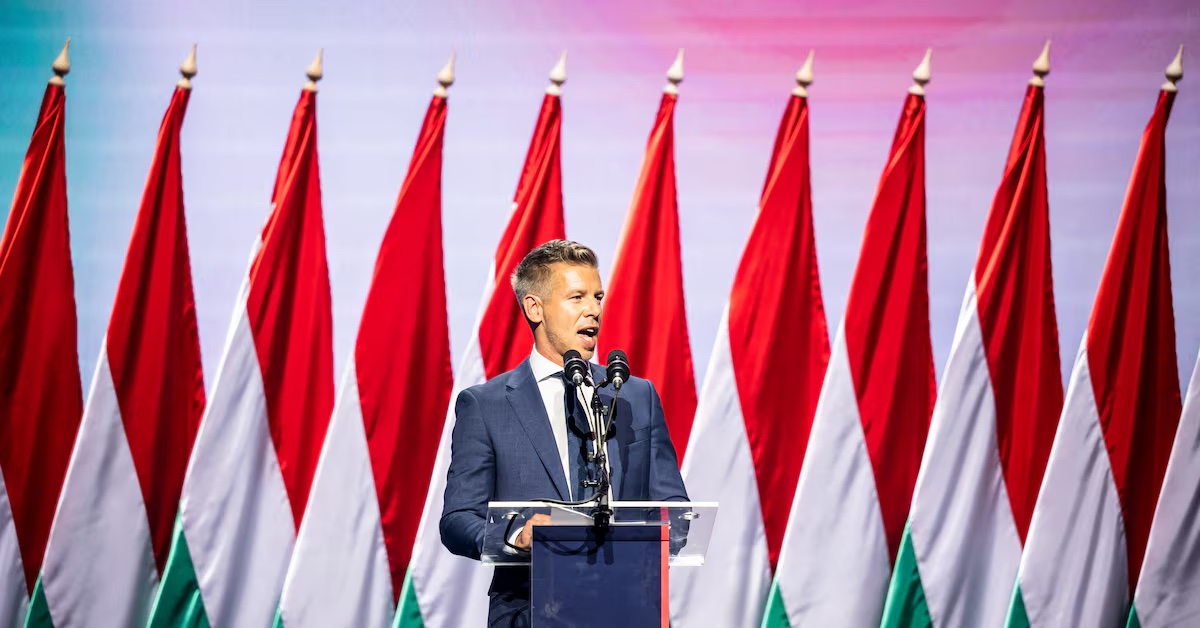
Peter Magyar, the leader of the opposition in Hungary, declared on Saturday that if his Tisza party wins elections the next year, it will implement a “Hungarian New Deal” that will use predictable policies and significant investment to boost the country’s flagging economy.
The largest political threat to nationalist Prime Minister Viktor Orban, who has been in power for 15 years and is finding it difficult to stimulate the inflation-stricken economy, is Magyar, whose center-right party leads the ruling Fidesz in the majority of public polls.
Recovery prospects are also threatened by the possibility of high U.S. tariffs on EU imports, and President Donald Trump’s statement on Saturday of 30% tariffs on the EU is terrible news for the Central European nation.
At his party’s congress at Nagykanizsa, in the west, Magyar told followers about his Hungarian New Deal idea.
Magyar stated that Tisza will combat corruption and repurchase state assets that he claimed had been plundered during the previous 15 years. “We need economic growth, investments, predictable financial and economic policy in Hungary,” he added.
A significant healthcare reform with additional funding of 500 billion forints ($1.5 billion) per year, a massive program of building rental apartments and homes, modernization of state railways with EU and national funds, and investments in household and educational energy efficiency will be the main pillars of Tisza’s plan.
Magyar, a former government insider who entered Hungarian politics last year, once again promised to release about 20 billion euros in EU funds that Hungary hasn’t received in years because of disputes between Orban and Brussels over alleged corruption and deterioration of democracy, which Orban disputes.
No date has been established for the parliamentary election, but it is expected to happen early next year. Orban’s 2026 election year budget, which included significant tax cuts for families—a crucial Fidesz target demographic—was approved by parliament in June.
“The public is tired with this government. And the ‘collecting party’ that was responsible for all of this (discontent) is Tisza. At the convention, Edit Piroska Borsi, a retired educator, stated, “People want change.”