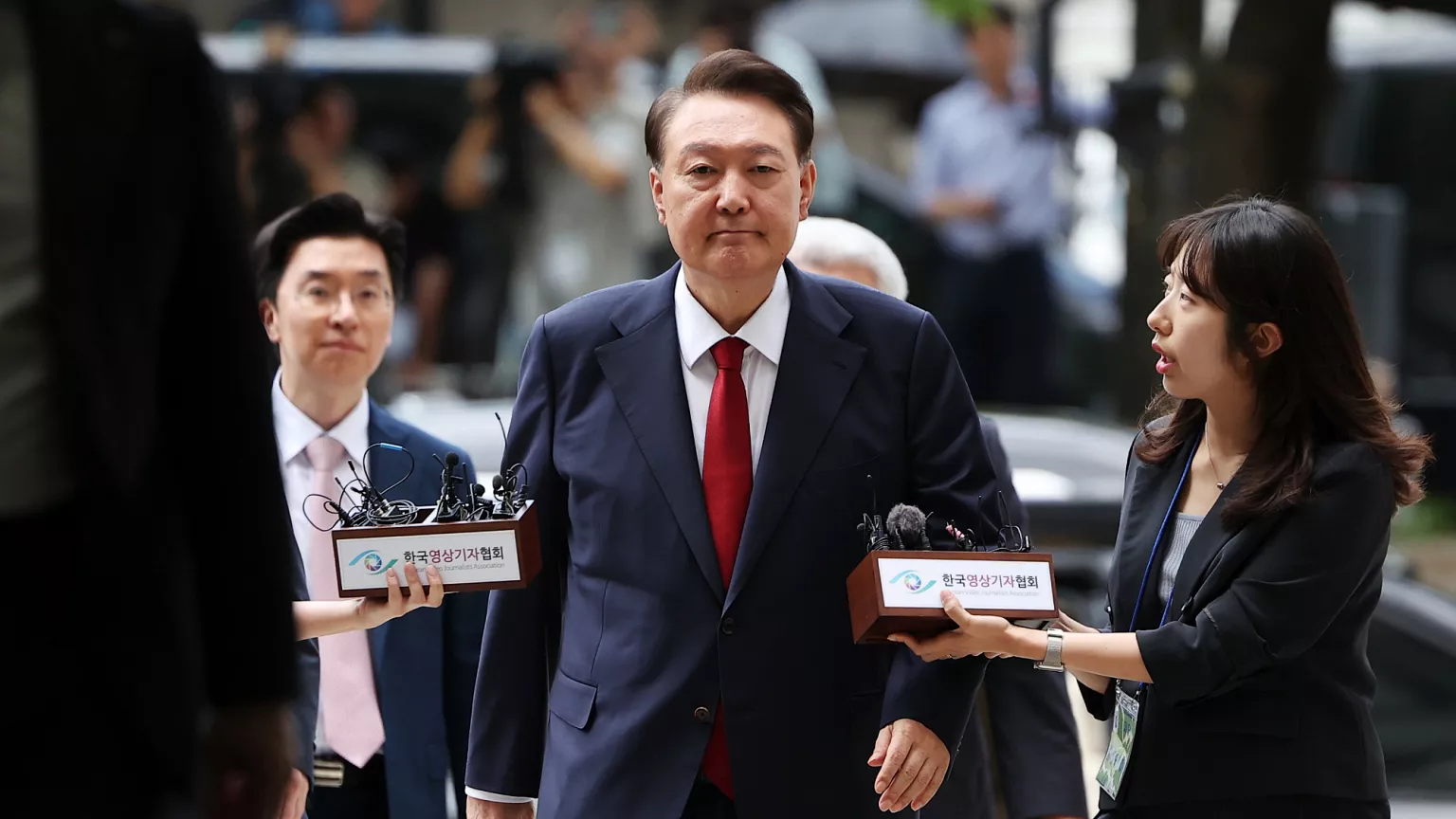
Yoon Suk Yeol, the former president of South Korea, was detained again on allegations of insurrection, abuse of power, and obstruction while martial law was in effect.
A new arrest warrant for former President Yoon Suk Yeol was approved by a South Korean court early Thursday on charges related to his contentious but brief declaration of martial law in December of last year.
Special prosecutor Cho Eun-suk made a request, and the Seoul Central District Court granted it, citing Yoon’s substantial risk of deleting evidence.
Just four months after being freed from custody in March, this most recent move returns the expelled conservative leader to a detention facility close to the capital. The same court then reversed his original arrest in January, enabling him to stand trial for rebellion without being placed under custody.
Additional charges, such as obstruction of official duties, misuse of power, and forging official records, are being pursued by the team of Special Prosecutor Cho. Before the arrest request was made on Sunday, Yoon was questioned twice.
The second arrest request was denounced as “excessive and unsubstantiated” by Yoon’s legal team. They still haven’t formally responded to the court’s ruling. After the court’s decision, Yoon was returned to detention. He did not speak to media when he came for the seven-hour hearing on Wednesday.
Yoon, who was officially removed from office in April after his impeachment was affirmed by the Constitutional Court, may now be subject to a lengthy period of detention. He could be detained for up to 20 days prior to a formal indictment under South Korean law. Yoon may spend up to six months in pre-trial custody for a court decision if he is charged.
The lawsuit concerns Yoon’s declaration of martial law on December 3, 2024, which he said was required to combat leftist MPs who he described as “anti-state” and interfering with his programs. The move was swiftly revoked when MPs met again in the National Assembly and, with the help of security forces who disobeyed Yoon’s orders, reversed the edict in a matter of hours.
Public prosecutors charged Yoon on January 26 with orchestrating an attempted uprising, which included attempts to take over the legislature, the national election commission, and to imprison political opponents. Serious punishments for the charges include life in prison or the death penalty.
According to further charges, Yoon circumvented the legal system by declaring martial law without Cabinet consent and thwarted attempts by law enforcement to apprehend him in early January by using presidential security officers as a personal militia.
A bill authorizing a comprehensive investigation into Yoon’s actions, including distinct accusations involving his wife and former administration officials, was signed into law last month by President Lee Jae Myung, Yoon’s liberal opponent who won the June snap election, in response to the constitutional crisis.
Legal actions against Yoon are anticipated to take center stage in the news as South Korea deals with the aftermath of one of its worst political upheavals in recent memory, furthering the country’s continuing struggle with presidential overreach.