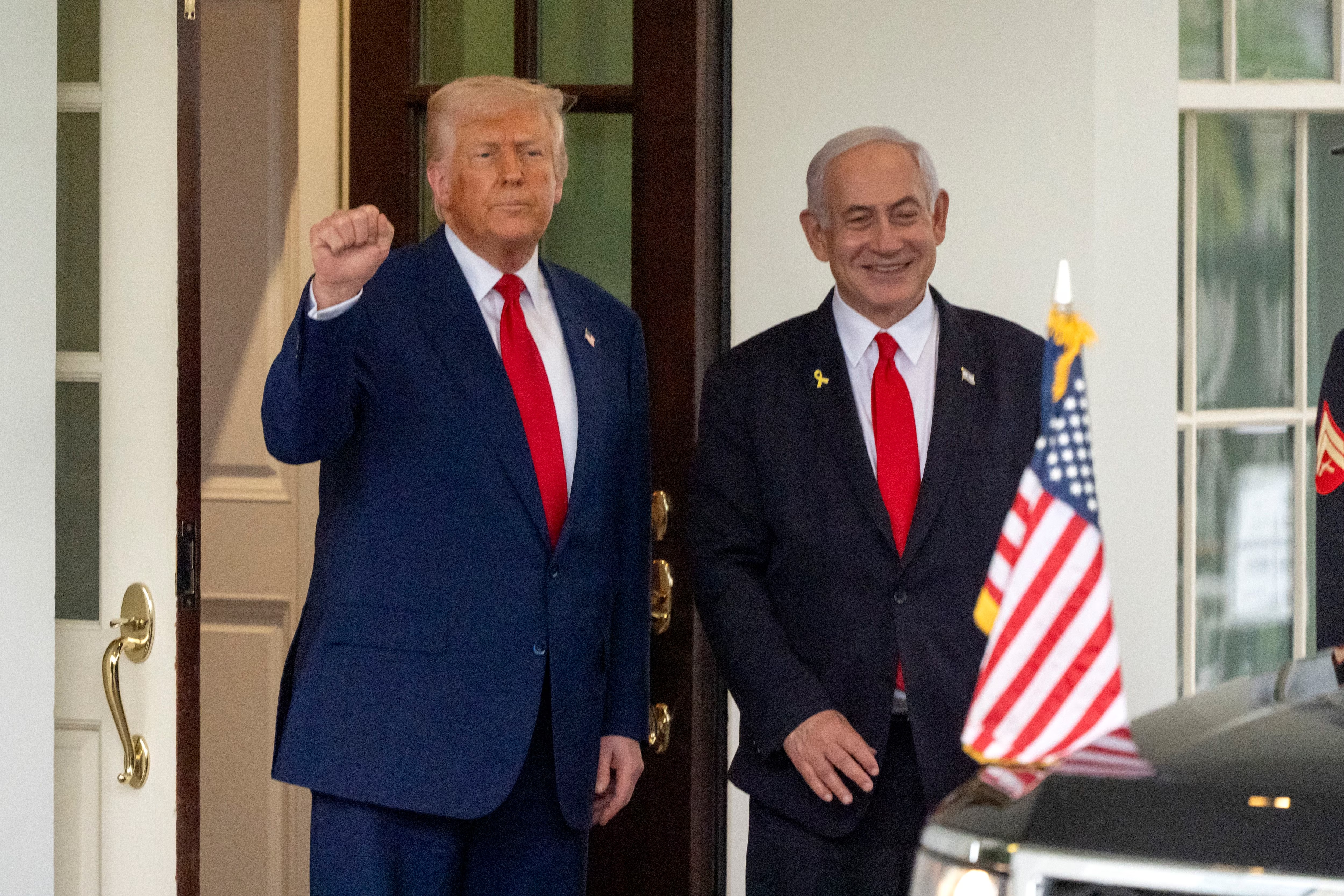
Trump and Netanyahu Meet as Hopes for a Ceasefire Deal in Gaza Increase
Hopes for a truce in Gaza after 21 months of conflict are growing as Netanyahu meets Trump in the midst of fresh hostage negotiations.
As Israeli Prime Minister Benjamin Netanyahu meets with US President Donald Trump in Washington, there are increasing expectations of a new ceasefire announcement in Gaza following 21 months of conflict.
Prior to this, Trump told reporters that he believed “we’ll have a deal” this week and that he had been “very firm” with Netanyahu about resolving the argument.
The seasoned Israeli prime minister stated, “We are working to achieve the deal that has been discussed, under the conditions we have agreed,” prior to boarding his aircraft. “We all hope for this outcome, and I think the conversation with President Trump can definitely help advance it.”
Israel and Hamas started indirect negotiations in Qatar on Sunday night over a US-sponsored plan for a 60-day truce and hostage release agreement.
Whether significant disagreements that have continuously stalled an agreement can be resolved is unknown, though.
The distraught relatives of Israeli captives still held by Hamas and exhausted Palestinians living in appalling conditions amid the daily Israeli bombardment are expressing only cautious confidence.
The end of all conflict is what I want, not a truce. Sincerely, I’m worried that the conflict may recommence after 60 days,” says Nabil Abu Dayah, who evacuated northern Gaza’s Beit Lahia to Gaza City with his kids and grandkids.
“After living in tents, we became weary of being uprooted and of hunger and thirst. We have nothing at all in terms of basic essentials.
There were sizable demonstrations on Saturday night calling on Israel’s leadership to reach an agreement to free about 50 hostages from Gaza, of whom up to 20 are said to still be alive.
Some family members asked why the framework agreement would not instantly release all prisoners.
How is it possible to exist under such circumstances? During the last two-month ceasefire earlier this year, Ilay David, whose younger brother, a singer, was captured on camera in agony as he witnessed the release of fellow captives, said, “I’m waiting for Evyatar to return and tell me himself.”
“We need to save lives now. Ilay urged a Jerusalem gathering, “Now is the time to save the bodies from the danger of disappearance.”
In light of the Middle East’s fast shifting circumstances, now is the time to negotiate a comprehensive agreement that will result in the unconditional release of all hostages.
For the third occasion since Trump took back the presidency almost six months ago, Netanyahu is attending the White House.
However, this will be the first time the leaders have met since the United States backed Israeli strikes on Iranian nuclear sites and subsequently mediated an agreement between Israel and Iran to end hostilities.
Most people believe that the last 12-day conflict has made it easier to put an end to the conflict in Gaza.
The Israeli prime minister has been buoyed by widespread public support for the Iran offensive after months of low popularity ratings, and analysts believe he now has more clout to reach a peace agreement despite the adamant protests of his far-right coalition partners, who favor Israel maintaining control of Gaza.
The assaults on Iran, a significant regional backer, are thought to have further damaged Hamas, making it more receptive to the compromises required to establish a consensus.
Trump is eager to move on to other Middle East issues in the meantime.
Among these are mediating boundary negotiations between Syria and Israel, resuming efforts to normalize relations between Saudi Arabia and Israel, and concluding outstanding business with Iran, including potential nuclear deal negotiations.
One basic disagreement has caused ceasefire negotiations between Israel and Hamas to stall for months.
In order to return captives, Israel has been willing to agree to a short-term truce that would not put an end to the conflict. Hamas has called for an end to Israeli military operations in Gaza and a permanent halt to hostilities.
According to reports, the most recent proposal made to Hamas included assurances that Washington will stick to the agreement and pursue further negotiations to achieve a permanent truce and the release of all captives.
The arrangement, which has not been formally declared, would see Hamas release 28 hostages—10 alive and 18 dead—in five phases over 60 days, omitting the uncomfortable handover ceremonies it held during the previous ceasefire.
Aid from the humanitarian community would flood into Gaza.
On the first day of the deal, Israeli forces would leave portions of the north after the first eight surviving captives returned. Parts of the south would be abandoned by the army after a week.
Hamas would list the hostages who are still alive and their current conditions on Day 10, while Israel would provide information about the more than 2,000 Gazans who were detained during the conflict and are still being held in “administrative detention,” a procedure that permits the Israeli government to hold them without charge or trial.
Many Palestinians would be freed from Israeli prisons in return for hostages, as has previously happened.
This is the “final” peace proposal, according to President Trump, who stated last week that Israel had agreed to “the necessary conditions” to finalize it.
Hamas stated on Friday that it had reacted in a “positive spirit,” albeit it had certain concerns.
According to a Palestinian official, the UN and its allies are still in charge of overseeing all relief activities, and Hamas is demanding that the controversial Gaza Humanitarian Foundation (GHF), which is supported by Israel and the United States, immediately cease operations.
It is also reported that Hamas is contesting the timeline for Israeli soldier withdrawals and the operation of the Rafah gate between Egypt and southern Gaza.
On Saturday, Netanyahu’s office declared that Israel would not accept the amendments that Hamas had demanded.
Hamas has so far refused to discuss the prime minister’s insistence that the Islamist organization disarm itself.
The military claims that more than 20 troops have been killed in the last month, which has increased resistance to the war in Gaza in Israel.
Lt Gen Eyal Zamir, the chief of staff for the Israeli military, stated last week that the war’s objectives were almost complete and hinted that the government would need to choose between preparing for Israeli forces to reestablish military authority in Gaza or proceeding with a deal to return the hostages home.
A ceasefire agreement to return the captives home is supported by two-thirds of Israelis, according to polls.
Given that this occurred in May as Trump got ready to travel to the Arab Gulf states, some Gaza residents worry that the current uptick in optimism is being staged to defuse tensions during Netanyahu’s US visit.
The days ahead will be crucial both humanitarianly and politically.
Children in Gaza are suffering from severe malnutrition, according to medical personnel, as the situation continues to worsen.
With no fuel entering for more than four months, the UN claims that reserves are now all but gone, endangering essential services including telecommunications, water supplies, and medical care.
In reprisal for the Hamas-led attacks on October 7, 2023, which claimed over 1,200 lives and resulted in the hostage-taking of 251 more, Israel began its war in Gaza.
More than 57,000 people have subsequently died in Gaza as a result of Israeli attacks, the health ministry administered by Hamas said. The United Nations and other organizations cite the ministry’s statistics as the most trustworthy source of casualty data.