Insight: Ukraine’s fight against Russia shifts to Africa
Mauritania, on the arid western edge of Africa, has turned into an improbable staging ground for Ukraine’s growing international conflict with Russia.
Food aid deliveries to refugees from neighboring Mali have been supervised by Kyiv’s new embassy in the capital of Nouakchott, one of eight it has established in Africa since Russia’s 2022 invasion of Ukraine, according to embassy and relief authorities.
Amid tensions between Mauritania and Mali, where Moscow supports government forces against Tuareg rebels, Ukraine’s senior envoy to Africa told Reuters that Kyiv is also ready to train Mauritanian soldiers.
Russian mining firms are well-established in the Sahel region, which includes Mali, while Moscow’s troops and mercenaries protect presidents in a number of West and Central African nations.
According to the envoy Maksym Subkh, Russia’s military deployment in the Sahel “undermined stability” during an interview in Kyiv.
Subkh stated that Ukraine had previously offered such training before Russia’s invasion and that “Ukraine is ready to continue training officers and representatives of the Mauritanian armed forces, to share the technologies and achievements that Ukraine has made” on the battlefield against Russia.
A request for response regarding Ukraine’s offer of additional training was not answered by the Mauritanian authorities. A request for comment from Russia’s embassy in Mauritania was not answered.
The Kremlin announced earlier in June that Russia would expand its collaboration with African nations, including in delicate fields like defense. Russia is Africa’s biggest supplier of armaments, the Stockholm International Peace Research Institute claims.
In addition to access to new missions in Mauritania and the Democratic Republic of the Congo, Reuters conducted interviews with four senior Ukrainian officials, two aid officials, and Western diplomats and analysts for this story. These interviews provide new information about Kyiv’s Africa strategy, including the delivery of aid to Malian refugees, the plan to train Mauritania’s military, and the larger effort to counter Russia’s much more established presence.
Many African nations refused to support Kyiv at the UN early in the conflict in Ukraine, despite the fact that Russia’s bombardment of Ukraine’s ports increased prices on the continent due to the restriction of food and fertilizer shipments.
A few months later, Ukraine released a public document outlining its initial Africa policy. The declared objectives were to boost trade and investment on a continent that recalls Moscow’s opposition to apartheid and Russian backing during the Cold War, as well as to refute Russia’s narrative.
He noted that since Subkh was brought in to spearhead the initiative, Kyiv has opened eight of the ten new embassies that were planned in 2022, increasing Ukraine’s total number of missions in Africa to 18.
Ivory Coast and Congo, two host nations, denounced Russia’s incursion at the outset. The U.S. accuses Russia of arming both sides in a bloody battle in Sudan, where Kyiv intends to erect an embassy this year. Russia disputes any involvement there.
But Kyiv is unable to compete with a rival that has strong security and business ties, including a history of Moscow’s intelligence services operating there. Russia now maintains over 40 missions throughout Africa, and it just revealed plans to open seven more.
FIGHT FOR INDIVIDUALITY?
According to Subkh, Ukraine hopes to convince African countries that its struggle against Russia, its former Soviet colonizer, is similar to their own attempts to remove the effects of European colonization.
Ukraine has mostly concentrated on food in its wartime efforts to gain allies in Africa, despite the prospect of military training.
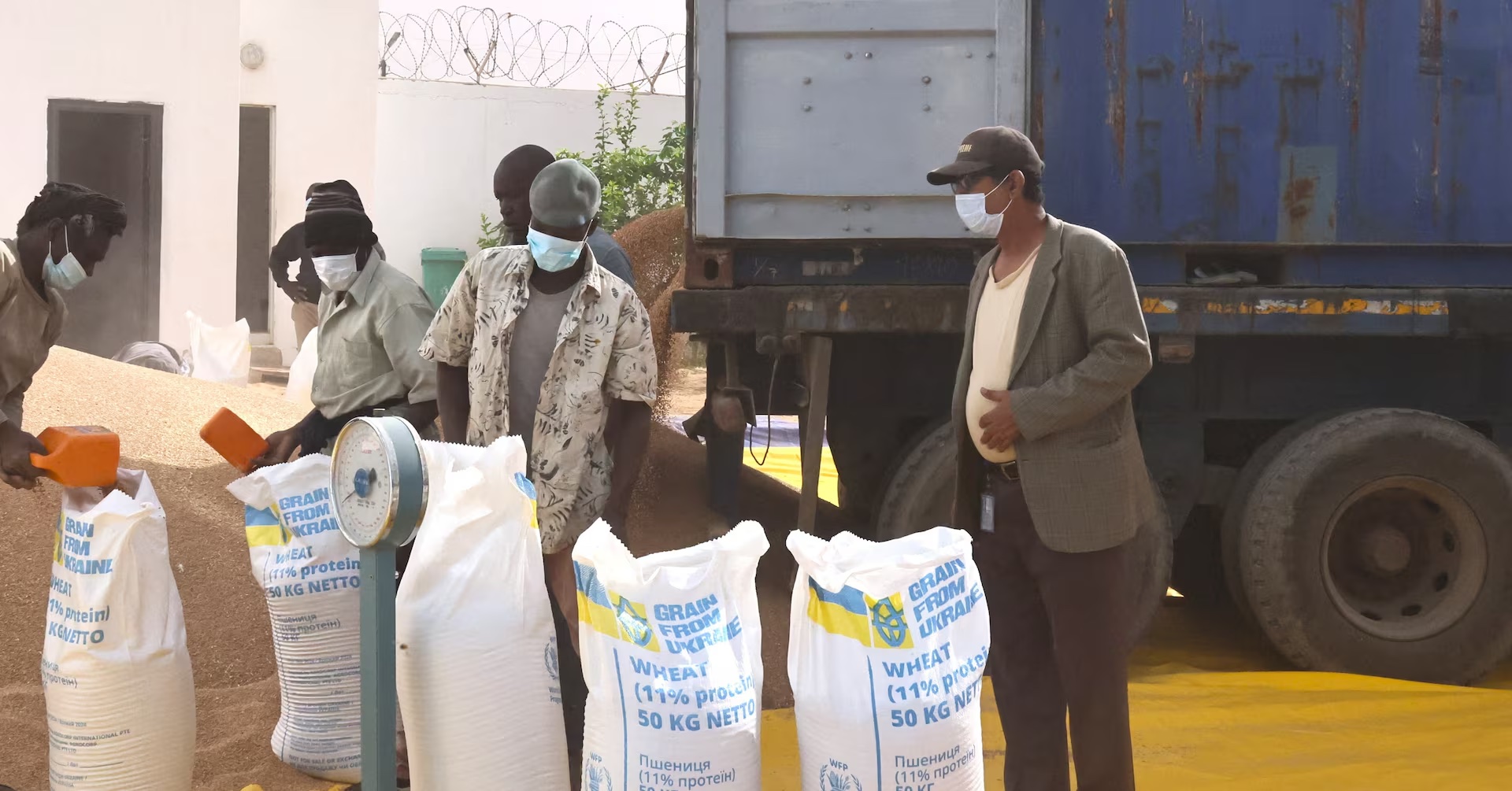
According to Kyiv, it has provided almost 300,000 tons of aid through the World Food Programme (WFP) as part of the EU- and U.S.-funded Grain from Ukraine program, which competes with a comparable Russian food aid program for Africa.
In April, the think-tank European Policy Center reported that 8 million people in 12 countries had received the Ukrainian-branded aid. Congo, Ethiopia, Somalia, Nigeria, Kenya, and Sudan have all been recipients.
It has primarily been headed toward Mbera, the biggest refugee camp in West Africa, which is home to an increasing number of Malians escaping Russia-backed forces on the other side of the border in Mauritania.
Additionally, Ukraine shipped nearly 10 million tons of grain to Africa in 2024, roughly double the previous year, following the reopening of Black Sea ports that Russia had blockaded and bombarded during the first two years of the conflict, according to data from the agriculture ministry.
Ukraine hopes African countries who have remained neutral during the conflict will start to put pressure on Moscow to halt the war in Ukraine by demonstrating that it is a significant alternative to Russian food supplies.
“Ukraine can stop Russia from using food supplies as political leverage by maintaining its role as one of the guarantors of the world’s food security,” said Roman Sereda, Ukraine’s chargé d’affaires in Nouakchott, where Russia has had an embassy for 60 years, in an interview.
Ukraine is becoming more well-known.
The first Ukrainian president to travel to South Africa, a close ally of Russia, was Volodymyr Zelenskiy in April. He urged acknowledging Ukraine’s suffering and highlighting possible agreements on security, energy, and fertilizer production.
Russia and Ukraine are allies, according to Chrispin Phiri, a spokesman for the South African foreign ministry. He said that South Africa promoted peace and mediated humanitarian disputes, including the repatriation of Ukrainian children that Kyiv claims were abducted to Russia.
Tim Murithi, a South African analyst, claimed that Ukraine’s Africa policy lacked consistency, citing the fact that Kyiv had failed to designate an ambassador to Ethiopia, a crucial position that nations like Russia utilize to interact with the powerful African Union, which is headquartered in Addis Ababa.
According to Ukrainian data, sub-Saharan countries like Ethiopia, Kenya, and Nigeria only purchase a small portion of what they imported prior to the conflict, indicating that Ukraine’s commercial exports are skewed strongly towards North Africa. Compared to 2021, Mauritania purchased significantly less food from Ukraine last year.
The planned October 2024 Ukraine-Africa summit has been downgraded to a video conference, one of the setbacks in Ukraine’s Africa drive. In 2023, a well-attended Africa conference was held in Moscow.
Jean-Yves Ollivier, chairman of the Brazzaville Foundation, a conflict prevention group Ukraine consulted on the summit, stated, “At first, they wanted to have it physically in Kyiv.”
There have been no prior reports of the downgrade. A request for comment regarding the occurrence was not answered by Subkh.
MALI REFUGEES
Ukraine’s increased prominence has occasionally generated controversy. After a Ukrainian intelligence official seemed to imply Ukrainian complicity in a Tuareg rebel offensive in July that killed 47 Malian soldiers and 84 Russian fighters assisting the government, Mali severed ties with Kyiv.
Since then, Ukraine has vehemently denied any involvement. According to Subkh, Ukraine was not involved in any clandestine activities in the area.
Now, in answer to questioning for this article, the WFP representative in Mauritania acknowledged that a tiny amount of Ukraine’s help has reached the Malian refugees escaping the violence.
In just two years, the number of people living in the camp has nearly tripled to around 250,000.
By December, three shipments totaling approximately 1,400 tonnes had reached Mauritania, according to Viktor Bort, one of Ukraine’s diplomats in Nouakchott. According to the WFP representative, Mbera was still receiving the split peas, vegetable oil, and wheat in May.
When the operation first began in May 2024, Bort, 29, who worked alone, told Reuters that his main goals were to establish contacts with the government and supervise the delivery of aid to WFP for the Malian refugees, who he claimed were escaping Russians.
Subkh, Kyiv’s senior Africa ambassador, stated that the WFP made the decisions for aid distribution. According to him, Ukraine resisted politicizing aid and its contributions were solely humanitarian.
The government of Mauritania has welcomed delivery of Ukrainian food aid, according to the country’s communications ministry. It claimed to be unaware that Ukrainian aid had made its way to the camp.
SHORTLY STAFFED
Due to a shortage of personnel, Ukraine has turned to sponsors and volunteers to help staff its new missions.
According to two foreign diplomats, Bort, the embassy officer in Mauritania, first traveled without protection and relied on friendly envoys from other nations for assistance, but he soon became well-known for his zeal and connections.
Ukraine’s outreach and aid delivery have boosted Kyiv’s reputation and Mauritanians’ comprehension of its position, according to Sereda, the chargé d’affaires who joined Bort a few months ago. He hopes that further trade links will follow.
The government of Mauritan declined to comment.
The war-torn Democratic Republic of the Congo has also received aid; Ukraine’s envoy, Vasyl Hamianin, told Reuters that the two nations were negotiating long-term deals on agriculture and food security.
“We welcomed the Ukrainian ambassador with an attitude of candor and collaboration. Congo’s presidential office issued a statement saying, “There is no need to link its presence to the conflict between Russia and Ukraine.”