Tesla launches a robotaxis test in Texas
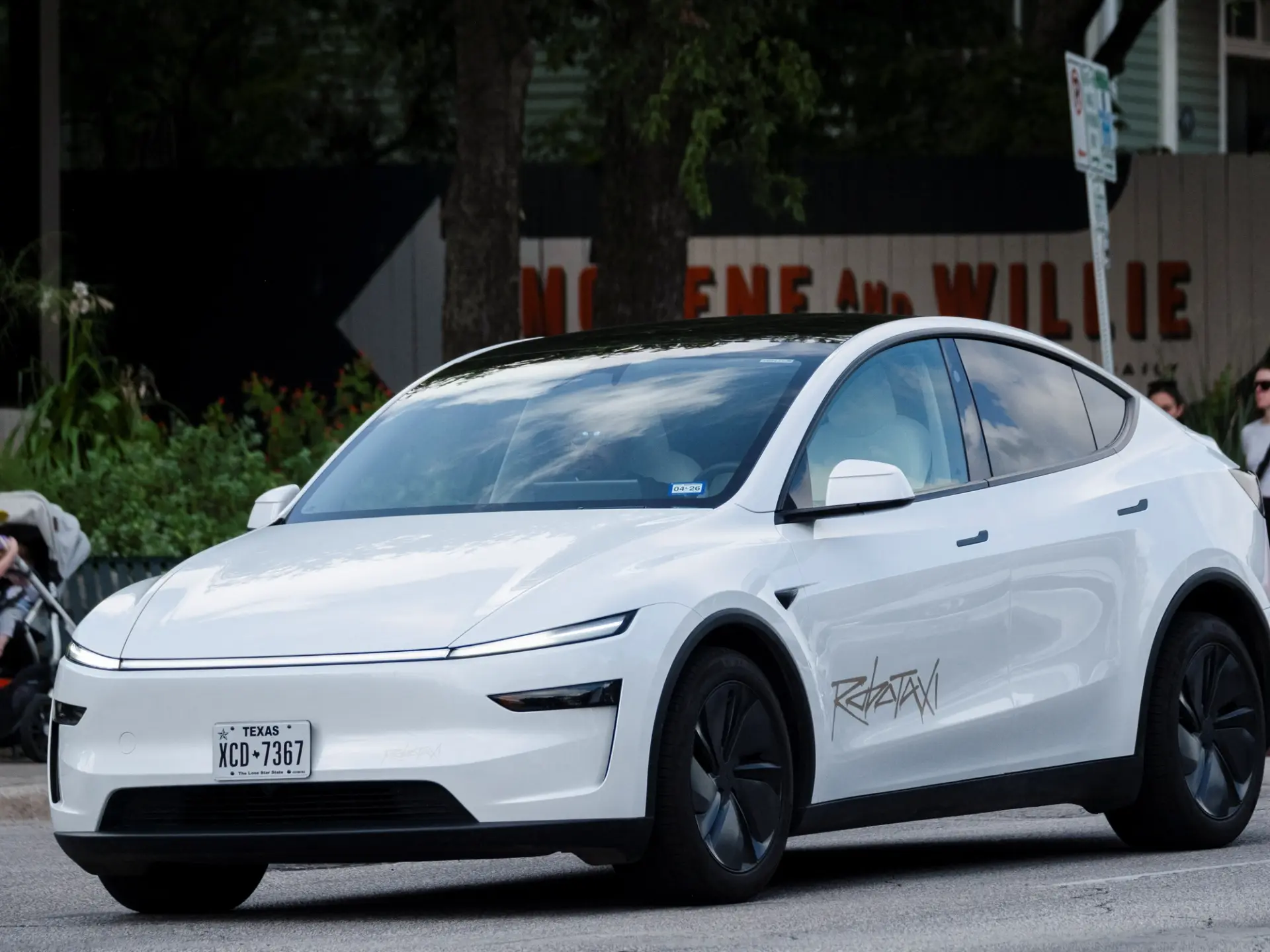
Elon Musk, the CEO of Tesla (TSLA.O), announced the “robotaxi launch” on Sunday in Austin, Texas, and social media influencers shared footage of their initial trips. Tesla also opened a new tab where a small number of self-driving taxis picked up paying clients.
This was the first time that Tesla vehicles without human drivers have paid passengers, a business that Musk believes is essential to the electric vehicle manufacturer’s long-term financial success.
In a post on his social media platform, X, he referred to the event as the “culmination of a decade of hard work” and mentioned that “the AI chip and software teams were built from scratch within Tesla.”
In the South Congress area, Teslas were seen early on Sunday with only one occupant in the passenger seat and no one in the driver’s seat. The carmaker intended to conduct a modest test with roughly ten cars with front-seat riders serving as “safety monitors,” though it was unclear how much power they actually had over the cars.
Recently, the carmaker invited a few influencers to participate in a closely watched robotaxi testing in a restricted area. According to Musk on X, the rides are available for a one-time payment of $4.20.
On X Sunday afternoon, Sawyer Merritt, a social media personality and Tesla investor, shared videos of himself utilizing a Tesla robotaxi app to order, open a new tab, get picked up, and take a journey to Frazier’s Long and Low, a neighboring bar and restaurant.
Even if the first deployment goes well, industry analysts believe Tesla still has a lot of work ahead of it in fulfilling Musk’s pledges to swiftly expand in Austin and other places.
Tesla and its self-driving competitors, including Alphabet’s (GOOGL.O) recently launched Waymo, may need years or decades to fully establish a robotaxi sector, according to Philip Koopman, a professor of computer engineering at Carnegie Mellon University who specializes in autonomous vehicle technology.
According to him, a successful Austin trial for Tesla would mark “the end of the beginning – not the beginning of the end.”
Many industry observers believe that the majority of Tesla’s extremely high stock value now depends on its capacity to produce humanoid and robotaxis robots. The most valuable car company in the world is without a doubt Tesla.
Legislators in Texas took action to pass regulations governing autonomous vehicles as Tesla’s robotaxi debut date drew near. Republican Governor Greg Abbott of Texas signed legislation on Friday that mandates a state authorization in order to operate self-driving cars.
The law, which goes into effect on September 1st, indicates that both party state officials want to see cautious progress from the autonomous vehicle sector.
Requests for comment were not answered by Tesla. The governor’s office opted not to respond.
“EASY TO GET, EASY TO LOSE”
The state’s prior anti-regulation position on autonomous vehicles is loosened under the statute. Cities in Texas were expressly barred from regulating self-driving cars under a 2017 law.
According to the new rule, operators of autonomous vehicles must obtain permission from the Texas Department of Motor Vehicles before they can operate on public roads without a human driver. It lets state officials cancel licenses for operators they believe pose a risk to the public.
According to the regulation, companies must also tell first responders how to handle their autonomous cars in an emergency.
It is not difficult to obtain a permit for an “automated motor vehicle” under the law, but businesses must certify that their vehicles can drive safely and lawfully.
An automated vehicle is defined as having at least “Level 4” autonomous-driving capabilities under a recognized standard, which means that under certain circumstances, it can function without a human driver. A automobile that reaches level 5 autonomy can drive itself anywhere, in any situation.
It is still much simpler to comply than in some places, such as California, where vehicle-testing data must be submitted under governmental supervision.
According to Bryant Walker Smith, a law professor at the University of South Carolina who specializes in autonomous driving, it seems that any business that satisfies the minimal application requirements will be granted a Texas permit; yet, if issues develop, they may also lose it.
“California permits are hard to get, easy to lose,” added the politician. “In Texas, the permit is easy to get and easy to lose.”
MUSK’S COMMITMENT TO SAFETY
The launch of the Tesla robotaxi follows over ten years of Musk’s unmet promises to produce self-driving Teslas.
According to Musk, Tesla would operate in restricted locations and be “extremely paranoid” about robotaxi safety in Austin.
Other limitations will also apply to the Austin service. Tesla intends to steer clear of inclement weather, challenging intersections, and passengers under the age of 18.
The commercialization of autonomous vehicles has proven costly and risky. A new tab is opened by GM’s (GM.N) A tragic accident led to the closure of Cruise. Amazon’s (AMZN.O) and Waymo, Tesla’s competitors, are being closely watched by regulators. Zox.
Additionally, Tesla is defying the conventional wisdom in the nascent business that relies on a variety of technology to read the road, by utilizing solely cameras. Compared to rivals’ radar and lidar systems, Musk claims that this will be safer and far less costly.