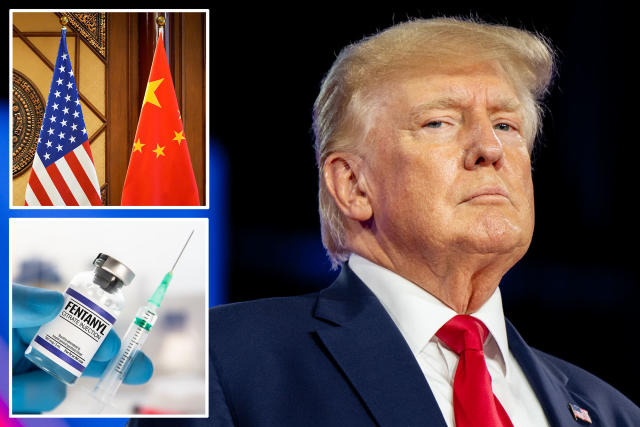
The Trump administration’s placement of a long-threatening 10% tax on Chinese imports was condemned by China’s government on Sunday, but it also left the door open for negotiations with the United States that might prevent the crisis from getting worse.
China’s finance and commerce ministries announced that Beijing will contest President Donald Trump’s tariff at the World Trade Organization as a symbolic move and implement unidentified “countermeasures” in reaction to the charge, which goes into effect on Tuesday.
That reaction echoed Beijing’s more measured rhetoric in recent weeks and fell short of the sudden escalation that had characterized China’s trade confrontation with Trump during his first term as president.
Trump said Beijing needed to stop the flow of the deadly narcotic fentanyl into the United States, so he announced 25% tariffs on imports from Canada and Mexico and 10% on goods from China on Saturday.
The outright reprisal and aggressive rhetoric from Mexico, the top export destination for the United States, and Canada, a longstanding ally, contrasted with China’s muted response.
China’s commerce ministry called for the United States to “engage in frank dialogue and strengthen cooperation” after claiming that Trump’s action “seriously violates” international trade regulations.
Beijing may gain a message victory by suing the WTO to defend the rules-based trading system that both parties’ U.S. administrations have long supported. Beijing has taken the same action in opposition to the European Union’s 45% tariffs on electric automobiles manufactured in China.
However, Washington faces no immediate threat or expense from a WTO appeal.
Since Trump prevented judges from being appointed to handle appeals in 2019, the WTO’s dispute settlement process has been essentially shut down. The United States has accused the WTO appeals panel of overreaching its jurisdiction ever since President Barrack Obama took office.
“The American Problem”
Beijing believes there is no winner in a trade war, according to Chinese Foreign Ministry spokesperson Mao Ning for weeks.
Signs that Trump may be looking for a more complex relationship with China following a meeting with Chinese leader Xi Jinping last month have also given Chinese officials hope.
China is now seen by both Democrats and Republicans as the United States’ largest economic and foreign policy concern.
Beijing is vulnerable because to China’s enormous trade imbalance, which was close to $1 trillion last year. China’s exports in important sectors, such as automobiles, have been increasing in volume rather than value more quickly, which may indicate that producers are lowering prices in an effort to attract foreign buyers while domestic demand has been sluggish.
Analysts have therefore anticipated that China will attempt to negotiate with Trump as soon as possible in order to lessen the impact of the U.S. trade action.
For months, China has also been getting ready for the long-awaited Trump tariff move by strengthening its alliances, advocating for some degree of independence in critical technological fields, and allocating money to support a faltering economy.
The second-largest economy in the world, China’s, achieved its stated growth target of 5% last year despite widespread complaints about falling living standards and dwindling employment opportunities.
In the case of fentanyl, where the Biden administration had also been pressing Beijing to suppress shipments of the Chinese-made precursor chemicals required to produce the narcotic, China’s retaliation was the most severe on Sunday.
China’s foreign ministry declared, “America’s problem is fentanyl.” “The Chinese side has carried out extensive anti-narcotics cooperation with the United States and achieved remarkable results.”