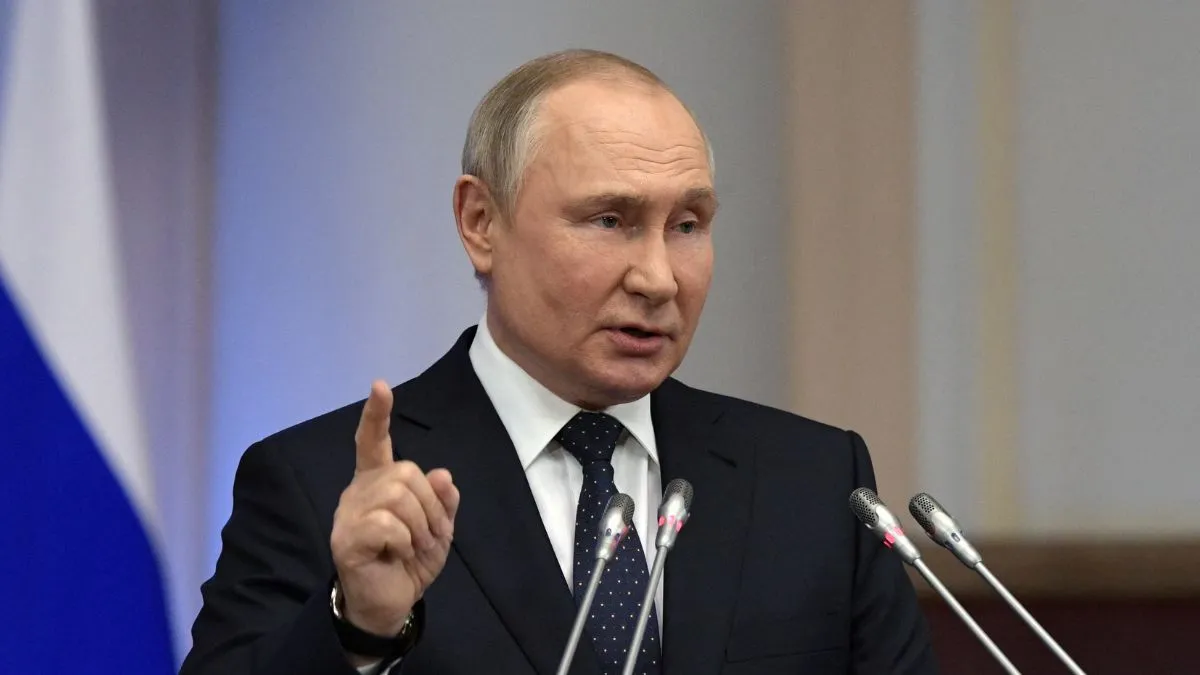
In a New Year’s speech, Russian President Vladimir Putin assured Russians that the nation would proceed with confidence in 2025, but he made no concrete pledges on the economy or the conflict in Ukraine.
Putin promised Russians that their well-being was his top priority at a time when many common people are concerned about price increases and the central bank’s 21% interest rate is putting pressure on businesses and homebuyers.
He invoked historical successes, like as Russia’s involvement in defeating Nazi Germany in World War Two, to portray Russia’s difficulties as part of a larger historic mission.
He claimed that throughout the first quarter of the twenty-first century, which precisely matched his tenure as its supreme leader, Russia had surmounted hardships, accomplished significant objectives, and strengthened its unity.
And as the year draws to a close, we are considering the future. We will only proceed because we are sure that everything will work out. We are certain that the destiny of Russia and the welfare of its people were, are, and will remain its highest priority,” he stated.
Russia’s eleven time zones, starting with Kamchatka and Chukotka in the far east, were broadcasting his three-and-a-half-minute seasonal greeting from the Kremlin at midnight.
He was speaking precisely twenty-five years after he first spoke to the country as its acting president following the surprise resignation of Boris Yeltsin on the final day of 1999.
Putin, 72, praised Russian servicemen who are engaged in the conflict in Ukraine, calling them heroes. “Your boldness and courage are admirable. “We have faith in you,” he declared.
He didn’t specifically address the state of affairs on the battlefield or the likelihood that the war will finish when Donald Trump takes office again on January 20. Trump has promised to end the war quickly, but he hasn’t given any specifics.
LOSSES IN THE UKRAINE
In 2024, Russian forces took control of around a fifth of Ukraine and made the quickest advance since 2022, the first year of the conflict. However, the advantages have come at the expense of significant, albeit unreported, losses in equipment and personnel.
In 2024, Ukraine launched a surprise counterattack on August 6th, capturing a portion of Russia’s western Kursk region, marking the first invasion of Russia since World War Two.
According to estimates from South Korea, Ukraine, and the United States, Russia has brought in over 10,000 troops from its ally North Korea, but has not yet forced Ukrainian forces out of Kursk. Their presence has not been verified or disputed by Russia.
According to British security specialist Ruth Deyermond, “Russia has been forced to ignore the months-long occupation of part of its own territory by Ukrainian forces in order to sustain even the very slow advance in Ukraine.”
“Taking a ‘nothing to see here’ attitude to the loss of its own land is not what great powers do, particularly one so preoccupied with the idea of state sovereignty.”
In a lengthy discussion on X, Deyermond stated that Russia’s growing reliance on China and the overthrow of its main Middle East partner, former Syrian President Bashar al-Assad, also harmed Putin’s attempts to present Russia as a major global force.
On December 19, Putin, who has ruled Russia for the longest time since Josef Stalin, declared that the nation has retreated from “the edge of the abyss” and rejected challenges to its independence.
He claimed that in retrospect, he should not have held off on initiating his “special military operation” in Ukraine—the phrase he continues to use to refer to the full-scale invasion of Russia’s neighbor—until February 2022.