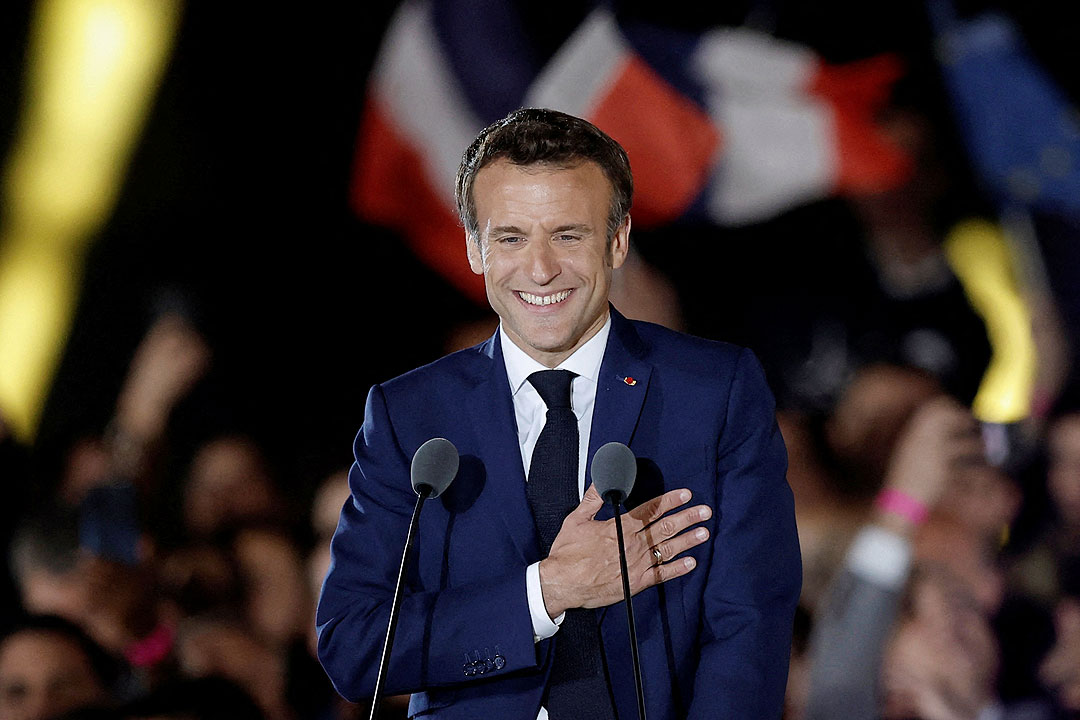
In a rare show of remorse, French President Emmanuel Macron acknowledged Tuesday that his decision to hold early legislative elections in June had increased political instability in the nation.
The address brings an end to Macron’s turbulent 2024. He surprised the country by calling early elections halfway through the year, a risk that backfired when voters gave him a hung parliament with a significant increase in far-right legislators, reducing his authority.
In a televised speech prior to the New Year’s festivities, Macron stated, “Lucidity and humility force (me) to recognize that at this stage, this decision has produced more instability than peace, and I fully own up to that.”
His admission of guilt was the most obvious since the elections. “The dissolution caused more divisions in the Assembly than solutions for the French people,” he continued.
Macron used the need to “clarify” the political situation as justification for calling early elections following a poor showing in the European elections.
For the first time since 1962, however, he lost his viable majority and required two months to form a minority administration, which ultimately fell in December.
Consequently, France was unable to adopt a 2025 budget before the year ended, forcing Macron to appoint Francois Bayrou, a centrist veteran, as his fourth prime minister this year in December.
SELECTIONS TO MAKE
By stating that he would ask the French to decide on “decisive” topics without specifying which ones, Macron also hinted at the possibility of using referendums this year.
“I want us to take action with 2050 in mind. For the sake of our democracy, economy, security, and children, we will have to make decisions,” he stated.
The president of France has the authority to call referendums under the constitution.
In the past, Macron has also utilized “citizen conventions,” which are assemblies of randomly chosen citizens with no legal authority, to put an end to uprisings like the Yellow Vest uprising on particular themes.
Regarding international affairs, where he still has extensive diplomatic and military authority, Macron stated that the European Union should no longer be “naive” about global trade, given that U.S. President-elect Donald Trump has threatened to impose tariffs on the bloc.
“We must say no to trade rules enacted by others and that we are the only ones to still comply with, say no to everything that makes us more dependent on others, without tradeoffs and without preparing the future,” he stated.
As evidence that Europe shouldn’t take its security for granted, he also cited the war in Ukraine and the Middle East as well as election tampering in Georgia, Romania, and Moldova.
He urged EU members, who frequently depend on the U.S. security umbrella, to do more for their own defense, saying, “That’s why Europe should stop delegating its security and defense to other powers.”