Israeli incarceration leaves Palestinians with scars despite the ceasefire push
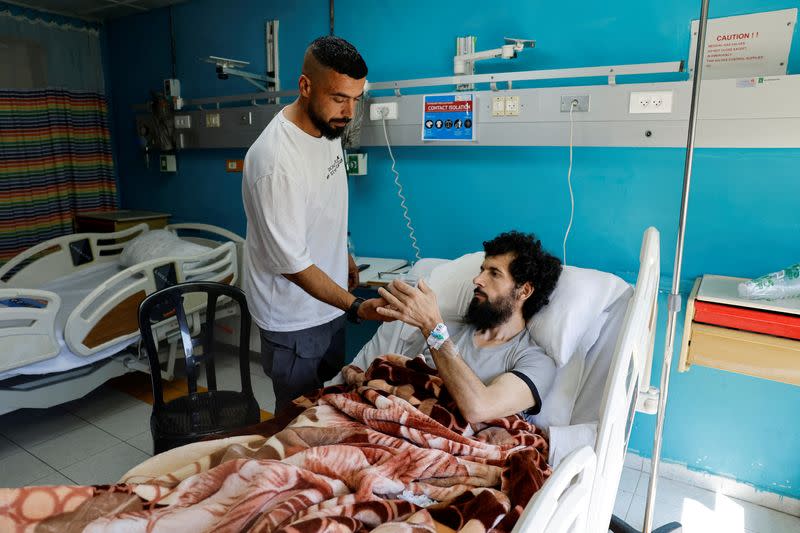
Palestinian bodybuilder Moazaz Obaiyat was once strong and muscular, but after nine months in Israeli detention, he was unable to walk without assistance when he was released in July. Then soldiers arrested him once more during a predawn raid on his house in October.
According to medical records obtained by Reuters from Bethlehem Psychiatric Hospital, a public facility in the occupied West Bank, the 37-year-old father of five was diagnosed with severe PTSD prior to his re-arrest. The diagnosis was tied to his time at Israel’s remote Ktz’iot prison.
Obaiyat suffered from “physical and psychological violence and torture” while incarcerated, according to the notes, which also detailed symptoms such as extreme anxiety, alienation from his family, and a refusal to talk about recent events or painful experiences.
As international mediators stepped up their efforts in December to secure a ceasefire that could see the release of thousands of prisoners detained during and before the Gaza war in exchange for Israeli hostages held by the Palestinian group Hamas in Gaza, allegations of abuses and psychological harm to Palestinian detainees in Israeli prisons and camps have come back into the spotlight.
According to Qadoura Fares, head of the Palestinian Commission for Detainees and Ex-Detainees Affairs, a government agency in the West Bank, many detainees “will require long-term medical care to recover from the physical and psychological abuse they have endured” if they are released in any future agreement. Fares claimed to be aware of Obaiyat’s situation.
Four Palestinian males who have been held by Israel since the start of the war following the October 7, 2023, Hamas attacks were interviewed by Reuters for this story. Accused of joining an unlawful group, all were detained for months before being freed without being officially charged or found guilty of any offense.
All of them spoke of long-lasting psychological damage they linked to mistreatment that included beatings, starvation, and protracted confinement in stressful positions while they were inside. Reuters was unable to independently confirm the circumstances of their detention.
Their statements align with other inquiries conducted by human rights organizations that documented severe mistreatment of Palestinians in Israeli custody.
Documented reports of widespread “torture, sexual assault and rape, amid atrocious inhumane conditions” in jails since the start of the war were detailed in an August report released by the UN human rights office. Additionally, according to the U.N. office, Hamas’ actions on October 7 may qualify as crimes against humanity and war crimes.
Reports of torture, rape, and other mistreatment in Israeli prisons have been deemed “deeply concerning” by the White House.
The Israeli military “categorically” denied claims of systematic abuse within its detention facilities, but it did say it was looking into multiple examples of suspected torture of Gazan inmates by military personnel in response to questions from Reuters.
Regarding specific cases, the military refuses to comment. Both the nation’s internal security service and the Israel Prison Service (IPS), which are under the hard-right national security minister Itamar Ben-Gvir, stated they were unable to comment on specific cases.
In response to questioning from Reuters, Ben Gvir’s office stated that Israeli jails comply with the law and provide terrorists with controlled living circumstances and housing suitable for criminals. “The’summer camp’ is over,” stated Ben Gvir’s boss.
The symptoms the men described were typical and can reverberate throughout victims’ lives, frequently upsetting their families, according to Tal Steiner, executive director of the Israeli rights organization Public Committee Against Torture in Israel (PCATI).
Since October 7, the use of torture in Israeli jails has skyrocketed. “It has had and will continue to have a devastating impact on Palestinian society,” Steiner stated.
A severely malnourished Obaiyat, speaking from his hospital bed in July, described the treatment of himself and other inmates as “disgusting,” displaying wounds on his withered legs and detailing, without providing specifics, isolation, starvation, handcuffs, and assault with metal rods.
Obaiyat appears to be a strong, muscular man in pictures taken before to his imprisonment.
Israel’s High Court ordered the state to respond to a petition filed by rights organizations on December 19 regarding the dearth of sufficient meals provided to Palestinian prisoners.
Israel has also claimed that some of the 251 of its people who were captured in Gaza following the Hamas onslaught were mistreated. According to an Israeli Health Ministry assessment released on Saturday, the hostages endured psychological and sexual abuse as well as other forms of torture. Hamas has denied mistreating the hostages on numerous occasions.
Totally free
According to an advocacy group called the Palestinian Prisoners’ Club, Obaiyat is presently being kept in a small prison facility in Etzion, south of Bethlehem.
According to the group, the official reason for his arrest is unknown, and he is being kept for six months under “administrative detention,” which is a type of confinement without accusation or trial. Questions concerning his particular case received no response from Israel’s military, internal security agency, or prison service.
According to PCATI, at least 56 Palestinians have perished while in detention during the conflict, as opposed to only one or two every year in the years before. According to Israel’s military, it looks into all fatalities of Palestinians under its control as criminal cases.
Based on court records and information gathered via freedom of information requests, PCATI estimates that the number of Palestinian prisoners in Israel and the West Bank has at least doubled to over 10,000 throughout the conflict.
In answer to a question from Reuters, the Israeli military stated that some 6,000 Gazans have been imprisoned throughout the battle.
Gazan Palestinians are detained in Israel under the country’s Unlawful Combatants Law, in contrast to West Bank Palestinians who are detained under military law.
According to Professor Neve Gordon, an Israeli scholar who focuses on human rights and international law at Queen Mary University in London, the law has been used to imprison people for long periods of time without charge or trial, hold them incommunicado, and deny them their rights as prisoners of war or as prisoners under military occupation.
The detentions were compared to enforced disappearances by the Palestinian Prisoners’ Club.
Regarding the number of inmates and deaths, Israel’s prison service declined to comment.
TEIMAN CAMP SDE
On August 20, a few dozen Palestinians were freed at the Kerem Shalom crossing into Gaza, including 21-year-old Fadi Ayman Mohammad Radi, a former engineering student from Khan Younis, Gaza.
After spending four months in chains and handcuffs at Israel’s Sde Teiman military detention camp—officially a temporary prisoner sorting facility—Rradi spoke of his struggles to stretch out his limbs.
“They didn’t interrogate us, they destroyed us,” Radi replied.
Whistleblowers among the camp’s guards have claimed that Sde Teiman, which is situated in the Negev desert, has been the scene of serious atrocities, including rape.
Five soldiers are suspected of anally piercing a detainee with a rod that punctured his internal organs in what the United Nations described as “a particularly gruesome case” of alleged sexual abuse at Sde Teiman, which Israel is currently looking into.
Radi claimed that in addition to being blinded and permanently restrained, he was also hung up in stressful postures, beaten arbitrarily and repeatedly, and made to sit on the floor virtually nonstop.
He claimed that at one time, he was kept awake for five days in a row while listening to loud music in what he claimed were Israeli soldiers’ “disco room.” He didn’t talk about sexual assault.
Radi claimed that he had trouble falling asleep and that discussing his experience brought it back to him.
Radi, who was taken into custody by Israeli forces in Gaza on March 4, stated, “Every time I say the words, I visualize the torture.”
Reuters was unable to independently confirm his account. Because Reuters was unable to obtain Radi’s ID number, the Israeli military stated it was unable to comment and could not locate his files.
According to PCATI, Sde Teiman is still open even though the government decided to phase it out.
KTZ’IOT AND OFFER
More well-known institutions, including the Ktz’iot jail in the Negev and the Ofer military camp in the West Bank south of Ramallah, have also been the scene of widespread abuses.
Earlier this year, Israeli rights group B’Tselem published a report accusing Israel of purposefully transforming the prison system into a “network of torture camps” based on testimony and evidence gathered from 55 former Palestinian detainees.
Ben Gvir, the hardline minister, ordered conditions for “security prisoners,” a group that almost exclusively consists of Palestinians, to be decreased using emergency legislation that was established following Hamas’ attack on Israel on October 7.
Gordon, a human rights professor, compared the practice of torture in Israeli prisons to acts of terrorism.
“Terrorism often affects a small number of individuals directly, but it has a profound psychological impact. Gordon, who co-edited a book on abuses in the Israeli jail system, stated that the same is true of torture.