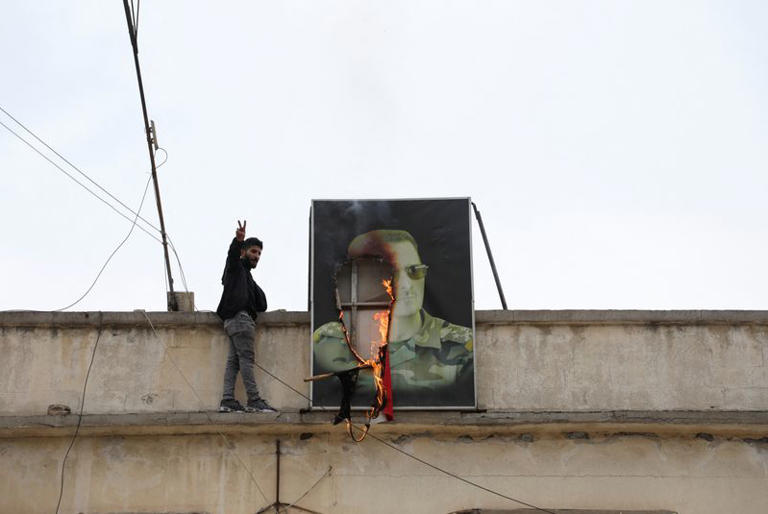
The US views the overthrow of Assad as an opportunity to “once and for all” remove Syria’s chemical weapons
A senior U.S. official stated Thursday that the United States saw the overthrow of Bashar al-Assad as a unique opportunity to “once and for all” free Syria of the chemical weapons that killed or maimed thousands of people during its civil war.
Nicole Shampaine, U.S. ambassador to the Organization for the Prohibition of Chemical Weapons, told Reuters ahead of a closed-door OPCW conference on Syria in The Hague that Washington will vigorously support efforts by the international chemical weapons watchdog to eradicate Syria’s deadly arsenal.
The OPCW chief was anticipated to ask important member nations for their approval of finance and technical help to undertake a laborious chemical nonproliferation procedure in Syria during the meeting, which was scheduled to start at 1430 GMT.
Under a U.S.-Russian agreement, Syria joined OPCW in 2013 and committed to dismantling its chemical weapons. However, after more than ten years of inspections, Syria continues to retain prohibited weapons, and inspectors discovered that President Assad’s troops frequently deployed them throughout the 13-year civil conflict.
“We want to finish the job and it’s really an opportunity for Syria’s new leadership to work with the international community, work with the OPCW to get the job done once and for all,” Shampaine stated.
She anticipates that “there will be a lot of support in trying to seize this opportunity … and get Syria to comply with its obligations under the Chemical Weapons Convention” (CWC).
The Netherlands’ OPCW is a treaty-based agency charged with carrying out the 1997 Chemical Nonproliferation Treaty. The majority of the 1,300 metric tons of Syrian chemical weapons and precursors that were destroyed were on a U.S. ship that had specialized hydrolysis equipment.
These shacks, which are situated on the brink of a cliff in El Alto, Bolivia, are becoming increasingly unstable due to heavy rainfall.
Syria under Assad’s administration and its military alliance Throughout the catastrophic civil war, Russia always denied employing chemical weapons.
Three investigations—a U.N. war crimes probe, the OPCW’s probe and Identification team, and a combined U.N.-OPCW mechanism—came to the conclusion that Syrian government forces used chlorine barrel bombs and the nerve agent sarin during the protracted struggle with opposition forces.
PERILOUS DISORDER
With Syria currently in chaos and several armed factions operating throughout the broken nation, the OPCW will be worried about taking prompt action to stop any chemical weapons from ending up in the wrong hands.
According to diplomatic sources, identifying and protecting chemical weapons sites, assessing the quantity of chemicals and munitions still in circulation, and figuring out how and where to securely destroy them are the top priority right now.
According to them, the end of the 54-year rule by the Assad family also offers a chance to gather evidence and gain access to regions where chemical weapons were deployed.
According to OPCW diplomats, Assad’s departure presents a chance to obtain access to the program’s manufacturing and storage facilities, which have included chlorine bombs, sarin nerve agent, and other toxic weapons.
The OPCW held 28 rounds of talks with the government of Assad. “Potentially undeclared, full-scale development and production of chemical weapons at two declared chemical weapons-related facilities” is one of the outstanding problems, according to OPCW chief Fernando Arias’ November statement.
Thursday’s meeting of the 41-member executive council of the OPCW, which was called after years of battlefield impasse and the abrupt fall of Assad’s administration last weekend in the face of a fierce rebel attack, will address the matter.
“The Assad and Syrian regimes repeatedly used chlorine barrel bombs, sarin, and chemical weapons, but they never reported them to the OPCW or verified that they had been destroyed.” “That is a proliferation concern by nature,” Shampaine stated.