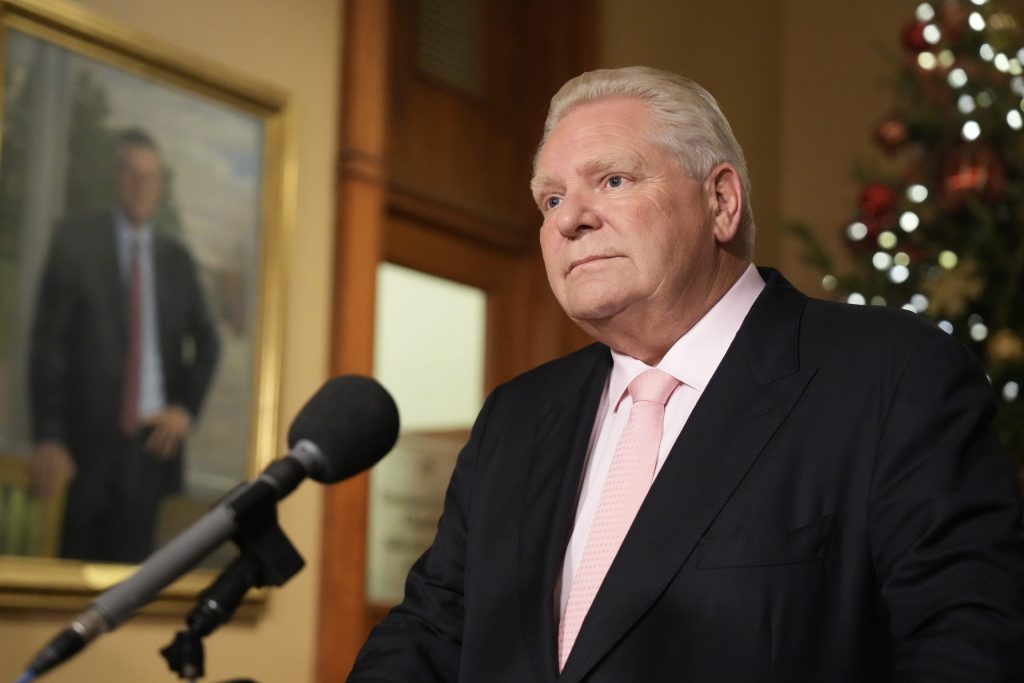
The premier of Ontario has warned to reduce energy exports to the United States as Canada prepares for possible Trump-era tariffs.
In the event that President-elect Donald Trump puts broad tariffs on Canadian goods, Ontario Premier Doug Ford issued a warning on Wednesday that Canada may reduce its energy exports to the United States.
Trump has threatened to impose a 25% tariff on all imports from Mexico and Canada unless they act to stop the migration and drug flows.
“I’m confident that the other provinces will compile their lists in the same way as we will. Depending on how far this goes, however, we will go to the maximum extent. Following a meeting with Prime Minister Justin Trudeau and several province premiers, Ford declared, “We will even go so far as to cut off their energy.”
Ford said he was pessimistic about avoiding tariffs but admitted he did not want to use such measures.
Referring to the date of Trump’s inauguration, he declared, “This fight is 100% coming on January 20 or January 21.”
About 85% of the power and 60% of the crude oil imported into the United States come from Canada. Whether Ford’s comments applied to all provinces or simply Ontario was not apparent. Nonetheless, Grace Lee, a Ford spokesman, acknowledged that Trudeau and the premiers discussed energy export reductions.
“Ontario is a major exporter of electricity to Michigan, Minnesota, and New York, and it powers about 1.5 million homes in the United States each year,” Lee continued.
Although Premier Ford is only able to speak for Ontario, she stated, “We would definitely look at it’s an area of provincial jurisdiction.”
Along with exporting 34 essential minerals that are essential to American national security, Canada is the US’s top supplier of steel, aluminum, and uranium.
“Canada, of course, will respond to unjustified tariffs,” said Deputy Prime Minister Chrystia Freeland, adding that province premiers backed a strong response that may include actions over vital minerals.
With around $3.6 billion Canadian (US $2.7 billion) worth of products and services crossing the border every day, the US-Canada economic connection is substantial. For 36 US states, the biggest export destination is Canada.
Canada has committed to implementing more police, drones, and sniffer dogs as part of its increased border security measures in response to Trump’s worries. Dominic LeBlanc, the minister of public safety, stated that the new Trump administration will be briefed on these measures in the days ahead.
While describing the possible tariffs as “absolutely devastating” for Canada, Prime Minister Trudeau cautioned that Americans will also suffer as a result. Economists expect that when firms pass on the additional expenses to customers, the prices of food, clothing, cars, and other commodities would rise.
Trump’s tariff threats have been described as “a major source of new uncertainty” by the Bank of Canada, which has also voiced worry by lowering its benchmark interest rate by half a percentage point. Tiff Macklem, the bank governor, said.
“We don’t know whether those tariffs will be applied, how much they will be, or whether Canada will retaliate.”
Concurrently, Trudeau was criticized for his comments on Trump, implying that the US victory was a blow to the advancement of women. Trump supporter and billionaire Elon Musk referred to Trudeau as “insufferable” in a post on X. Ford also criticized Trudeau’s remarks, saying they were useless. “Democrats elected Donald Trump.” It’s none of our business whether you like him or not,” Ford stated.