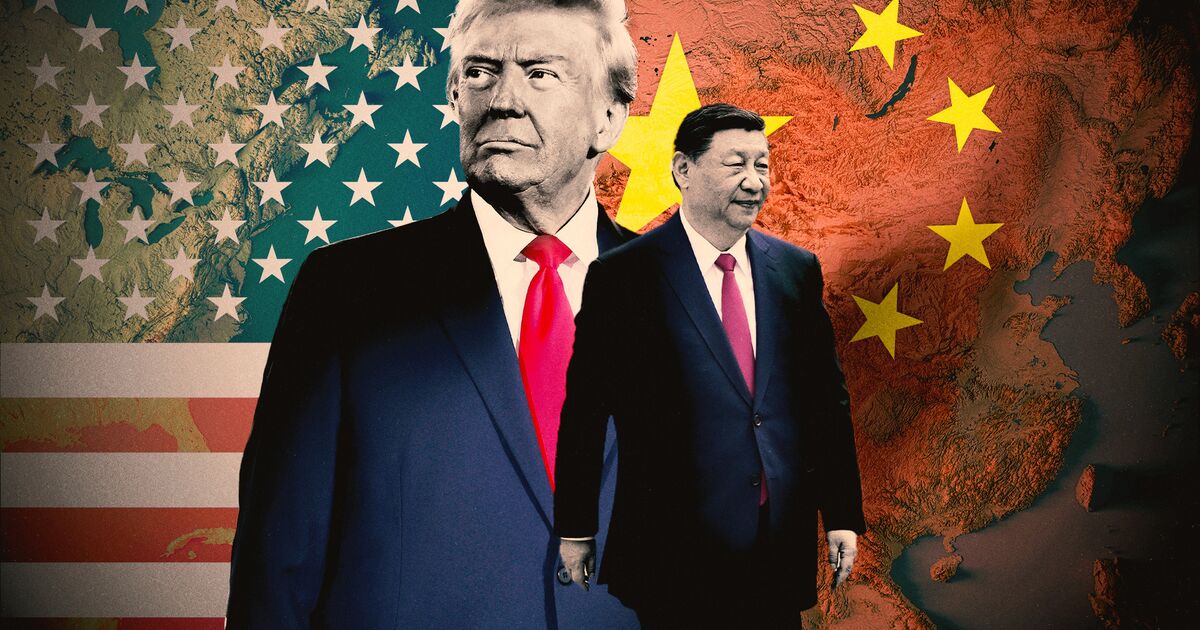
Trump has already lost a trade fight with China in South America
In Peru, a big copper producer in South America, the new White House under Donald Trump will already be losing a trade war with China. This is part of a larger shift in power in the resource-rich area near Washington, D.C.
This week, Asia-Pacific Economic Cooperation leaders will be in Peru, which is the second-largest copper exporter in the world. Chinese President Xi Jinping is expected to attend and open a big new port in the country that was built by China. President-elect Joe Biden is also on the list of guests.
China’s position in South America has grown quickly because it wants so much of the area’s main exports, like corn, copper, soy, beef, and lithium metal for batteries. Peru is a good example of this problem for the White House.
Because of this, Beijing has become the most popular trade partner for countries from Brazil to Chile and Argentina. This has made Washington less powerful in the region’s politics, and this trend grew during Trump’s “America First” policies and again under Biden.
“The strategic value is that this is the United States’ backyard,” said Li Xing, a professor at the Guangdong Institute for International Strategies. He also said that it helped counter the U.S. position in the Indo-Pacific and lower the risks of a trade war.
“China can’t start by building military bases there because it would be too dangerous and make its war with the US too clear… It has first made progress with business ties.
Peru shows how dramatically things have changed. UN Comtrade figures show that China’s trade lead over the US grew to $16.3 billion last year. This is a big change from just ten years ago, when Washington was the main player. That has gone along with investments in everything from mining to energy.
In 2015, China traded more with Peru than the US did. The gap grew during Trump’s first term, from 2017 to 2021, and again under Biden.
Eric Farnsworth, who used to work for the State Department and now works for the Council of the Americas and the Americas Society, said, “China has entered the region aggressively, is learning quickly, and is ready to stay for the long term.”
“Unless the United States meaningfully prioritizes regional economic policy in a new and more effective way, the region will continue to tilt toward Chinese interests.”
A request for comment was sent to the U.S. embassy in Lima, but they did not reply. Officials in Washington have said many times that the US is a more dependable partner than China and that Chinese investment in the region comes with conditions.
This is “Singapore of Latin America.”
A new giant port in Chancay, 80 kilometers (50 miles) north of Lima, is a sign of the times. China’s state-owned Cosco Shipping (1199.HK) is building it. It opens a new tab and claims to cut down on the time it takes for goods from both Peru and Brazil to get to Asia by sea.
The United States is worried about the safety of the area because of the Chinese-controlled port, which will be opened by Xi while he is in Peru. More importantly, the port will speed up the trade route between the area and China.
Reuters was at the port and talked to Raul Perez Reyes, Peru’s Minister of Transport and Communications. “We will have direct routes to Asia, especially to ports in China. Depending on the route, it will cut travel time by 10, 15, or 20 days.”
He also said that it would be up against the Port of Manzanillo in Mexico and, finally, Long Beach in California.
“Our aim is to become the Singapore of Latin America.”
Other investments are being made to improve connectivity because of the port on the Pacific side. This is especially helpful for soy producers in Brazil who want to save money and time on shipping to Asia by not going through the Panama Canal in the north. The government of Peru wants to build a train system that could cost $10 billion.
That could mean that more soy from Brazil is shipped by road to Peru and then to China. Last few years, trade between Brazil and the world’s second-largest economy has grown very quickly.
An cautious tone is used by most local leaders and diplomats, though. They say that the US and China are both important friends. In private, though, they agree that China has paid more attention to Latin America.
A top Peruvian official who did not want to be named said, “Peru is open to doing business with all countries.” the official said, “What China does is focus its investments in Latin America and Africa,” which have the money it needs.
He also said that Peru hoped to sign an agreement with China at APEC to improve their 2009 free trade agreement. The main things that they wanted to improve were intellectual property, internet commerce, and the way customs works.
“SMELLS OF ENTHUSIASM”
Clemente Baena Soares, Brazil’s ambassador in Lima, said that the Chancay port would help his country’s soybean farmers a lot by cutting travel times to Asia by almost half.
In order to help Brazilian haulers, he asked Peru to remove restrictions on things like load limits on roads that connect the two countries.
The head of the Peru-China Chamber of Commerce, Jose Tam, said that China was taking more initiative than other countries in South America to improve its trade and investment links.
“China is sending the clearest signals of enthusiasm in the region,” said Tam, who is in charge of the group that big copper mines like MMG Ltd’s (1208.HK) Las Bambas and Aluminum Corp’s Chinalco (ALUMI.UL) belong to.
Mario de las Casas, who is in charge of corporate affairs for Cosco Shipping, said that Peru’s move toward China wasn’t political and that companies from all over the world were welcome. Less U.S. investment was on the table, so the trend was only business.
He said, “Let the United States come to invest; it hasn’t done that in many years.” He also said that Peru was in a good situation to benefit from any trade tensions around the world. “Here there are no good or bad guys, here there are only interests.”